Serious failure on the Soyuz 31 ramp after a launch: a 20-ton platform crashed. It is the only operational Russian ramp and the problem puts pressure on ISS logistics.
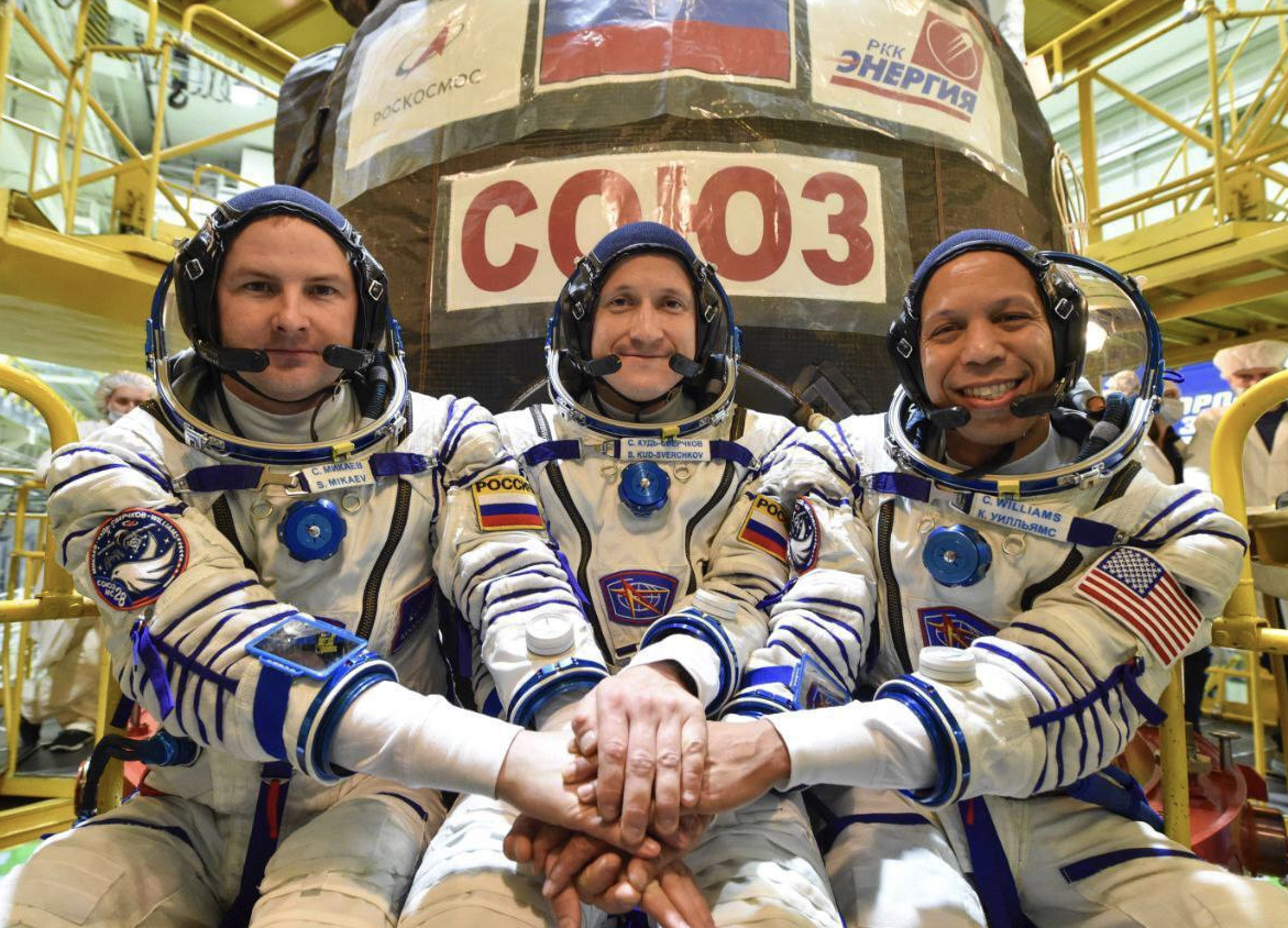
On Thursday 27 November 2025, a Soyuz rocket lifted off from the Baikonur Cosmodrome, Kazakhstan, carrying Russian cosmonauts Sergei Kud-Sverchkov and Sergei Mikayev into orbit together with US astronaut Christopher Williams of NASA (photo below). The three reached the International Space Station (ISS) without problems, where they will remain for a mission of approximately eight months. Behind the success of the launch, however, lies a serious accident on the ground. Immediately after liftoff, at Site 31 – the only Russian ramp currently configured to support the launches of manned Soyuz vehicles and Progress cargo shuttles – significant damage to the service structures emerged.
20 ton platform thrown away
In a minimal statement released on Telegram, Roscosmos spoke of “damage to several components of the ramp”, observed during a normal post-launch inspection. But videos circulated in the following hours show a different scene: a massive service platform, weighing an estimated 20 tons, crashed into the gas outflow trench beneath the launch pad.
According to various technical sources cited by industry experts, that platform allows operators to access the rocket base in the hours before takeoff. It appears that it was not properly secured and that the thrust of the Soyuz literally threw it into the waste pit. “The platform has significant damage,” confirmed the same source.
The criticality is high: today Russia has only one operational ramp capable of supporting manned and Progress launches, Site 31. “Site 1”, the historic platform from which Yuri Gagarin departed in 1961, has been closed and transformed into a museum. There are other Soyuz ramps on Russian territory, as recalled by analyst Anatoly Zak, but none can be quickly adapted for missions to the ISS with Soyuz and Progress. Roscosmos assured that the repair will be rapid: «All necessary spare components are available and the damage will be repaired shortly», reads the note.
Test for Russian commitment to the ISS
Until a few years ago, such a sentence would not have raised doubts. But since the invasion of Ukraine, an increasing portion of the country’s resources have been absorbed by the military, and several US observers have noted a weakening of the Russian space program’s civilian capabilities.
The failure at Site 31 now forces Moscow to demonstrate how much it really wants to continue investing in the International Space Station. Russia had agreed to extend collaboration with NASA until 2030, but without significant financial commitments, reducing manned missions from four to three every two years to keep costs down.
“This accident will test the resilience and priorities of the Russian leadership,” said Jeff Manber, executive of Voyager Technologies and former CEO of Nanoracks (a private US aerospace company that provides commercial hardware and services for space activities, such as satellite launches). NASA, coinciding with the Thanksgiving holiday, did not immediately comment on the incident, but according to a source close to the relationship between the two agencies, the concerns are considerable.
The central node is the Progress cargo vehicle. In addition to transporting supplies to the Russian segment, it is essential for critical functions: from raising the Station’s orbit (the ISS regularly loses altitude due to friction) to managing the attitude, thanks to the thrusters that work together with the American gyroscopes. Theoretically these operations can also be carried out using other vehicles, but with much higher fuel consumption. SpaceX’s Dragon and Northrop Grumman’s Cygnus have demonstrated capabilities rebootbut it is not clear whether they can entirely replace the Progress in the long term. According to the current schedule, two more Progress launches are planned between now and July 2027, and a new crewed Soyuz mission next summer.
With Site 31 out of action — even if only temporarily — the ISS logistics system becomes even more dependent on the United States. SpaceX, in particular, finds itself supporting the entire operational flow almost alone: the Crew Dragon is today the only NASA vehicle capable of carrying crew to the ISS; the Boeing Starliner will have to fly in uninhabited mode again before carrying astronauts again. Falcon 9 is currently the only carrier capable of launching both the Dragon and Cygnus shuttles, after the difficulties of other US rockets.
In a paradoxical scenario, at least for a certain period, SpaceX could also find itself having to indirectly support the logistical functions of the Russian component of the Station. And if an emergency similar to the one recently experienced on the Chinese space station were to occur — where the capsule intended for the crew’s return was declared unusable after the micrometeorite impact — how could such a situation be managed without the full operation of the Soyuz and Progress vehicles?
