
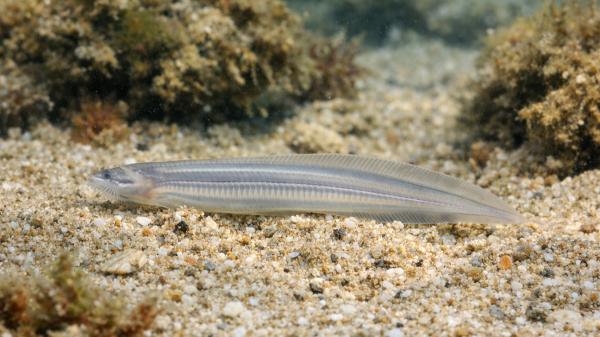
Amphioxus, or cephalochordates, are small marine animals shaped like an elongated fish, but without a skull or spine. Their body is narrow and pointed at both ends, their musculature is divided into V-shaped segments called myomeres, they do not have a differentiated head or jaws. Some examples are Asymmetron lucayanum, Branchiostoma californiense and Branchiostoma lanceolatum.
If you want to know more about what amphioxus or cephalochordates are, characteristics and examples of this type of animal, continue reading this Evidence Network article.
What are amphioxus or cephalochordates?
Amphioxus, or cephalochordates, are small marine animals with an elongated body and an appearance similar to that of a very thin fish, although they are not fish. They form a subphylum within the phylum Cordata and, together with the tunicates (urochordates), they make up the so-called invertebrate chordates, because they share the basic “body plan” of the chordates without developing the complex structures of the vertebrates.
They live mainly in shallow coastal waters with sandy bottoms or fine sediments, where they usually remain half-buried and with the anterior end barely exposed to feed by filtering, capturing particles suspended in the water. They generally measure between 5 and 8 cm, their body is translucent and tapered at both ends, a shape that explains the common name “sea lancets”.
Despite their simple appearance, amphioxus are of great scientific interest because, in the adult stage, they clearly maintain the four basic characteristics of chordates: the notochord, the hollow dorsal nerve cord, the pharyngeal slits and the post-anal tail. In many vertebrates, these traits transform during development (for example, the notochord is largely replaced by the vertebral column), while in amphioxuses they are preserved as a central part of their body structure, making it easier to study them as a “window” to the ancestral condition of chordates.
Precisely because of their relatively simple anatomy and their basal position in the chordate evolutionary tree, amphioxus are used as a model to compare how key vertebrate innovations (such as head regionalization or the complexity of organs and tissues) emerged from older developmental programs, analyzing genes, expression patterns and body organization.

What are the characteristics of amphioxus or cephalochordates?
Amphioxus or cephalochordates have a simple anatomy that is characterized by the following:
- They lack a bony skeleton; Its support comes from a notochord that runs throughout the body to the head.
- The body is narrow and pointed at both ends, with a dorsal fin extending to the caudal fin; They also do not have paired fins.
- The muscles are divided into V-shaped segments called myomeres, responsible for their wave movements when swimming.
- They do not have a distinct head or jaws: the mouth is located in an oral vestibule surrounded by small tentacles (ciriri) that filter water towards the pharynx.
- The pharynx has numerous gill slits, and at its base is the endostyle, a glandular groove that secretes mucus to trap food particles.
- The filtered water goes out through the atriopore, while the food captured in the mucus passes to the intestine for digestion.
- The circulatory system of amphioxus is closed but lacks a heart (blood circulates by contraction of the vessels), and excretion occurs through multiple nephridia distributed throughout the body.
- Their nervous system consists of a hollow dorsal cord without a developed brain or complex sensory organs.
- Regarding reproduction, amphioxus are dioecious (separate sexes) and lack sexual dimorphism. They have rows of gonads on both sides of the body and release gametes into the water, where external fertilization occurs. The planktonic larvae, after a period of free life, descend to the bottom and transform into adults.
Examples of amphioxus or cephalochordates
Currently, about 30 species of amphioxus are recognized, grouped in a single family (Branchiostomidae) and three genera: Branchiostoma, Asymmetron and Epigonichthys.
The Branchiostoma genus is the most numerous and its members are found in various coastal regions of the world. For example:
- Branchiostoma lanceolatum: inhabits the shallow waters of the eastern Atlantic and the Mediterranean Sea. This species, known since the 18th century, is usually seen buried in the sands of European beaches.
- Branchiostoma floridae: lives on the western coasts of the Atlantic (Florida and the Caribbean).
- Branchiostoma californiense: distributed in the eastern Pacific (from California to Mexico).
- Branchiostoma belcheri: this species stands out in the Indo-Pacific region, and is common on the coasts of China and Japan.
The other two genera are rarer: Asymmetron and Epigonichthys comprise a few species with restricted distribution. Despite their different geographical origins, all sea lancets share very similar characteristics and ways of life. An example of the genus Asymmetron is:
- Asymmetron lucayanum, recorded in the Bahamas, Gulf of Mexico and the Caribbean, whose name refers to the Lucayan Islands.
If you want to read more articles similar to Amphioxus or cephalochordates: what they are, characteristics and examples, we recommend that you enter our Biology category.
- Del Moral-Flores, LF, Guadarrama-Martínez, M. Á., and Flores-Coto, C. (2016). Taxonomic composition and distribution of cephalochordates (Cephalochordata: Amphioxiformes) in Mexico. Latin American Journal of Aquatic Research, 44(3), 497-503. https://doi.org/10.3856/vol44-issue3-fulltext-8
- Bertrand, S., & Escriva, H. (2011). Evolutionary crossroads in developmental biology: Amphioxus. Development, 138(22), 4819-4830. https://doi.org/10.1242/dev.066720
- Fernández, R. (2007). The Cephalochordates. Asturnatura. https://www.asturnatura.com/temarios/biologia/cordados/cephalocordados
