
On November 5, 2025, the capsule of the Shenzhou-20 mission may have been hit by a fragment of orbital debris: six astronauts stuck on board.
In recent days, an episode occurred on the Chinese Tiangong space station, which could have significant consequences for the Shenzhou-20 mission and for the management of future Chinese space operations. It all started on November 5, 2025, when the China Manned Space Agency (CMSA) announced that the capsule with which the crew of the Shenzhou-20 mission was supposed to return to Earth may have been hit by a fragment of orbital debris.
This is a well-known risk in low-Earth orbit, where the growing density of debris — decommissioned satellites, collision fragments and old rocket stages — poses a growing threat to space infrastructure. Following the impact, CMSA immediately activated emergency protocols, initiating a full technical evaluation of the vehicle and postponing the return of the crew, originally scheduled for November 5th. The analyzes serve to verify the integrity of the heat shield and the capsule control systems, which are fundamental for safe atmospheric re-entry.
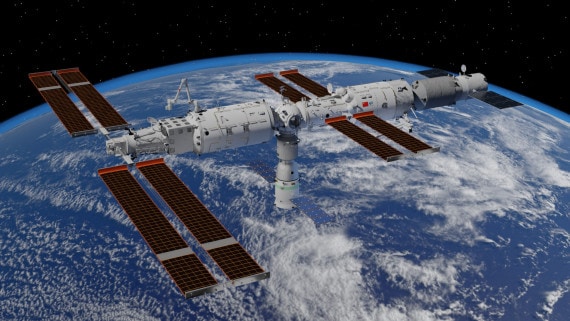

Operational hypotheses. In the following hours and days, the lack of official updates fueled curiosity and hypotheses. Among these, according to discussions circulating on Chinese platforms, there would be the possibility of bringing forward the launch of the uncrewed Shenzhou-22 mission, in order to provide a new re-entry capsule to the crew currently on board the Tiangong.
In this way, some Chinese and international experts suggest that the Shenzhou-21 capsule (still docked at the station) could be adapted for the return of the Shenzhou-20 team, if damage is confirmed, and Shenzhou-22 will return the other three astronauts on board in due time. This option would be viable due to China maintaining multiple launch-ready capsules as part of its safety protocol, a lesson learned after decades of manned missions by other space powers.
Orbital emergency room. The Tiangong, designed to simultaneously accommodate two crews of up to six astronauts, has the resources necessary to support a prolonged stay. Currently, the six taikonauts of the Shenzhou-20 and Shenzhou-21 missions have been living together for 11 days, continuing to carry out scientific experiments and on-board maintenance in conditions considered “stable and safe”.
On November 11, the CMSA released an official update: the verification and return planning activities “are proceeding in an orderly manner and according to protocols”. The agency also confirmed that reentry simulations, safety tests and evaluations of critical systems, including checks on propulsion and attitude control systems, are underway.
Meanwhile, satellite images and CCTV footage have shown movement at the Jiuquan Launch Center, where a new Long March-2F vehicle may be in preparation. However, it is unclear whether these are emergency exercises or preparations for a real replacement mission.
Three possible scenarios for the return. According to various space agencies, China is now faced with three possible operational scenarios: the first involves re-entry with the Shenzhou-20 capsule after thorough inspections. If the analyzes confirm that the vital systems and the heat shield have not suffered serious damage, the mission could proceed regularly by the end of November. This would be the simplest and least expensive outcome.
The second involves an emergency launch of the uncrewed Shenzhou-22. In this scenario, the new capsule would be sent into orbit to replace the Shenzhou-20. The current crew would use the new spacecraft to return to Earth, while the Shenzhou-20 would be returned empty in a controlled manner. This more complex option, however, would test China’s ability to conduct orbital rescue operations, an ability previously untested by the Tiangong program.
Finally, the third scenario sees an extension of the stay on board until a safe return window. If the tests require more time, the crew could remain on board for several weeks, sharing resources and tasks with colleagues from Shenzhou-21. The station’s reserves of oxygen, food and fuel would allow a temporary extension of the mission without immediate risk.
