A desalinizer that produces drinking water directly from the depths of the Pacific Ocean: if it worked, Water Farm 1 could be exported elsewhere.
California is facing one of its most serious water crises in human memory. According to the National Oceanic and Atmospheric Administration (Noaa), 44% of the California-Nevada region are currently in drought conditions, with many areas that reach the level of “exceptional drought” (D4). Added to this is the fact that traditional water resources, such as the Colorado river, are decreasing, with forecasts indicating new low level records in the coming years. In this context, the Water Farm 1 project, which aims to produce drinking water directly from the bottom of the ocean, could be an innovative and sustainable response.
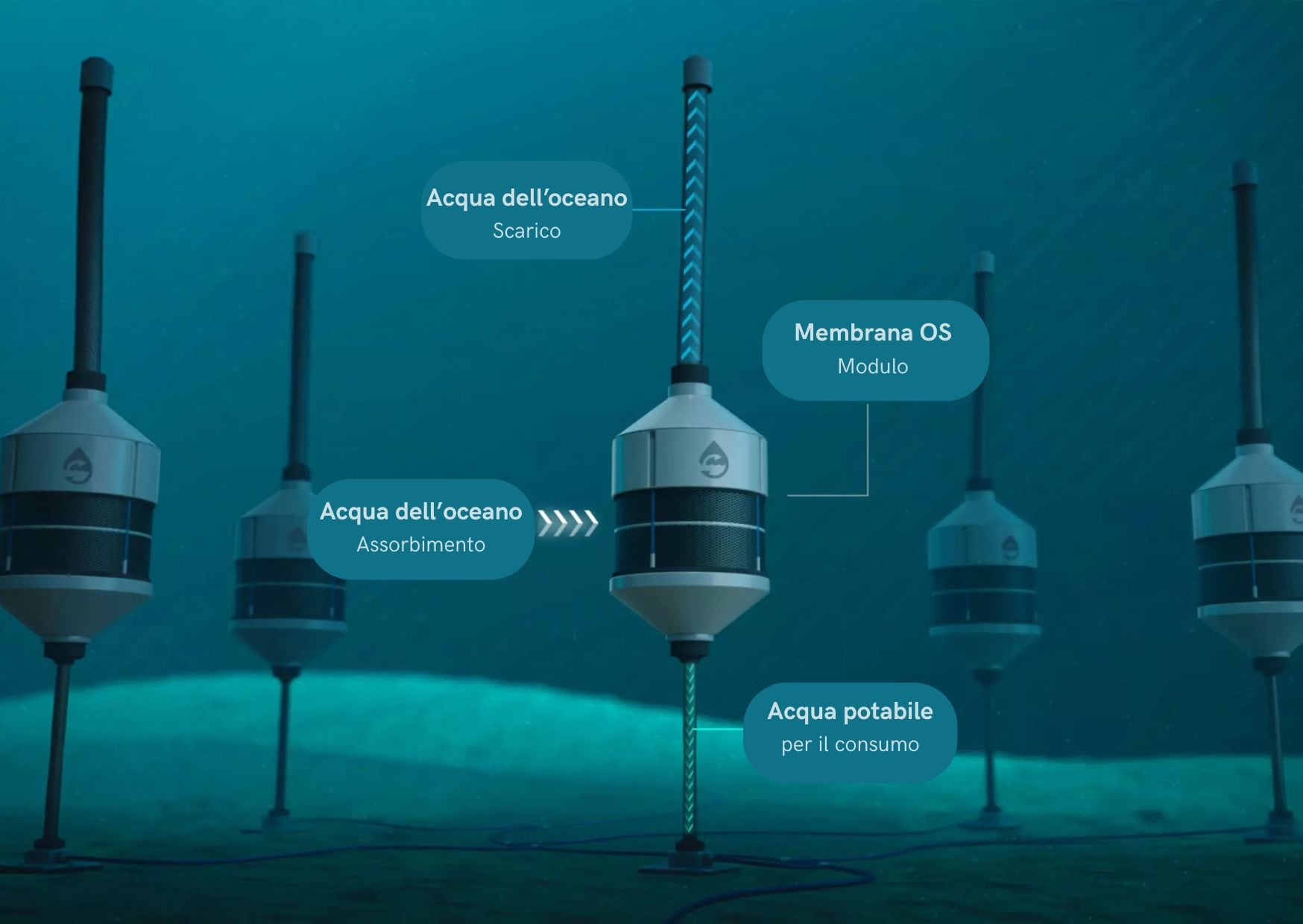
What is Water Farm 1. Water Farm 1 is an underwater desalinization system. The project, developed by the Oceanwell startup in collaboration with the Las Virgenes Municipal Water District (LVMWD) and six other Californian water agencies, provides for the installation of about 60 submarine modules to form what is called “water farm”, at a depth of about 400 meters in the Bay of Santa Monica, off Malibu.
Reduced electrical consumption. These modules exploit the natural hydrostatic pressure of the ocean to power the reverse osmosis process in order to pass the water through a semi -permeable membrane, filtering salts and impurities. In this way, energy consumption is reduced by 40% compared to traditional systems. Each module is able to produce up to about 3.8 million liters of ultra-pure drinking water per day.
How drinking water is produced. The water is filtered to remove salts, bacteria, viruses, pfas and microplastics, without the use of mechanical pumps and without interrupting marine life. In addition, the absence of salary discharges and the deep installation reduce the environmental impact to the minimum.
It is always good to specify that PFAS are synthetic heat -resistant chemical compounds, water and fat, used in products such as non -stick coatings, waterproof fabrics and fire foam. They are problematic because they persist in the environment and in the body, accumulating and potentially causing health effects.
The benefits for the community. Water Farm 1 aims to produce up to 227 million liters of fresh water per day by 2030, helping to reduce pressure on already overloaded water systems such as Bay-Delta and the Colorado river.
The project will provide drinking water directly to the residents of the LVMWD (Las Virgenes Municipal Water District). They are citizens and businesses located in the cities of Calabasas, Hidden Hills, Agoura Hills, Westlake Village and in some non -incorporated areas of the county of Los Angeles, California.
And to other partners, such as the city of Burbank, through an exchange with the Metropolitan Water District of Southern California (MWD). Despite the potential, however, the project faces significant challenges from a technological point of view.
Help to the serious problem of the scarcity of water. Water Farm 1 represents a significant step towards sustainable solutions for the management of water resources in California. If the project is successful, it could serve as a model for other world regions that face similar challenges.
Oceanwell stresses that the scarcity of water is a growing problem throughout the planet, with over a quarter of the world population that is facing extreme water stress. This phenomenon will increase significantly by 2050, accelerated by a combination of factors: demographic growth, economic development and climate change. All three exert pressure on renewable water sources and limit access to clean and reliable water sources.
The disadvantages of the weighing. Desalinization has long been considered a solution to solve some of the problems related to global water deficiency, but this technology has some disadvantages that make it not always suitable, especially in terms of costs. Italy currently produces about 650,000 cubic meters of water per day by means of desalinization, would like to increase the production capacity until it reaches millions of cubic meters per day by 2030.
However, it is essential to carefully monitor developments and face environmental and infrastructure challenges to guarantee long -term sustainability of the project.
