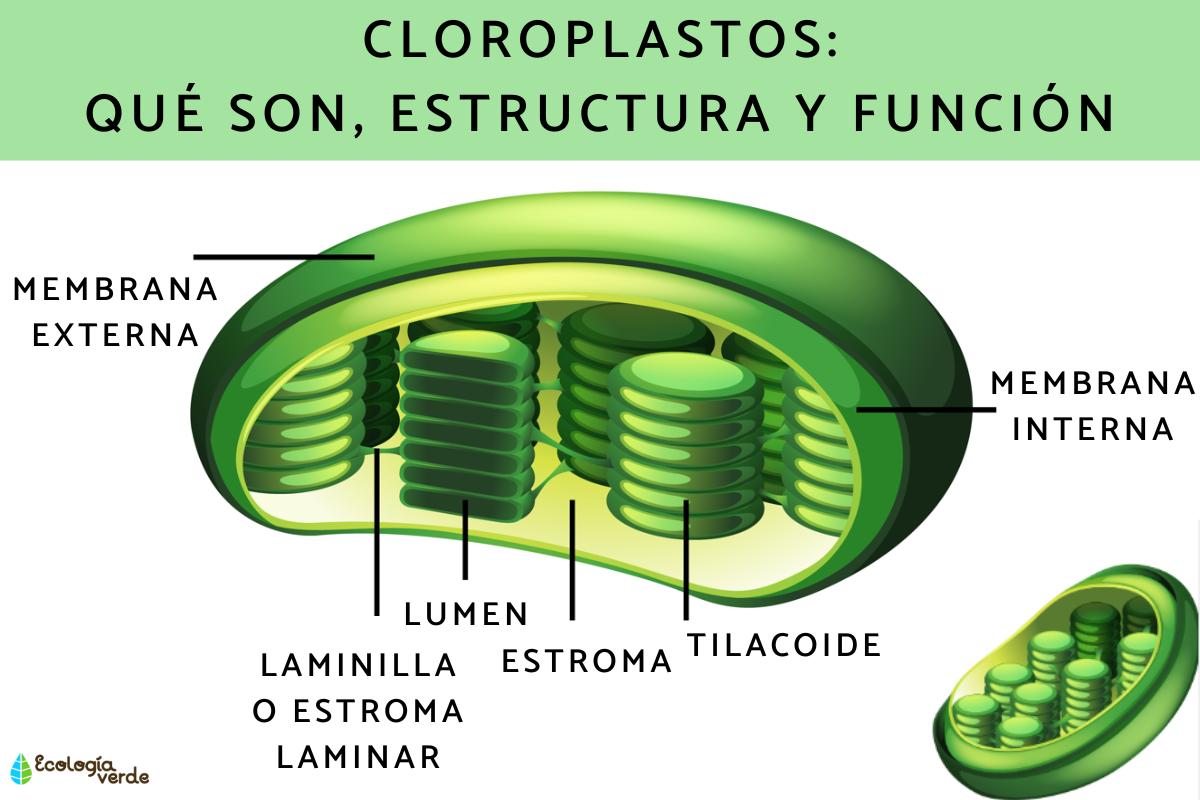
Chloroplasts are cellular organelles typical of photosynthesizing eukaryotic plant cells. Its structure includes inner membrane, outer membrane, intermembrane compartment, thylakoid, lumen, grana, stroma and lamellar stroma. Its main function is photosynthesis, in addition to other secondary but essential activities, such as the regulation of ions and metabolites, the synthesis of RNA and proteins, the synthesis of pigments and the accumulation of reserve substances. The green color of plants and algae comes from the sunlight-trapping pigment called chlorophyll, which is inside structures called chloroplasts. Given the importance of these organelles, we invite you to continue reading this Evidence Network article to learn more about what chloroplasts are, their structure, function and where they are located, among other data.
What are chloroplasts?
Chloroplasts are organelles found in photosynthesizing eukaryotic plant cells, both in algae and higher plants. They are classified within subcellular organelles called plastids or plastids.
Now, where are chloroplasts found? They are found in the mesophyll cells of the leaves, or in the cells that have the capacity to photosynthesize. In parts of the plant where light does not reach, such as the roots, there are no chloroplasts.
On a smaller scale, chloroplasts are arranged in the cell cytoplasm, and are not always the same shape or number, but vary from plant to plant. Higher plants have an average of 10,000 chloroplasts per cell, and are oval or circular in shape. Algae have only 1 to 2 chloroplasts, and can be star-shaped, ribbon-shaped, among other peculiar shapes.
We recommend you read this other article about the Plant Cell: what it is, parts, characteristics and functions.
What is the structure of chloroplasts?
For the chloroplast to be functional it needs each of its structures. The parts of chloroplasts are:
- External membrane: delimits the chloroplast from the outside, and is permeable to small molecules that pass through porins.
- Internal membrane: it is impermeable and is selective because it has specific proteins for the passage of molecules, both into and out of the chloroplast. As we can see, it has two membranes, so the chloroplast is generally known as a double-membrane lamellar system.
- Intermembrane compartment: located between both membranes. It’s very narrow.
- Thylakoids: are hollow sacs that contain chlorophyll molecules and other pigments that capture light. In addition, they contain enzymes and proteins. They also have a membrane that delimits them. These thylakoids have membrane inserts to Photosystems I and II, which are pigment-protein complexes.
- Lumen: is the space that is formed within the thylakoids.
- Grana: are stacks formed by several thylakoids, with the function of maximizing space. They range from 10 to 100 per chloroplast.
- Lamellar stroma: they connect the grains only by one segment and without being stacked.
- Stroma: is the internal space that surrounds the thylakoids. It is made up of a solution full of enzymes. It also contains DNA, RNA and ribosomes. It is a dense aqueous solution. It has a high pH.

What is the function of chloroplasts?
The most important function of chloroplasts is that they carry out the photosynthesis of eukaryotic organisms, a process that is divided into two phases and each one is completed in a different part of the chloroplast.
Light reactions that depend on sunlight to form ATP and NADPH occur in the thylakoid membrane. That is, light energy is transformed into chemical energy usable by the plant, which is called transduction. This is possible thanks to Photosystems I and II. Photosystem I is rich in chlorophyll a and Photosystem II in chlorophyll b, which vary from one to the other due to a small change in their structure.
Let us remember that photosynthesis not only has a light phase, but also a dark phase. Here, the energy produced in the light phase is used to fix CO₂ to produce glucose, through the Calvin cycle. This dark phase occurs in the stroma of the chloroplast. The manufactured glucose is a type of sugar, which will be used by the plant, or transferred to primary consumers who eat said plant.
In addition to carrying out photosynthesis, there are other important activities that occur in the chloroplast, especially aimed at its functioning in order to photosynthesize. Such are:
- Regulation of ions and metabolites: occurs in the membrane, which has proteins that modulate the entry of metabolites and ions necessary for photosynthesis, and to transport the products that resulted from said process to the cell.
- Synthesis of RNA and proteins: these components necessary for the chloroplast are manufactured in part by their DNA, but also by that of the nucleus of the plant cell. For this reason, it is said that the chloroplast DNA has partial genetic autonomy, because it depends on the nuclear DNA.
- Synthesize pigments: the chloroplast manufactures its own pigments, which are the essential part of capturing light.
- Accumulates reserve substances: it can accumulate substances that will be used later by the cell, such as starch, for example.

Where are chloroplasts found and how do they vary depending on the organism?
Chloroplasts are found in photosynthetic eukaryotic cells, mainly in plants and algae.
- In plants they are usually located in green tissues (young leaves and stems) and each cell can contain between 20 and 100 chloroplasts.
- In algae the quantity and shape are very variable: some species have a single large chloroplast with star, spiral or reticulated shapes, while others have several smaller ones.
These differences reflect the adaptation of each organism to its environment and the efficiency in capturing light.

Why are chloroplasts so important?
As a summary, chloroplasts are essential because they carry out photosynthesis, a process through which they convert solar energy into chemical energy and produce oxygen as a result or byproduct. Thanks to them, most of the oxygen we breathe is generated and the organic matter that constitutes the base of the food chain is produced. In short, without chloroplasts life on Earth would not be possible as we know it today.
At this point you have learned more about what chloroplasts are, their structure, function, and where they are found. As they are basic to the photosynthesis process, we encourage you to learn more about it with the video below and with this article on the Difference between photosynthesis and plant respiration.

If you want to read more articles similar to Chloroplasts: what they are, structure, function and where they are found, we recommend that you enter our Biology category.
- Voet, D., Voet, J.G. (2006). Biochemistry. Argentina: Editorial Médica Panamericana SA
- Curtis, H. (2006). Invitation to Biology. Argentina: Pan-American Medical.
- Villalobos Rodríguez, E. (2001). Physiology of Tropical Crop Production. Costa Rica: Publishing House of the University of Costa Rica.
