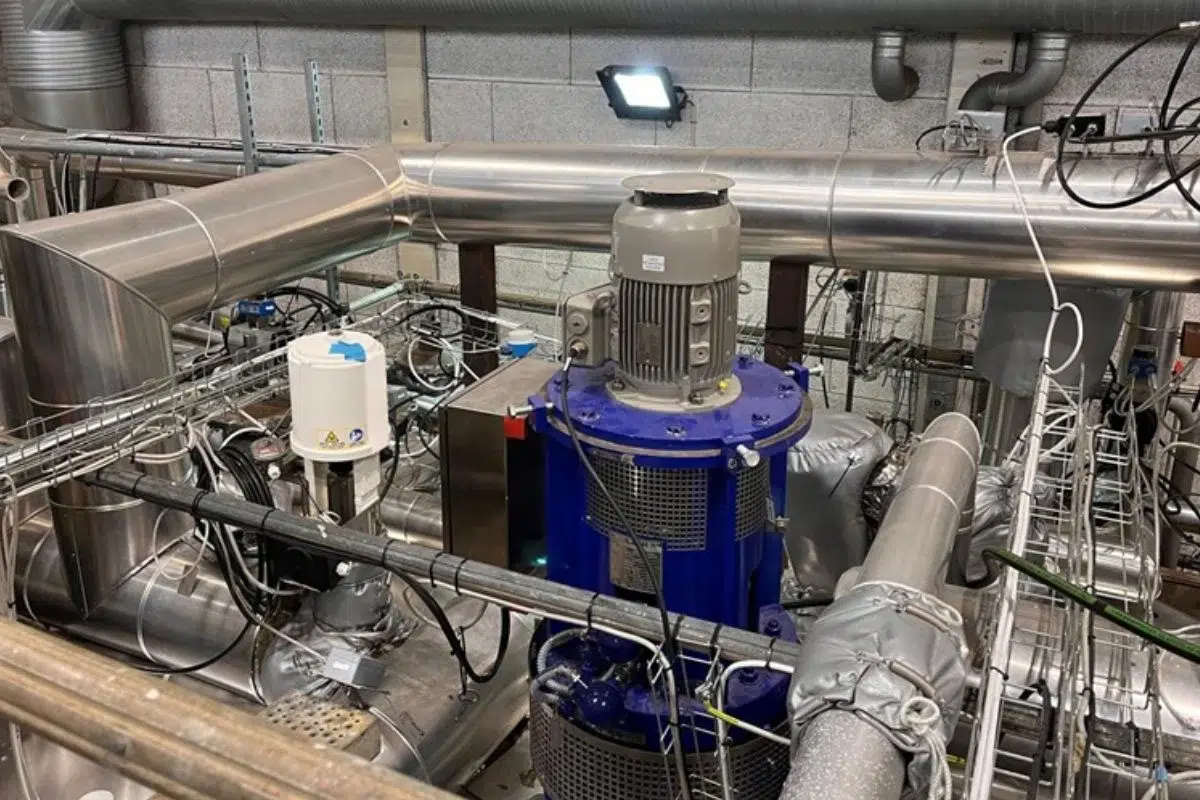
The Danish giant salt battery breakthrough represents a remarkable achievement in renewable energy storage technology. Engineers in Denmark have developed an innovative molten salt battery system capable of powering 100,000 homes for 10 hours straight, with efficiency rates reaching up to 90% in certain applications. This technological marvel could revolutionize how we store and utilize renewable energy on an industrial scale.
Revolutionary molten salt technology powers Danish energy storage
Denmark has unveiled a groundbreaking energy storage solution that harnesses the power of molten salt to store massive amounts of renewable electricity. Unlike conventional lithium-ion batteries, this thermal battery system utilizes hydroxide salt, a chlorine industry byproduct that’s both abundant and affordable.
The system works by converting excess renewable electricity into heat, which reaches temperatures of approximately 600°C. This thermal energy is then stored in large, well-insulated tanks containing the molten salt. When energy demand rises, the hot salt is directed through a steam generator that can either power turbines or supply heat directly to industrial processes.
Danish company Hyme Energy, in collaboration with Swiss firm Sulzer, has developed this gigantic thermal battery that boasts impressive efficiency metrics :
- 90% efficiency for direct industrial thermal applications
- 80-90% efficiency for combined heat and power systems
- Approximately 40% efficiency when producing electricity alone
- Energy storage capacity of up to two weeks
The technology has already been validated through the MOSS demonstrator project in Esbjerg, which began operations in April 2024. Now, Hyme Energy is scaling up with a 200 MWh system in Holstebro, which will be the world’s largest industrial thermal storage system. This project demonstrates how innovative physical transformations can create sustainable energy solutions without relying on rare or toxic materials.
Sustainable solution for industrial heat demands
One of the most promising aspects of this thermal battery is its potential to decarbonize industrial processes that require significant heat input. Many industries such as food processing, textiles, and chemical production consume enormous amounts of thermal energy, which has traditionally been difficult to supply from renewable sources.
The Danish-Swedish dairy cooperative Arla Foods will be the first industrial customer to benefit from the Holstebro site. The company expects to save approximately 3 million euros annually through this innovative green heat solution. This partnership highlights how renewable energy storage can address challenges similar to those faced in agricultural technologies requiring innovative energy solutions.
The molten salt system offers several advantages over competing energy storage technologies :
| Feature | Benefit |
|---|---|
| No critical metals | Sustainable supply chain |
| Non-toxic materials | Minimal environmental impact |
| Recyclable salt medium | Circular economy compatible |
| Non-flammable composition | Enhanced safety profile |
By storing surplus renewable electricity during peak production periods and releasing it when needed, this system effectively addresses the intermittency challenges of wind and solar power without relying on lithium-ion batteries or hydrogen technologies. This approach could significantly reduce resource waste in energy systems, similar to efficiency improvements needed in other sectors.
Engineering excellence behind the heat monster
The success of this massive energy storage project hinges on Sulzer’s expertise in handling extremely hot molten salts. The Swiss company has previously designed pumps for large-scale solar thermal projects in China, giving them valuable experience in managing the complex challenges of high-temperature salt circulation.
These engineering solutions address critical issues such as :
1. Preventing corrosion in metal components exposed to 600°C salt
2. Minimizing thermal losses throughout the system
3. Ensuring reliable circulation of the salt medium
4. Developing safe containment vessels for long-term storage
This level of technical sophistication represents a significant achievement in thermal engineering, creating systems that can map and manage energy flows with precision comparable to how NASA scientists map underwater mountains with advanced sensing technologies.
Danish energy innovation reshaping global renewable landscape
For Denmark, this technological breakthrough could become a cornerstone of the nation’s energy transition strategy. Rather than focusing solely on electricity production, the molten salt battery addresses the often-overlooked challenge of providing low-carbon industrial heat, which accounts for a significant portion of global energy consumption.
Hyme Energy aims to establish a robust European supply chain for this technology, making it competitive and readily deployable. If successful, this model could be replicated across thousands of industrial sites worldwide, potentially establishing Denmark as a leader in thermal energy storage solutions.
The implications of this technology extend beyond industrial applications. The ability to store renewable energy efficiently could accelerate the phase-out of fossil fuels in various sectors, contributing to global decarbonization efforts. Just as cosmic sounds reveal hidden patterns in space, these energy innovations reveal new possibilities for sustainable development.
Some energy experts are even exploring how this technology might complement other advanced energy concepts, though unlike speculative alien technologies, this Danish innovation is firmly rooted in proven scientific principles and practical engineering solutions ready for immediate deployment.
