
Elasmobranchs are a group of cartilaginous fish that includes two types: sharks and rays. Among their distinctive characteristics is that they do not have a bone skeleton, but rather a cartilaginous one. This feature gives them great flexibility and lightness, allowing them to move with agility even in deep waters. In this BIOencyclopedia article we will learn more about what elasmobranchs are, characteristics and types.
What are elasmobranchs?
Elasmobranchs are a group of cartilaginous fish (class Chondrichthyes) that includes sharks and rays. Unlike bony fish, their skeleton is composed entirely of cartilage rather than bone. This lineage has existed for at least 400 million years and has evolved a great diversity of shapes and sizes adapted to the marine environment.
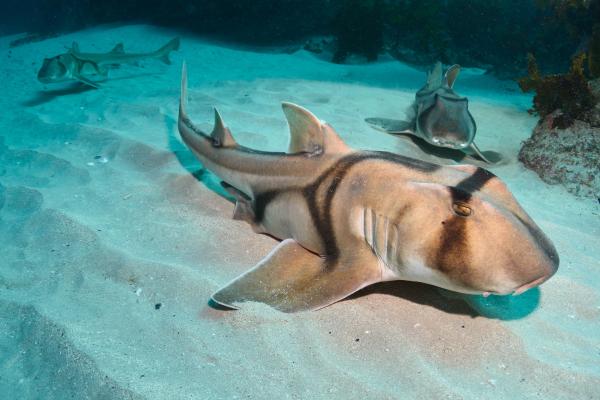
What are the characteristics of elasmobranchs?
Elasmobranchs have several distinctive characteristics:
- They do not have a bone skeleton, but rather a cartilaginous one.
- They lack a swim bladder and lungs; Instead, they breathe through 5 to 7 pairs of gill slits that open to the outside, through which water must constantly flow to obtain oxygen.
- The skin is rough, covered with placoid scales (dermal denticles) similar to teeth; in fact, their teeth are modified scales arranged in continually replaceable rows.
- They have two dorsal fins, a caudal fin and pairs of pectoral and pelvic fins (the latter, in males, transformed into copulatory organs or claspers).
What types of elasmobranchs exist?
The Elasmobranchii subclass encompasses two large types of cartilaginous fish:
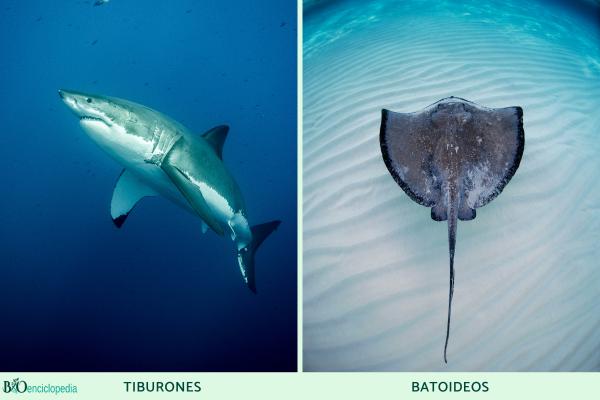
- Sharks: They have a fusiform (elongated) body with gill slits on the sides.
- Batoids: include rays, rays, torpedoes and guitarfish. They have a flattened body with pectoral fins extended like wings and gills on the ventral surface.
More than 1,100 species of elasmobranchs have been described in the world, distributed in about 14 taxonomic orders. For example, sharks are grouped into orders such as Carcharhiniformes (typical sharks) or Lamniformes (mako sharks), while rays belong mainly to the order Rajiformes.
You may be interested in knowing the Difference between a stingray and a stingray.
Where do elasmobranchs live?
Elasmobranchs live in all the planet’s oceans. They can be found from shallow coastal waters to abyssal depths of several thousand meters, and in climatic regions ranging from the tropics to cold temperate zones. The greatest diversity of species occurs in tropical and subtropical seas, especially on shallow coastal shelves.
Although almost all are strictly marine, there are exceptions: some rays of the family Potamotrygonidae (river rays) live in freshwater in South America, and even certain sharks such as the sarda shark (Carcharhinus leucas) can go up rivers and tolerate fresh water temporarily.
What do elasmobranchs eat?
The vast majority of elasmobranchs are carnivorous predators, feeding on other marine animals. Sharks usually hunt various types of prey: fish, crustaceans and cephalopods, and even larger species can capture birds, turtles or marine mammals. Many rays, for their part, eat benthic invertebrates (bivalves, worms, crustaceans) that they dig up from the seabed by sucking or expelling jets of water from their mouths.
Only a few elasmobranchs feed by filtering plankton: for example, whale sharks, basking sharks, and manta rays obtain their food from zooplankton and other tiny creatures suspended in the water.
What is the behavior of elasmobranchs?
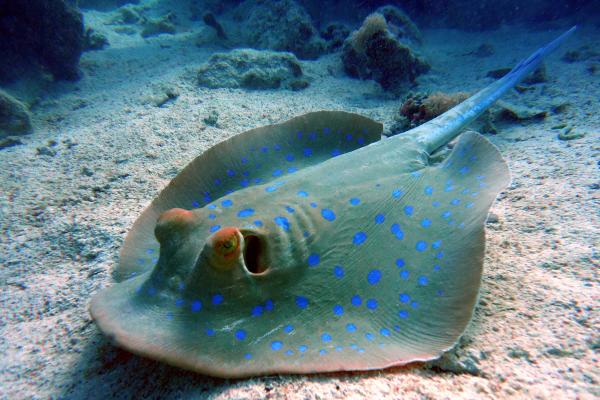
In general, sharks are solitary and have nomadic habits, traveling long distances, while many rays are more sedentary and remain motionless on the seabed. Without an active gill pumping mechanism, many sharks must swim continuously to breathe. These animals have very acute senses: an excellent sense of smell, a lateral line that detects vibrations, and the ampullae of Lorenzini that perceive the electrical fields of their prey. Even with their feared reputation, most elasmobranchs avoid humans and do not represent a danger; only a few large species have attacked people on isolated occasions(1).
How do elasmobranchs reproduce?
In all elasmobranchs, fertilization is internal, through copulatory organs called claspers. Depending on the species, there are three reproductive strategies:
- Oviparous: the female lays eggs protected by horny capsules deposited in the aquatic environment until they hatch. You may be interested in this post about oviparous animals: what they are, characteristics, examples and differences with viviparous animals.
- Ovoviviparous: embryos develop inside eggs retained in the mother’s uterus and, upon hatching, live offspring are born nourished only by the yolk of the egg.
- Viviparous: The young develop inside the mother, receiving direct nutrition (through a placental connection or other mechanism) and are born fully formed.

Are elasmobranchs in danger?
More than a third of shark and ray species are threatened with extinction worldwide.(2). The main causes are overfishing (targeted fishing for their fins, meat and other products) and accidental catches, which have drastically reduced their populations.
Their biology makes them very vulnerable: they take many years to mature sexually and have very few offspring, so their populations recover very slowly after overexploitation. Consequently, many elasmobranch species are officially considered threatened or critically endangered, requiring urgent conservation measures to prevent their extinction.
If you want to read more articles similar to Elasmobranchs: what they are, characteristics and types, we recommend that you enter our Biology category.
- CRAM Foundation (2019). Elasmobranchs – Sharks and Rays. Marine Animal Recovery Center (CRAM), Barcelona. https://cram.org/clinica-y-rescate/acciones-de-rescate/elasmobranquios-tiburones-y-rayas/.
- Shark Specialist Group (2021). Shark and ray crisis: overfishing drives a third of species to extinction. Press release, September 6, 2021. https://www.dulvy.com/uploads/2/1/0/4/21048414/es_media_briefing_notes_global_chondrichthyan_status_2021.pdf.
- Chelonia Association – Bycatch Reduction Project (2015). Elasmobranchs. https://bycatch-reduction-project.jimdofree.com/elasmobranquios/
- De Anda Fuentes, D. (2010). “Elasmobranchs.” In Biodiversity and Human Development in Yucatán. Yucatán Scientific Research Center (CICY) – CONABIO. https://www.cicy.mx/Documentos/CICY/sitios/Biodiversidad/pdfs/Cap4/45%20Elasmobranquios.pdf.
- Ministry of the Environment of Colombia (2023). Environmental Statistical Compendium – I Semester 2023. Directorate of Coasts and Seas, Ministry of the Environment. (Data on chondrichthyan diversity).
