
The Great Green Wall of China is one of the largest reforestation projects in the world. It was created to stop desertification in the north of the country and reduce the impact of sand storms from the Gobi Desert. Over several decades, this program has transformed large areas of territory through massive tree planting and soil restoration.
In this Evidence Network article you will be able to learn in-depth everything you need to know about what the Great Green Wall of China is, where it is and why it was built, among other curiosities.
What is the Great Green Wall of China?
The Great Green Wall of China is one of the largest reforestation projects in the world. This is a huge strip of artificial forests that began to be planted in 1978 with the aim of stopping the advance of the Gobi Desert and stopping the desertification that was seriously affecting the north of the country.
Officially, this project is known as the Northern Three Regions Protection Forest Program and aims to create a vegetation barrier more than 4,500 kilometers long, crossing several provinces such as Inner Mongolia, Gansu, Ningxia, Shaanxi and Hebei. Its completion is scheduled around the year 2050.
Unlike the traditional Great Wall, built of stone, the Great Green Wall is made up of millions of trees and shrubs strategically planted to reduce soil erosion, stop sandstorms and improve air quality. This green belt acts as a true “natural shield” that protects agricultural lands and cities from the impact of the desert.
In this other Evidence Network post you can learn more about Desertification: definition, causes and consequences. Also, below you can see a video about reforestation and its importance.

Where is the Great Green Wall of China?
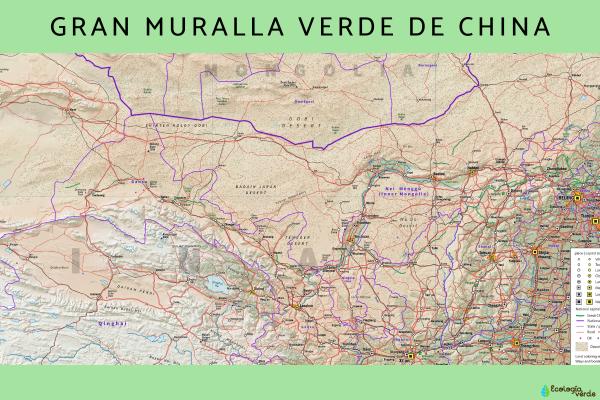
The Great Green Wall of China extends across the north of the country, in one of the areas most affected by desertification. This enormous green belt runs through several strategic regions, including:
- Inner Mongolia, one of the areas most vulnerable to sandstorms.
- Gansu, where soil erosion and water scarcity have been historical problems.
- Ningxia, a semi-arid region very sensitive to land degradation.
- Shaanxi, with large agricultural areas that need protection from dust and the advance of dunes.
- Hebei, close to large urban centers such as Beijing, which is affected by sand storms coming from the north.
Together, the Great Green Wall covers a strip that runs through more than a dozen provinces and autonomous regions, forming a forest line that follows the southern edge of the Gobi Desert and other arid areas of northern China.
Its location is not coincidental, but has been specifically designed in areas where desertification is most aggressive, with the aim of protecting farmland, infrastructure and large cities from the impact of sand and soil degradation.
Why was the Great Green Wall of China built?
The Great Green Wall of China was not born as an aesthetic or symbolic project, but as an urgent response to an environmental and social crisis that threatened the north of the country. In the mid-20th century, China began to suffer accelerated deterioration of its ecosystems, especially in the regions near the Gobi Desert. We are going to carefully analyze the reasons that led to the construction of the Great Green Wall of China:
- The advance of desertification and sandstorms: Large areas of fertile soil began to transform into arid land due to deforestation, overgrazing and intensive land use. As a result, sandstorms became increasingly frequent and intense. These storms not only affected rural areas, but also reached large cities like Beijing.
- Loss of agricultural land and displacement of communities: As the desert advanced, thousands of agricultural hectares became unusable, directly affecting the food security and livelihoods of millions of people.
- The environmental and economic impact: Soil degradation reduced agricultural productivity, increased land reclamation costs, and forced the government to invest large resources in emergency measures. Furthermore, the loss of vegetation meant a reduction in the CO₂ absorption capacity, aggravating the effects of climate change.
What are the main objectives of the Great Green Wall of China?
These are the long-term goals of the Great Green Wall of China:
- Mass reforestation: China has planted billions of trees over decades with the intention of creating a continuous vegetation barrier. These artificial forests help fix the soil, reduce wind erosion and improve moisture retention in previously arid or semi-desert areas.
- Reducing dust storms in Beijing and other cities: The forest wall acts as a natural filter, stopping dust particles before they travel hundreds of kilometers, thus improving air quality and the health of millions of people.
- Restoration of ecological balance: The reintroduction of vegetation favors the return of local fauna, improves soil fertility and helps stabilize water cycles, allowing ecosystems to function again in a more natural and sustainable way.
- CO₂ absorption and climate change mitigation: By increasing the forest mass, the territory’s capacity to absorb greenhouse gases increases, contributing to the mitigation of climate change and helping to reduce the country’s carbon footprint in the long term.
Are there other massive reforestation projects in the world?
Similar initiatives have been launched in some regions of the planet with the aim of stopping desertification, restoring ecosystems and protecting human communities from the effects of climate change. Let’s see which are the most important:
- The Great Green Wall of Africa (Sahel region): In Africa, one of the most ambitious projects is the so-called Great African Green Wall, which crosses the Sahel region, a semi-arid strip located south of the Sahara Desert. This project seeks to create a vegetation corridor of about 8,000 kilometers in length, from Senegal to Djibouti, involving countries such as Mali, Niger, Chad, Sudan and Ethiopia. Learn more about the Sahel: what it is, countries, climate, flora, fauna and conflict.
- Reforestation projects in America: In countries such as Brazil, Mexico and Colombia, restoration plans for degraded forests have been developed, especially in the Amazon and in areas affected by historical deforestation.
- Projects in Europe and other regions: In Europe, although on a smaller scale, there are reforestation and landscape restoration projects in countries such as Spain, Portugal and Italy, especially in areas affected by forest fires or soil erosion.
If you want to read more articles similar to Great Green Wall of China: what it is, where it is and why it was built, we recommend that you enter our Other environment category.
- The Great Green Wall of China: Stopping the advance of the Gobi Desert. (May 25, 2015) Naider Lab. Available at: https://naider.com/naiderlab/knowledge/articulos/la-gran-muralla-verde-china-freno-al-avance-del-desierto-de-gobi/
- The Great Green Wall of China: How the Chinese tame their deserts. (1977). Lanchow Academy of Sciences (China). Laboratory for Deserts, Glaciers and Tundra. UNESDOC Digital Library. UNESCO. Available at: https://unesdoc.unesco.org/ark:/48223/pf0000046674_spa
- China’s “Great Green Wall” brings hope but also difficulties. (October 6, 2025). Earth News. Available at: https://noticiasdelatierra.com/gran-muralla-verde-china-reforestacion-impacto-ambiental-desafios/
- Dhin, J. (August 23, 2021). Earth Org. Explainer: What Is the ‘Great Green Wall’ of China? Available at: https://earth.org/what-is-the-great-green-wall-in-china/
- Pardo Torregrosa, J. Active Sustainability. How China is using a wall of trees to hold back the desert. Available at: https://www.activesustainability.com/environment/green-great-wall-china
