
The seabed has been, for decades, one of the great blind spots of global pollution. A deep, dark and difficult to access place where waste accumulates unseen for years: fishing nets, tires, metal and plastic remains that end up sunken and trapped in areas where currents and lack of visibility make their removal with traditional methods almost impossible. This invisible pollution slowly degrades while affecting marine ecosystems that can barely be studied or directly intervened.
Now, a European project is beginning to change that scenario with a proposal that until recently seemed distant: underwater robots coordinated with artificial intelligence capable of locating, identifying and removing garbage from the seabed without damaging the environment. These systems work together with drones and autonomous platforms, interpreting the ecosystem in real time to distinguish between waste and marine life, and allowing precise interventions in areas where humans cannot operate safely.
A problem hidden beneath the surface
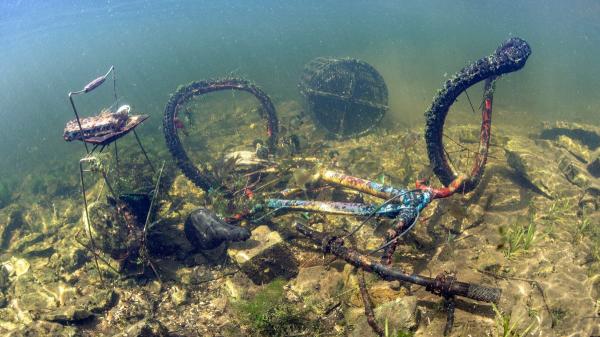
Marine pollution does not always float. A large part ends up sinking: tires, fishing nets, metal parts of ships, industrial debris or remains of coastal infrastructure.
This waste remains on the seabed for decades, slowly degrading and affecting ecosystems without it being evident from the surface. Its removal is complex: it involves technical diving, high costs and significant risks for people.
It is precisely at that point where European technology has decided to intervene.
It’s not just a robot: this is how the technology that cleans the seabed works
The SeaClear 2.0 initiative is a project funded by the European Union that brings together robotics, artificial intelligence and underwater vision to intervene where it was practically impossible before.
It is not a single device, but a coordinated ecosystem of machines:
- Drones that detect accumulations of waste.
- An autonomous mother ship that organizes the operation.
- Underwater robots equipped with high-precision sensors and cameras.
Everything works as a synchronized network that locates, identifies and extracts trash from the seabed.
Artificial intelligence underwater
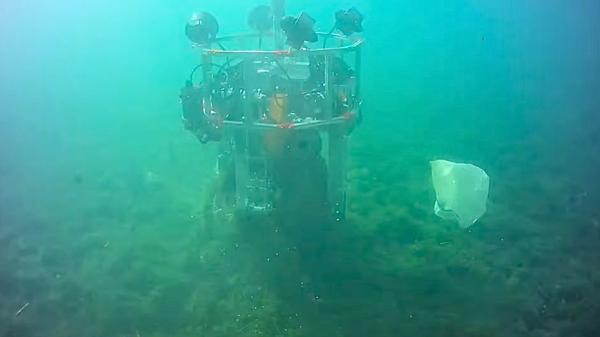
One of the most relevant elements of the system is its ability to “see” the seabed.
Underwater robots use artificial intelligence trained on thousands of images to distinguish between:
- Marine trash.
- Natural rocks.
- Sediments.
- Marine fauna.
This classification is key, because it allows us to act with precision in environments where an error can damage fragile ecosystems.
The system even reconstructs 3D models of the environment to plan how to pick up each object without disturbing the background.
A robot capable of lifting 250 kilos without damaging the ecosystem
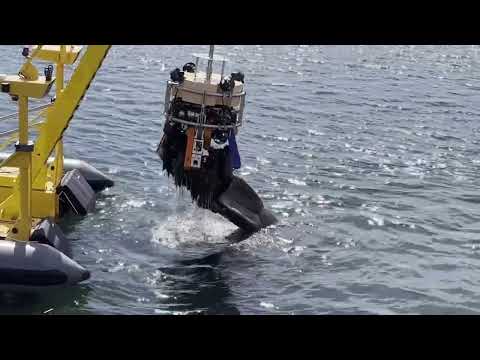
The system’s robotic arm has been designed for a very specific task: removing heavy objects from the seabed without destroying what surrounds them.
According to project data, it can lift up to 250 kilos of waste, including:
- Sinking industrial tires.
- Abandoned fishing nets.
- Metal remains of ships.
- Scrap metal from coastal works.
The key is not only in strength, but in precision: the system can manipulate objects without fragmenting them, reducing the risk of generating new waste.
An environment designed to not disturb marine life
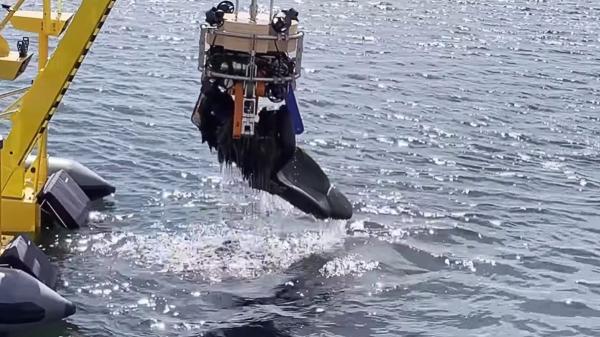
One of the most relevant advances is that the robot does not act “blindly”. Its sensor and vision system avoids sensitive areas and reduces disturbance to the environment to a minimum.
Furthermore, its design seeks to avoid common problems in human interventions:
- Less turbidity in the water.
- Less physical impact on the seabed.
- No risk for divers.
- Controlled and repeatable intervention.
This makes it a safer alternative to traditional underwater cleaning methods.
A system tested in real scenarios
The project has been tested in environments such as Marseille and Hamburg, where real port conditions and complex currents have been simulated.
The idea is clear: to check if this type of technology can go from research to an operational tool in European ports.
In the current phase, the objective is to validate its use in broader Mediterranean scenarios.
Beyond cleaning: a European strategy
The interest of the project is not limited to removing garbage.
The European Union proposes this type of system as part of a broader strategy to reduce marine pollution, with the goal of significantly reducing ocean waste in the coming decades.
Additional applications are also being studied, such as the detection of dangerous objects on the seabed, including remains of old ammunition or potentially dangerous materials.
A paradigm shift in ocean cleanup
The appearance of systems such as SeaClear 2.0 does not replace the need to reduce pollution at source, but it does introduce a new possibility: intervening directly in areas that until now were inaccessible.
For the first time, cleaning the seabed stops depending exclusively on human dives and begins to rely on coordinated autonomous systems.
And although it is still in the testing phase, the idea it raises is clear: the ocean could no longer be a place that is impossible to clean.
If you want to read more articles similar to Marine biologists celebrate a historic advance: in Europe a robot is already removing garbage from the ocean with AI, we recommend that you enter our Pollution category.
