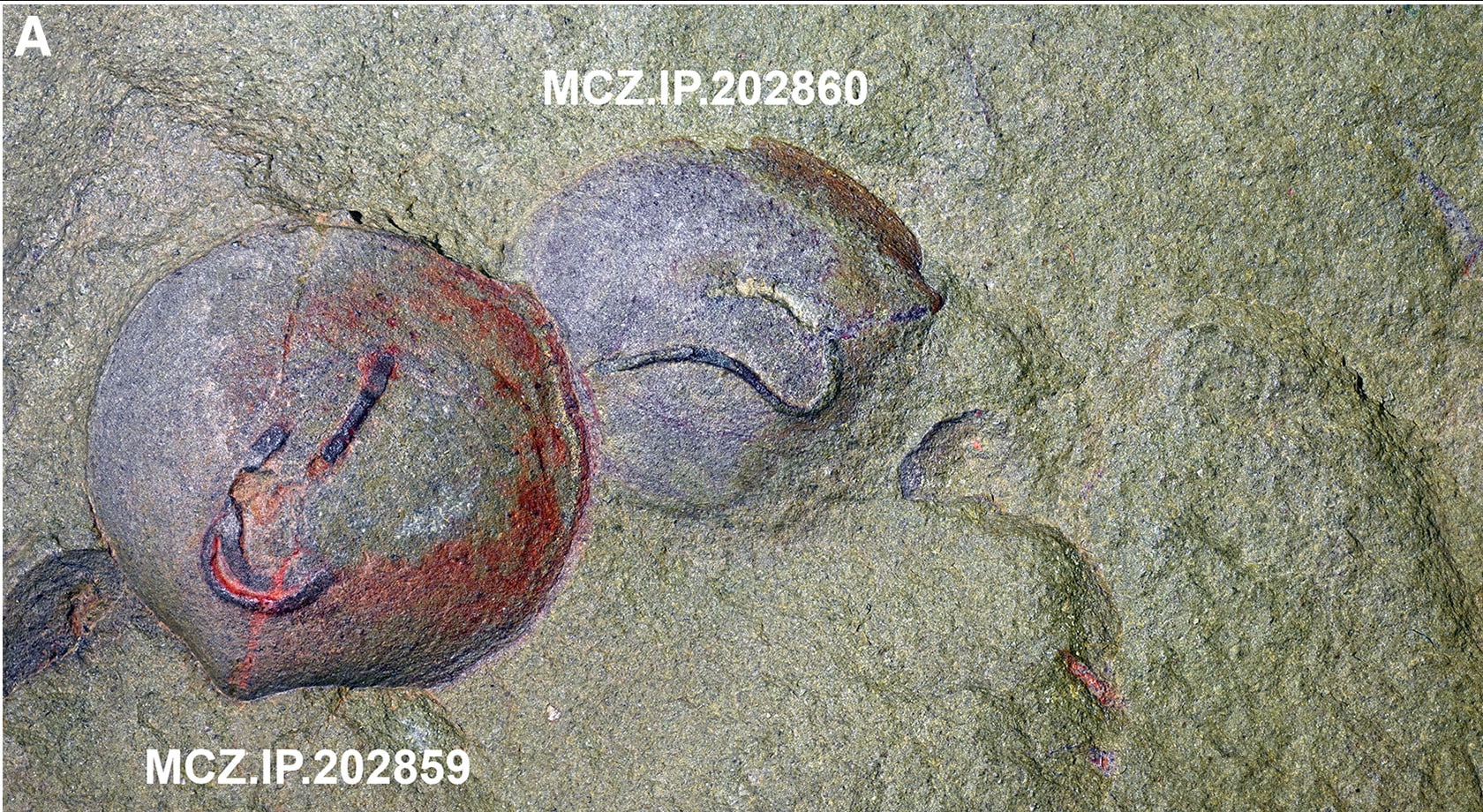
A group of scientists from Harvard University recently found themselves faced with a fascinating paleontological puzzle. Analyzing the fossil remains of a series of bivalves found in Morocco, which date back to 480 million years ago, they began to notice that their shells all bore the same signs: small marks in the shape of question marks, which looked at them mockingly, almost as if challenging them to identify them.
Yesterday like today. A series of high-resolution 3D scans, and comparison with modern bivalves, allowed us to discover the solution: these are signs of parasitic polychaete worms, in every way similar to those that infest oysters and other bivalves today. The history of these very ancient parasites is explained in a study published on iScience.
The worms on the shells. The authors’ first reaction to seeing the marks was to interpret them as scratches or other random marks. The problem is that question marks were everywhere: every fossil found had seven or eight on the shell, and 3D scans revealed that the same marks were also found inside the animal. To identify them it took a bit of luck: reading a recent study that contained photos of some modern bivalves with the exact same marks.
In the case of contemporary shells, the marks had been left by parasites: polychaete worms of the order Spionida, which instead of attacking the flesh of bivalves feed on their shell, causing damage to the organism that can even be lethal. The method these polychaetes use is always the same: when they are still larvae they attach themselves to a shell and dissolve a small area of it, to which they anchor themselves. As they grow, the parasites penetrate deeper into the bivalves, leaving the unmistakable question mark-shaped marks.
The hypotheses. Of course, the authors do not rule out that the marks left on the fossil shells could have been caused by other animals and not by spionid worms – which are structureless animals that are preserved in the fossil record. If this were the case, however, they would be parasites never seen before, and which have evolved the exact same behavior as current polychaetes. The most logical explanation, therefore, is that the fossil shells of Morocco suffered the same fate as their modern relatives.
A success for 500 million years. This means that spionids evolved this parasitic behavior 500 million years ago, and have not changed anything since then, continuing to parasitize the shells of bivalves that come within their reach: it is therefore an incredibly successful strategy, which these worms have been carrying out for half a billion years, even surviving all the mass extinctions that have hit the Earth since then.
If something works, in short, why change?
