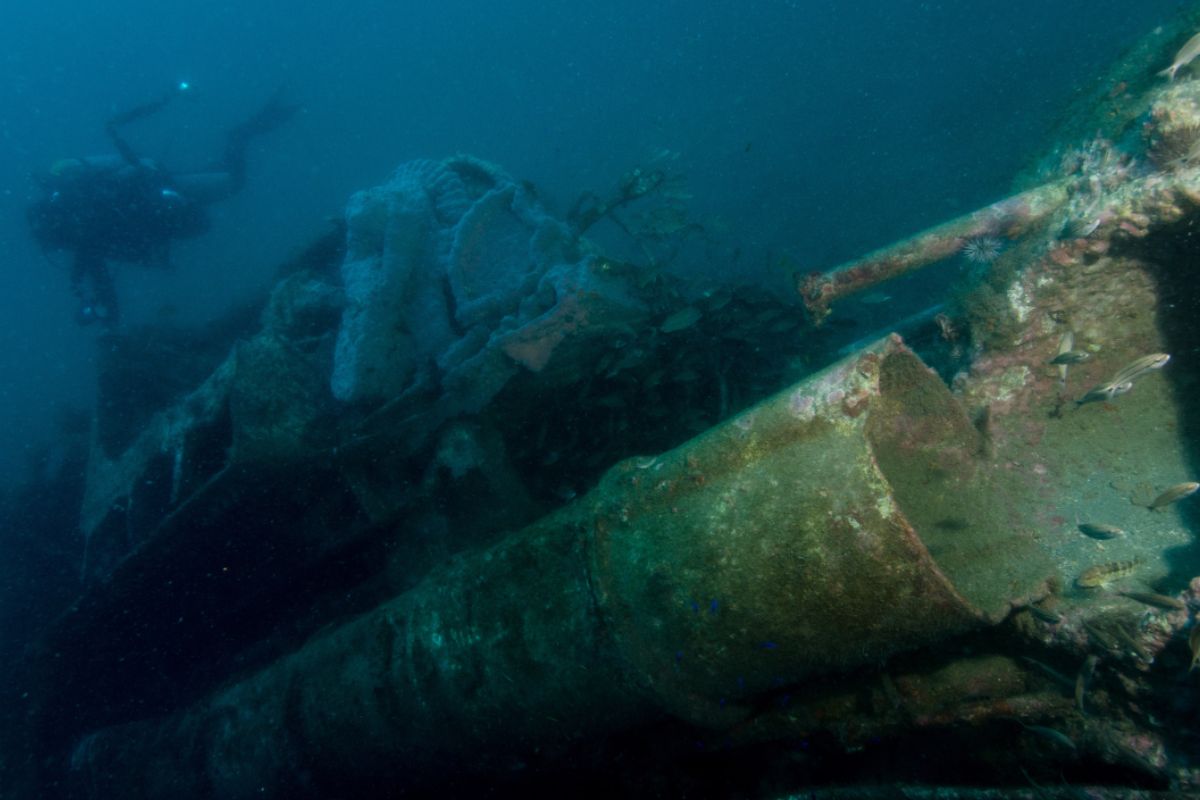
Deep beneath the Pacific waters off California’s coast, marine archaeologists have uncovered a remarkable dual discovery that spans two world wars. At depths exceeding 400 meters, researchers identified the remnants of an American submarine from World War I alongside a World War II bomber aircraft. These underwater findings represent significant historical artifacts that illuminate different chapters of U.S. naval aviation and submarine warfare history.
Revolutionary deep-sea exploration techniques reveal wartime secrets
The Woods Hole Oceanographic Institution (WHOI) collaborated with the U.S. Navy to locate these submerged military vehicles using cutting-edge underwater technology. Their exploration team deployed the manned submersible Alvin alongside the autonomous underwater vehicle Sentry to reach the extreme depths where conventional diving operations prove impossible.
These advanced submersibles enabled precise documentation and identification of both wrecks situated several kilometers from San Diego’s coastline. The technical capabilities of modern oceanographic equipment have revolutionized underwater archaeology, allowing researchers to explore previously inaccessible maritime gravesites. Similar technological advances have facilitated other significant discoveries, including investigations of the Kosmos 482 Soviet probe precipitated in the Indian Ocean, demonstrating the global scope of deep-sea exploration efforts.
The extreme depth of 400 meters presents unique challenges for underwater exploration, requiring specialized equipment and expertise. Marine archaeologists must navigate crushing pressures, limited visibility, and complex ocean currents to successfully document these historical sites. Such conditions mirror those faced by researchers studying other deep-water phenomena, including seismic activities like a strong 7.5 magnitude earthquake shakes the Drake Strait.
USS F-1 submarine disaster : a century-old maritime tragedy
The USS F-1 submarine represents one of the most tragic naval accidents of World War I era. This vessel sank rapidly following a catastrophic collision with another U.S. Navy submarine during routine testing operations in 1917. The accident claimed nineteen crew members’ lives, marking a devastating loss for American naval forces.
According to Bradley Krueger, underwater archaeologist with the Naval History and Heritage Command, the submarine was conducting 48-hour technical trials departing from San Pedro and San Diego when disaster struck. The collision occurred during performance testing exercises, highlighting the inherent dangers of early submarine operations during wartime conditions.
| Vessel Details | USS F-1 Submarine | Grumman TBF Avenger |
|---|---|---|
| Era | World War I (1917) | World War II |
| Casualties | 19 crew members | 0 (crew escaped) |
| Cause of Loss | Submarine collision | Training accident |
| Discovery Depth | 400+ meters | 400+ meters |
The submarine’s rapid sinking demonstrates the vulnerabilities of early 20th-century naval technology. These vessels lacked modern safety systems and emergency protocols that contemporary submarines employ. The USS F-1’s fate serves as a somber reminder of the human cost associated with naval innovation and military preparedness during global conflicts.
Grumman TBF Avenger bomber : World War II aviation heritage
The second major discovery involved a Grumman TBF Avenger torpedo bomber, a aircraft that played crucial roles during World War II Pacific theater operations. This particular aircraft measured 16.51 meters in wingspan, 12.19 meters in length, and 4.70 meters in height, representing typical specifications for this bomber model.
Bruce Strickrott, Alvin group leader at WHOI, explained that this specific wreck had been known to researchers for years, though its precise location remained elusive until this expedition. The aircraft served as a training bomber, indicating its role in preparing naval aviators for combat operations against Axis forces.
Unlike the submarine tragedy, the TBF Avenger’s crew successfully escaped before their aircraft descended to the ocean floor. This fortunate outcome reflects improved safety protocols and emergency procedures developed during World War II aviation training programs. The bomber’s preservation at such depths provides invaluable insights into 1940s military aviation technology and training methodologies.
The discovery of both wrecks contributes significantly to maritime archaeology and naval history preservation. These findings complement other oceanic research efforts, including studies of marine life such as investigations into largest ever great white shark recorded in the Atlantic, demonstrating the diverse nature of deep-sea exploration.
Historical significance and ongoing research implications
These dual discoveries offer unprecedented opportunities for understanding American military history spanning two global conflicts. The wrecks provide physical evidence of technological evolution between World War I and World War II military equipment, showcasing advancements in both submarine and aviation design.
Researchers emphasize the importance of preserving these underwater archaeological sites for future study. The exceptional preservation conditions at 400-meter depths protect metal structures from surface weathering and human interference. Such preservation allows detailed analysis of construction techniques, materials, and design features that shaped early 20th-century military engineering.
The discoveries also highlight key aspects of military training and operational procedures during both conflicts :
- Submarine warfare evolution from World War I collision risks to improved safety protocols
- Aviation training methodologies that reduced casualties during World War II operations
- Technological improvements in emergency escape systems and crew protection measures
- Strategic importance of California’s coastal waters for military testing and training
These findings contribute to broader understanding of oceanic history, complementing geological research such as at the origins of the earth : the Rocce del Québec tell terrestrial hell. The integration of historical, technological, and environmental perspectives enhances our comprehension of humanity’s relationship with marine environments throughout the 20th century.
