
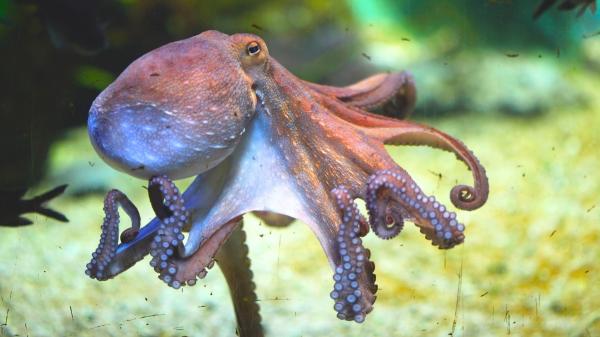
The southwestern coasts of the United Kingdom have been experiencing an unprecedented phenomenon since 2025: a population explosion of common octopus (Octopus vulgaris) that surpasses any record in the last 125 years. This is not just a biological curiosity: it is a clear symptom of how ocean warming is reorganizing European marine ecosystems.
In just six months, British fishermen caught more than 3,000 tonnes of octopus, thirteen times the annual average for the last decade, while English Channel temperatures reached up to 4°C above the historical average.
What happened off Cornwall illustrates a broader reality: European seas have become a “broth” where thermophilic species thrive and cold-water species decline, with profound ecological and socioeconomic consequences.
The sea warmed up to 4°C, creating the perfect conditions for an octopus explosion
The strongest scientific explanation points to a combination of altered ocean currents and extreme heat. Researchers from the UK Marine Biological Association (MBA) and the University of Plymouth documented that ocean currents carried millions of octopus paralarvae from nearby breeding grounds in northern France and the Channel Islands to the coasts of Devon and Cornwall.
Once there, these larvae encountered a sea in the process of warming: the Plymouth Marine Laboratory recorded three consecutive years of marine heat waves in the area, with temperatures up to 4 degrees above the historical average.
The common octopus, a common species of the Mediterranean and the eastern Atlantic, normally lives between one and two years and under typical conditions loses more than 99% of its offspring to cold and predation during the larval phase. Warmer water shortens egg incubation time, substantially improves larval survival, and accelerates reproductive maturation of adults.
The result is a cycle that feeds on itself: more larval survival, earlier reproduction and successive waves of births overlapping in time. Furthermore, the fact that sightings of juveniles and evidence of active reproduction have been documented in UK waters during 2025, something practically unheard of until then, suggests that the current bloom could continue or be repeated in the short term.
This phenomenon is not isolated. Similar events had already been recorded in the same region in 1899, 1932 and 1950, always followed by long periods without repetition. What sets the current episode apart is its scale: it surpassed the previous three in magnitude and geographic extent, with sightings already extending beyond Devon and Cornwall into Wales and southern Scotland.
The landing figures accompany this reading: according to official data from the British Marine Management Organization (MMO), in May 2025 more than 400 tons of octopus were unloaded in a single month, an unprecedented figure in British records. Before this year, monthly landings rarely exceeded 75 tonnes.
The invasion is already transforming the ecosystem: catches of lobsters, crabs and scallops fall
The common octopus is an opportunistic and very voracious predator, and its massive arrival had a measurable invasion effect on the species with which it shares habitat. The MBA’s January 2026 report, funded by the British environment body Defra alongside the counties of Plymouth and Devon, found that catch rates of sea crab, lobster and scallops fell by between 30% and 50% in 2025 compared to previous years.
More than half of the 40 fishermen surveyed for the study reported direct negative impacts, both from octopus predation on target species and from the damage it causes within the fishing pots themselves.
As the most accessible resource (crustaceans from fishing traps) became scarcer, octopus pressure shifted to other prey, including filter-feeding organisms such as mussels and scallops, with a subsequent knock-on effect on the rest of the seafloor community.
Some reports even mention drops of up to 80% in local catches of sea ox, lobster and lobster. This trophic reordering not only affects fishermen; It also alters the natural dynamics of the ecosystem. For example, Risso’s dolphins (also known as pilot whales) have been observed feeding on octopuses in the area, suggesting that even large marine predators are adjusting their diet to the new abundance of cephalopods.
The commercial impact is also notable. Spain, one of the largest importers of octopus, reacted with an aggressive strategy of purchasing and substituting products, taking advantage of the British abundance to supply itself at lower prices.
Fresh octopus is auctioned in Galician markets at an average of between 11 and 11.4 euros per kilo, while the frozen product that arrives from Brixham or Newlyn is between 8 and 9 euros, a saving of close to 20% for the entire distribution chain. However, this commercial bonanza comes at an ecological cost: the proliferation of octopuses is profoundly transforming the British fishing industry and the marine ecosystem.

What worries scientists most now: octopuses could be here to stay
That is the question that most worries the scientists of the study themselves. The fact that sightings of juveniles and evidence of active reproduction have been documented in UK waters during 2025, something practically unheard of until then, suggests that the current bloom could continue or repeat in the short term, rather than being an isolated episode.
The researchers emphasize that ongoing research and monitoring is needed to understand how the sudden arrival of a species, until now rare, affects a marine ecosystem that is already under pressure from climate change.
The underlying message of the report is clear: if marine heat waves in the English Channel become more frequent, as anticipated by many climate models for the region, this type of sudden rearrangement of species could cease to be a statistical rarity and become a recurring characteristic of these waters.
In fact, human-induced warming has added at least 1.3°C of additional heat to the Celtic Sea, according to a World Weather Attribution (WWA) study. This rapid warming directly threatens the future of fisheries that are essential for coastal communities, leading to the collapse of species such as cod, mackerel and lobster.
In short, the octopus invasion off Cornwall is a reminder that climate change is not just a future problem: it is already rewriting the rules of marine life in real time.
If you want to read more articles similar to The sea off Cornwall warmed up to 4 °C and caused the largest invasion of octopuses in the United Kingdom in 125 years, we recommend that you enter our Biodiversity category.
