
For years, the hole in the ozone layer over Antarctica has been one of the great indicators of the deterioration of the atmosphere. However, in 2025 something unusual happened: it reached one of its smallest sizes in the last two decades.
A combination of factors were behind this decline, from the weakening of the polar winds to the increase in temperatures in the stratosphere. What explains this change and what does it mean for the recovery of the ozone layer?
Why the ozone hole over Antarctica in 2025 was one of the smallest
The ozone hole over Antarctica had one of the least intense seasons in recent decades in 2025. The average area between September 7 and October 13 was about 18.7 million square kilometers, making it the fifth smallest since 1992, according to measurements by NASA and NOAA.
One of the main reasons was the atmospheric conditions. During August, the Antarctic polar vortex, the circulation of winds that surrounds the continent and keeps extremely cold air above the pole insulated, was weaker than usual. This favored relatively higher temperatures in the stratosphere and limited the conditions necessary for intense ozone destruction to occur.
Furthermore, in mid-September large-scale atmospheric waves rapidly raised temperatures in the Antarctic stratosphere, further slowing the chemical reactions responsible for ozone loss. Subsequently, the polar vortex weakened and disappeared earlier than usual, allowing air with higher concentrations of ozone to enter.
The result was a hole that not only reached a smaller extent, but also dissolved almost three weeks earlier than the average for the last decade. The maximum recorded in a single day was 22.86 million square kilometers, about 30% less than the 2006 record.
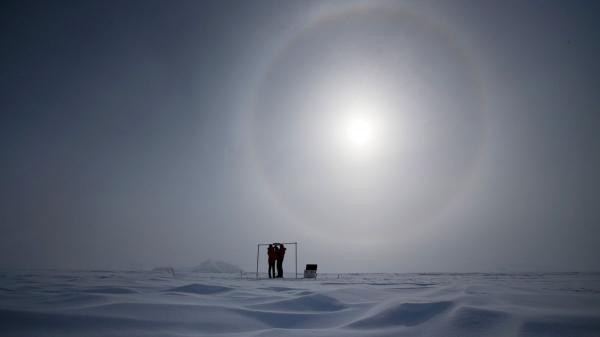
How winds and temperatures slowed ozone destruction
Meteorological conditions in the Antarctic stratosphere played a decisive role during the 2025 season. In mid-September, a series of large atmospheric waves caused a rapid increase in temperatures in the lower layers of the stratosphere, reducing favorable conditions for chemical reactions that destroy ozone.
The change in temperature also coincided with a weakening of the polar vortex, an extensive circulation of cold air that usually isolates the Antarctic region during the southern winter. When this system loses strength, it becomes easier for air with a higher concentration of ozone to enter from other latitudes.
This process caused ozone destruction to slow down earlier than usual and contributed to the hole reaching a smaller extent and depth than in previous years. At the end of October, the polar vortex quickly dissipated, further favoring the entry of ozone-rich air over Antarctica.
Recovery is progressing, but it will take decades for the ozone layer to return to 1980 levels
The recovery of the ozone layer is closely related to the Montreal Protocol, signed in 1987 to reduce and phase out chemicals responsible for destroying ozone, especially chlorofluorocarbons (CFCs) and other compounds containing chlorine and bromine. These substances were used for decades in products such as refrigerants, aerosols and fire extinguishing systems.
The effect of the agreement was not immediate. Although the production of many of these substances has been drastically reduced, chlorine and bromine remain in the atmosphere for years, so the recovery of the ozone layer is necessarily slow. Since about 2000, however, levels of ozone-depleting substances in the Antarctic stratosphere have fallen by about a third of their pre-hole levels, contributing to a gradual reduction in its size and depth.
The most recent research has also found a signal statistically consistent with the beginning of the recovery of Antarctic ozone as a consequence of the reduction of these substances, separating it from natural variations from one year to the next.
Still, the process will take decades. If current policies are maintained and compliance with the Montreal Protocol continues, it is estimated that the ozone layer will recover to approximate 1980 values by 2040 in most of the world, 2045 in the Arctic and around 2066 over Antarctica.
Europe registers more ultraviolet radiation despite the recovery of the ozone layer
The reduction of the ozone hole over Antarctica does not mean that ultraviolet radiation levels have decreased across the planet. The World Meteorological Organization bulletin points out that, since the mid-1990s, surface UV radiation has increased significantly in different areas of Europe, with increases of up to 20% at some measuring stations.
The main cause of this increase would not be directly related to a new deterioration of the ozone layer. According to the analysis cited by the WMO, around 80% of the increase in UV radiation is explained by less cloud cover, which allows a greater amount of solar radiation to reach the surface. The rest would be related to the reduction of atmospheric aerosols, particles that can block part of solar radiation.
This situation shows that the amount of ultraviolet radiation that reaches the ground depends on several factors and not only the state of the ozone layer. Therefore, although the recovery of ozone represents a positive long-term evolution, atmospheric conditions and solar exposure continue to be determining factors for the levels of UV radiation that people receive.
If you want to read more articles similar to The ozone hole in Antarctica is shrinking and, in 2025, it recorded one of its smallest sizes since 1992: the explanation lies in the winds and temperature, we recommend that you enter our Ozone Layer category.
