
Siberia is a region located in northern Asia that is part of the Russian Federation. It extends from the Ural Montes to the Pacific Ocean and from the Arctic Ocean to the borders with Mongolia, China and Kazakhstan. Due to its size, it concentrates a wide variety of landscapes, climates, ecosystems, flora and fauna. Therefore, we are going to dedicate this ecology article see in depth everything you need to know about what Siberia is, where it is, characteristics, temperature, flora and fauna.
What is Siberia and where is located on the map?
Siberia is a vast geographical region located in northern Asia, known for its immensity, its extreme climate and its natural landscapes ranging from endless forests to mountains and frost tundras. Many people ask if Siberia is a country. The answer is no. Siberia is not an independent country, but a region that belongs in its entirety to Russia.
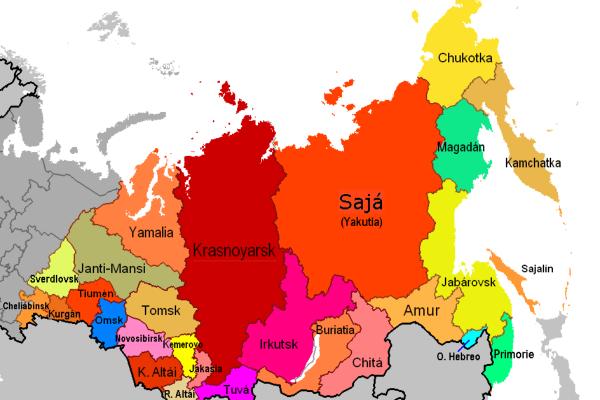
On the map, Siberia extends from the Ural Montes, which mark the natural border between Europe and Asia, to the Pacific Ocean in the East, and from the Arctic in the north to the borders with Mongolia, China and Kazakhstan in the south. Because of its size, it occupies around 77% of the Russian territory, which makes it one of the largest regions in the world.
Another common doubt among people is which countries are part of Siberia. Although it may seem to be distributed among several, the truth is that Siberia is only within Russia. No other country has part of its territory within this region, although it does limit with several, which sometimes generates confusion.
What characteristics does Siberia have?
Siberia not only impresses with its size, but also by the variety of landscapes and environments that it houses. The relief of Siberia is very diverse. To the west, the large plains predominate, ideal for the expansion of forests and agricultural areas; In the center are plateaus and highlands; and to the east mountainous mountain ranges appear, such as Verjoyonsk and Stanovói. This mixture of reliefs makes the region as wide as heterogeneous.
As for nature, the types of Siberia biomes and ecosystems cover from icy areas to more temperate regions. The Taiga, an immense coniferous forest, is the dominant bioma and occupies most of the territory. Further north the tundra extends, characterized by its icy soil (permafrost), mosses and lichens, where extreme temperatures make trees almost impossible.
Water resources are also a key feature of the region. The rivers of Siberia, such as the OBI, the Yeniséi and the Lena, are one of the longest and most caudalous on the planet, playing an essential role in both the ecology and in the transport of the area. In addition, Siberia lakes are equally impressive: the most famous is Lake Baikal, the deepest in the world, considered a natural treasure and heritage of humanity by UNESCO.
How are the climate and the temperature of Siberia?
Talking about Siberia is also talking about its extreme climate. The region is known for having some of the coldest winters in the world, with temperatures that in certain areas descend to –50 ° C. Cities such as Oimiakón or Verjoyonsk, in Yakutia, are considered the coldest inhabited by the human being. Siberia’s climate is mainly continental, which means very long and hard winters, and short but surprisingly warm summers in some areas.
Siberia temperature varies greatly according to the area. In the south, near Mongolia and Kazakhstan, summers can exceed 30 ° C, which contrasts with the cold cold of the north. In the Siberian Arctic, the cold is practically permanent, and the soil remains frozen throughout the year due to the permafrost. These climatic contrasts have molded both animal and plant life and the way in which human communities have adapted to survive in such a hostile environment.
Discover what are the coldest places in the world.

How is Siberia’s flora?
Siberia’s flora reflects the immensity and contrasts of the region. Due to its size and diversity of climates, it houses from dense forests to meadows and frost tundras. The vegetation is very conditioned by low temperatures and the presence of permafrost, which limits growth in many areas. Even so, biodiversity is surprising.
Some representative species are:
- Siberian pine (Pinus Sibirica): Taiga emblematic tree, reaches great heights and produces highly valued pinions for both food and traditional medicine.
- White birch (Betula pendula): One of the most resistant to cold species, stands out for its clear and flexible cortex. It is located in large extensions of the south and center of Siberia.
- SIBERIAN ALERCE (Larix Sibirica): Unlike most conifers, it loses its leaves in winter. Its wood is highly appreciated for its hardness and humidity resistance.
- Tundra lichens: although they are not trees, they are an essential part of the northern ecosystems. They resist extreme temperatures and serve as food for animals such as reindeer.
How is Siberia’s fauna?
Siberia’s fauna is as impressive as its geography. Adapted to extreme climates and vast territories, it includes unique species that range from large predators to animals resistant to polar cold. These ecosystems have allowed the survival of species that in other parts of the world would be very difficult to find.
Some best known examples are:
- Siberia tiger (Panthera Tigris Altaica): The biggest feline on the planet. He lives mainly in forests of the Far Siberian East. It is in danger of extinction, but conservation programs have allowed to increase its population.
- Brown bear (Ursus arctos): Very common in Taiga forests, it is one of the symbols of Russian fauna. It feeds on fruits, fish and small mammals, although it can also hunt larger dams. Discover these curiosities of the brown bear.
- Reinde (Rangifer tarandus): Typical of the tundra, it is a key animal for the nomadic peoples of Siberia, which use it for transport, food and clothing. Here you will find more information about the reindeer or caribú: what is, guys, where he lives and what he eats.
- Arctic fox (Vulpes Lagopus): Adapted to the most intense cold, change the color of its fur according to the station: White in winter to camouflage in snow and brown or gray in summer.

What is the importance of Siberia?
Siberia not only stands out for his geographical immensity, but also for the key role he plays worldwide.
Natural resources
This region concentrates some of the largest reserves of natural gas, oil and minerals on the planet. In its extensive basins metals such as nickel, gold, copper and iron are extracted, which supply both Russia and international markets. The exploitation of these resources constitutes a fundamental part of the Russian economy, turning Siberia into an energy and mining pillar of enormous global weight.
Global climate regulation
Siberian Taiga forests, considered the largest green lung in the northern hemisphere, act as a gigantic carbon sink. This ecosystem absorbs millions of tons of carbon dioxide and helps stabilize the climate of the planet. In addition, permafrost stores large amounts of carbon and methane. Its thaw, accelerated by global warming, has direct repercussions on world climate.
Indigenous peoples and local cultures
Siberia is also home to numerous indigenous communities, such as the Yakutos, Evenkis, Nenets and Chukchis. These populations maintain traditions, languages and ways of life that have endured for centuries, adapting to extreme conditions. Its practices, based on reindeer breeding, fishing, hunting and respect for nature, are part of an invaluable cultural heritage that is still alive despite modernization.
What curiosities exist on Siberia?
Siberia is a territory full of amazes and surprising data that attract the attention of geographers, travelers and scientists equally.
- Lake Baikal, the deepest in the world: located in southern Siberia, this lake is more than 1,600 meters deep, which makes it the deepest lake of the planet. In addition, it stores approximately 20% of the world’s non -frozen water and houses unique species, such as the Narpa seal and several endemic fish.
- The famous “Transiberian road”: more than a single highway, the Transiberian road is an extensive network of federal roads that Siberia from west to east crosses, connecting St. Petersburg with Vladivostok through several main routes. This route allows the region to be traveled by land, crossing forests, rivers and mountains, and complements the famous transiberian railway line.
- Cold records in Oymyakon: Oymyakon holds the title of one of the coldest inhabited places on the planet. Winter temperatures can descend below -50 ° C, which makes its inhabitants and the local ecosystem into real examples of adaptation to extreme conditions.
- The most extensive taiga in the world: Siberia houses the largest taiga on the planet, a coniferous forest that extends for millions of square kilometers. This ecosystem is vital for biodiversity and for the regulation of global climate.

If you want to read more articles similar to Siberia: what it is, where it is, characteristics, temperature, flora and fauna, we recommend that you enter our category of ecosystems.
- Wilde, L. (2025). Siberia fauna: wild animals that live in the icy heart of Russia. Fauna Lovovers. Available at: https://faunalvers.com/fauna-siberia/
- Bizhub Techinfus. (SF). Regions of Siberia and its characteristics. Available at: https://bizhub.techinfus.com/es/regionyi-sibiri-ih-osobennosti.html
- Flora and fauna. (2024). THE CASITA DE LA SIBERIA. Available at: https://www.lacasitadelasiberia.es/flora-y-fauna/
- Alar – Russian Latin American association. (2017). 5 unique animals of Siberia, Russia. Universities blog in Russia. Available at: https://www.blog.universities-rusia.com/2017/12/20/5-animales-unicos-de-siberia-rusia/
