Children’s skin can become covered in small spots for various reasons. How to understand when it comes to mushrooms? And how to distinguish and treat the different skin mycosis?
Summer is about to end and Marina’s mother decides to take advantage of one of the last sunny days to take the little girl to the seaside. As she spreads sunscreen on her daughter’s back, however, she notices that her skin is dotted with small white spots. They are skin mycoses, more commonly known as “skin fungi”. Let’s try to understand why they appear and what treatments are most suitable.
What are skin mycoses
Children’s skin can become covered in small spots for the most varied reasons: viral infections, allergies, exposure to the sun, genetic diseases. Sometimes skin blemishes are caused by fungi or skin mycosis.
Most mycoses can be classified as dermatophytoses, as they are caused by a group of fungi, similar to each other, called dermatophytes, such as trichophyton, microsporum and epidermophyton. These fungi feed on keratin, a protein found in skin cells and which forms nails and hair. Dermatophyte infections are also called tinea or ringworm.
Dermatophytes do not invade the deep layers of the skin but the presence of the fungus and its metabolic products can induce an allergic or inflammatory reaction which manifests itself with redness and scaling and which can cause itching.
While to contract dermatophytosis you need to come into contact with contaminated surfaces, other people or infected animals, some skin mycosis emerge following an alteration in the balance between the microorganisms that live on our skin. These include:
- candidiasis;
- diaper rash;
- pityriasis versicolor (caused by the excessive proliferation of a fungus of the Malassezia genus).
Types of skin mycosis
Tinea is a generic name that refers to a mycosis of the skin, which can be caused by different fungi. We talk about:
- tinea capitisif the scalp is affected;
- tinea faceisif it appears on the face;
- tinea corporisif it affects the skin of the trunk or upper limbs;
- tinea crurisif it affects the groin, buttocks and/or thighs;
- tinea pedis or athlete’s foot, if it affects the foot;
- tinea unguiumif nails are involved.
While tinea capitis is more common in children, tinea pedis, unguis and cruris mostly affect adolescents/adults.
Pityriasis versicolor, which can also be called tinea versicolor, also affects adolescents more often.
Skin fungi: causes and risk factors
Can you get mushrooms by walking barefoot? Yes, if someone with an infection has passed where you are walking. The superficial part of the skin, the stratum corneum, is made up of dead cells that slowly, imperceptibly, fall off. Together with these cells, walking barefoot, a person with a mycosis can release small elements of the fungus (hyphae). These desquamated cells dispersed in the environment can remain contagious for months and years, especially if they remain trapped in rugs or carpets.
Skin fungi are contagious, therefore, and contagion can occur not only through the environment but also through direct or indirect contact with the skin of an infected person (for example, exchanging combs or brushes can transmit tinea capitis). For this reason, if a child has a skin mycosis it could be useful to also evaluate the child’s family members and close contacts to verify that there are no other cases. Animals, such as dogs and cats, can also transmit fungal infections. If a child is infected by an animal, however, it is difficult for him to transmit the infection to other people.
Those who are most at risk of contracting a skin mycosis are those who often frequent shared bathrooms or changing rooms, those who practice contact sports such as fighting or wrestling, those who live in hot-humid climates and those who do not maintain adequate personal hygiene.
Excessive sweating, not drying your feet well after showering, wearing very tight socks or shoes are all factors that favor the so-called athlete’s foot. A state of immunosuppression or malnutrition increases the risk of infection and can lead to more serious conditions.
Symptoms of skin mycosis
As for the symptoms of skin mycosis, some fungal infections cause only mild irritation, while others, penetrating into the deeper layers of the skin, can cause itching, swelling, blistering or peeling.
Tinea corporis manifests itself with the appearance of one or more red spots on the skin. The skin may appear thickened, dry and sometimes flaky. As time passes, the spot expands and takes on a reddish ring shape with thickened edges. The area inside the ring may be hypo- or hyperpigmented, making it appear lighter or darker. The child may complain of itching. The spots generally appear in the most exposed areas: arms, legs, hands, neck, but all areas of the body can be affected, even the face, stomach, back or chest.
Tinea capitis manifests itself as a red, scaly rash on the head that can cause itching and hair loss. In rare cases, tinea can progress to a more serious lesion, called kerion. This presents as a thickened, purulent area on the scalp, which can cause fever, pain and swollen lymph nodes.
Tinea cruris affects males more frequently and appears more often in summer, manifesting itself as ring-shaped red spots in the groin area, which can cause itching and pain.
Tinea pedis typically occurs in the spaces between the toes: the skin may appear red and dry and, over time, blisters and cracks may appear. Athlete’s foot causes severe itching and sometimes even pain; it is often associated with a nail infection.
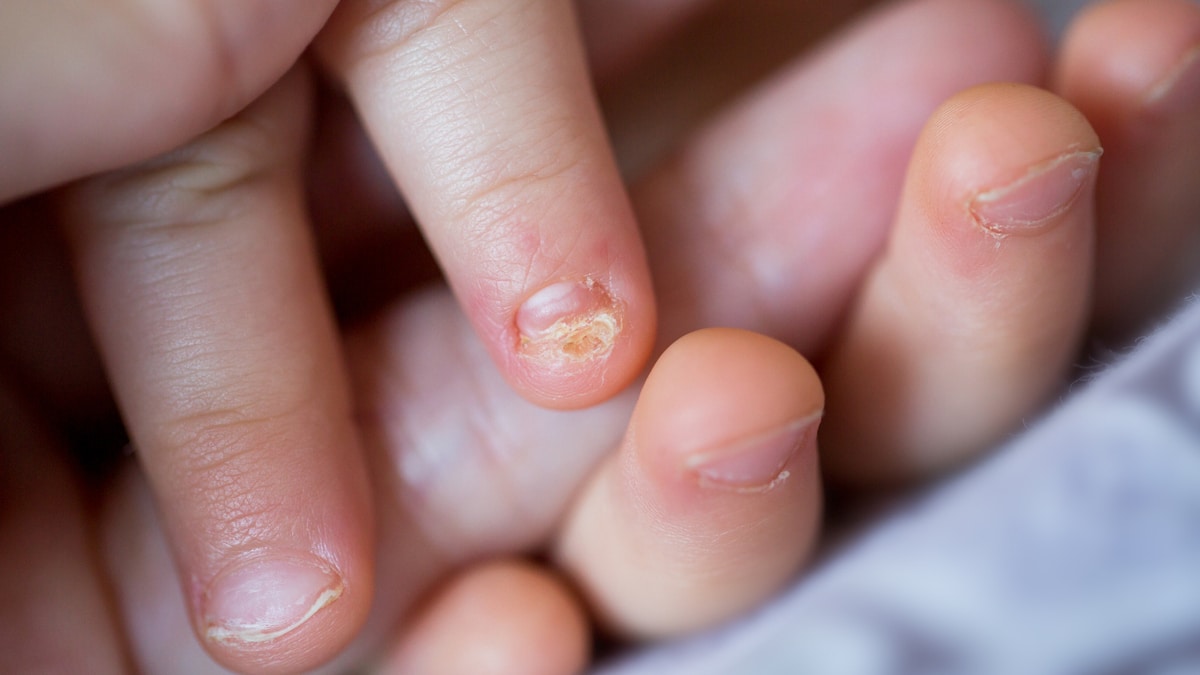
If fungi infect the nails, they thicken and become deformed. Nail tinea affects toenails more than fingernails. Nails may appear thickened and yellowed. Initially the affected part is the lateral and terminal part but, over time, the infection can involve the nail up to its root.
Some skin fungi manifest themselves with white spots: this is the case with tinea versicolor. Small oval- or round-shaped white or light brown spots appear on the trunk, arms, and, more rarely, on the face or neck. They are generally noticed after sunbathing; the tan, in fact, is not homogeneous and the skin appears patchy.
The spots may be slightly flaking but in most cases they do not cause itching or pain. The responsible fungus, the malassezia furfuris a yeast present on the skin of most people but can, in some cases, such as abnormal production of sebum or in very humid areas of the body, proliferate excessively and cause mycosis.
Diagnosis
The diagnosis of skin mycosis can be made by the doctor by evaluating the child’s medical history, the times at which the spots appeared and their characteristics, and examining the skin with the naked eye or with the help of an ultraviolet light lamp.
Sometimes more accurate investigations may be necessary, so the doctor may decide to take small samples of skin, hair or nails to proceed with microbiological tests, such as microscopic examination or cultural tests. The outcome of the latter can take weeks, as the mushrooms grow very slowly in the test tube. In the meantime, empirical therapies can be started.
Skin mycosis: care and treatments
How to cure skin fungus? Depending on the type of mycosis, different treatments may be necessary. Tinea corporis and cruris and athlete’s foot, for example, can be effectively treated with skin fungus creams that contain antifungals. If you use creams or lotions it is important to wash your hands well both before and after application. A single course of treatment may not be sufficient to eradicate the fungi and may need to be repeated if the lesions reappear.
In some cases a bubble bath for skin fungus may also be recommended and in others it may be necessary to resort to pills. To treat tinea versicolor, for example, lotions can be applied for several days, left on the skin overnight and washed off in the morning. Unfortunately, pityriasis versicolor tends to recur and multiple courses of treatment may be necessary.
In some cases, antifungals to be taken by mouth or treatments with detergents to be carried out monthly may be recommended. It can even take months for the skin to return to its normal color. Tinea capitis and onychomycosis, for example, require taking oral antifungals for several weeks to be effectively treated, in addition to the application of specific shampoos or nail polishes.
However, antibiotics are not recommended unless bacterial superinfections develop. Other remedies for skin mycosis, so to speak “do it yourself”, are not effective, if not downright harmful. Using lemon for skin fungus, for example, is not recommended, as it could also cause irritation on damaged skin.
Prevention
Here are some tips for preventing skin mycosis:
- good hygiene;
- frequent hand washing;
- avoid wearing other people’s hats or clothing;
- do not share towels and nail clippers;
- keep your feet dry and dry them thoroughly after showering;
- do not wear shoes that are too tight;
- use socks made of breathable materials and cotton underwear;
- keep your toenails short.
When to contact the doctor
The doctor’s opinion is essential for the diagnosis of skin mycosis, as sometimes fungal infections are not easily recognizable and can mimic other diseases. The choice of treatment then depends on the symptoms, the age of the child and the general state of health.
Not all medications and treatments are suitable for children, especially toddlers. Undertaking treatment without consulting your pediatrician can be counterproductive. If, for example, you decide to apply a cortisone cream on a mycosis, this could initially regress thanks to the anti-inflammatory effect of corticosteroids but, once the therapy is stopped, the lesion could reappear in a more extensive and serious form, with papules and pustules.
