A Trentino startup develops algorithms to predict extreme events by analyzing 30 years of historical data. The technology promises accuracy never seen before.
The weather has never been so unpredictable. In 2024 Italy recorded 351 extreme weather events, 485% more than in 2015. Annual damages amount to 6.8 billion euros according to the European Environment Agency. In this climatic chaos scenario, a Trentino startup promises to make a difference with surgical forecasts.
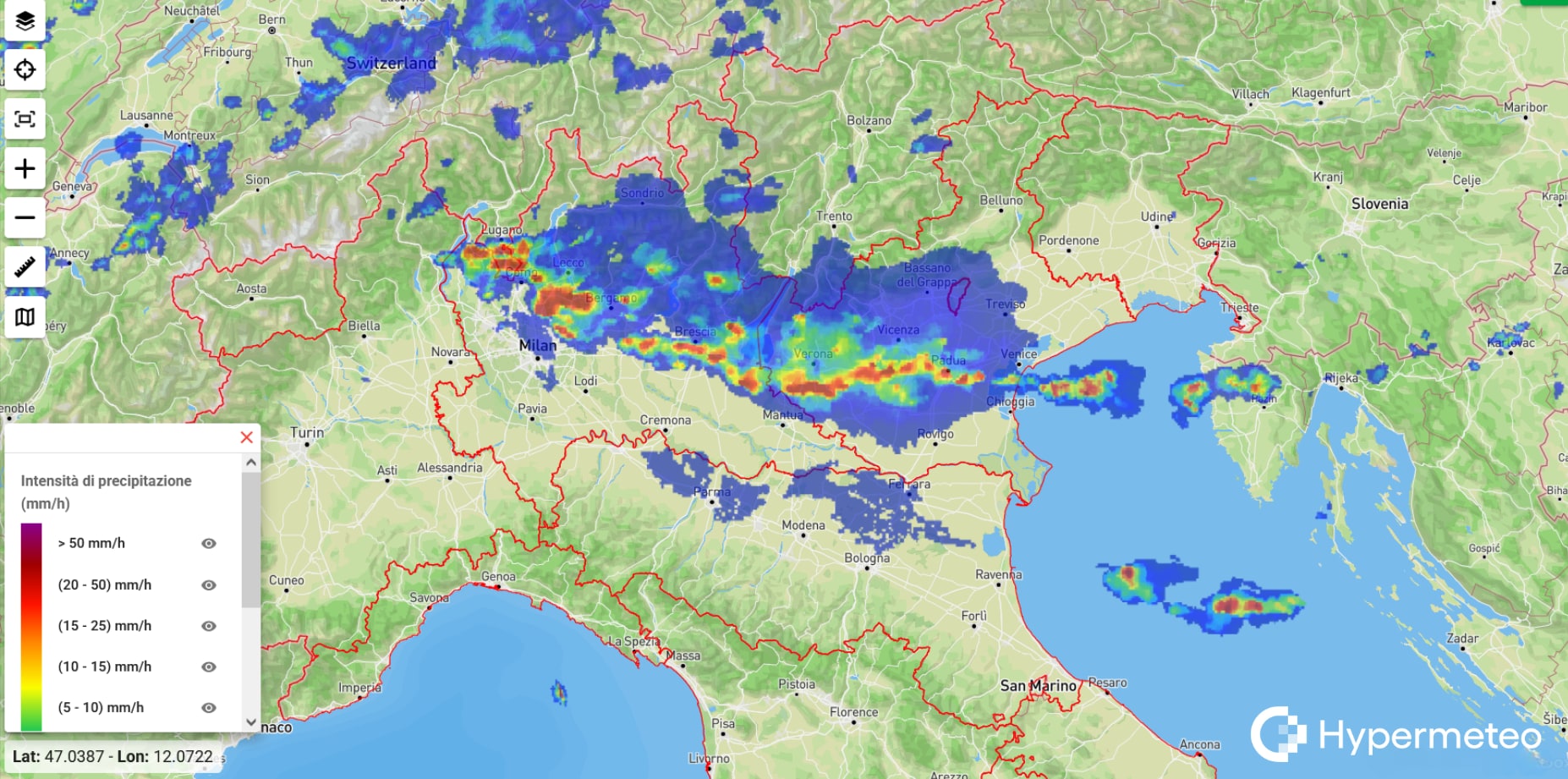
The challenge of local precision. Hypermeteo, this is the name of the startup settled in Rovereto, has chosen to focus on space resolution. Its approach is to provide weather forecasts with a square kilometer detail, well beyond the current standards that stop in cells of several kilometers.
“We start from a three -dimensional description of the initial atmospheric state, obtained from satellite measures and meteorological stations,” explains Tullio Degiacomi, the company’s meteorologist. The data are then processed with numerical models that simulate atmospheric evolution.
The historical archive as a key. The difference, according to the company, lies in the integration of a vast archive of observational data collected until the 90s. This historical database is used to “train” owner algorithms that should improve the accuracy of the forecasts.
The team, composed mainly of under 35 between meteorologists and data scientists, claims to have reconstructed historical weather data with mileage resolution for a time span of three decades. A complex operation, considering the fragmentation of Italian historical data.
The practical application ranges from agriculture to energy. Insurance companies, now obliged by law to cover catastrophic events, represent a growing market. But other sectors also show interest: managers of electricity networks, farms, operators in the construction sector.
Gianluca Ferrari, co -founder of Hypermeteo, cites some examples: “Predicting intense snowfalls can activate automatic defrosting systems on high tension cables. Knowing the probability of hailstorms affects decisions for new wind plants”.
Limits and perspectives. It should be remembered that the weather forecasts, even the most sophisticated, remain probabilistic. The atmosphere is a chaotic system where small variations can produce unpredictable effects. Milometric precision, however technically interesting, has yet to demonstrate its practical usefulness on an industrial scale.
