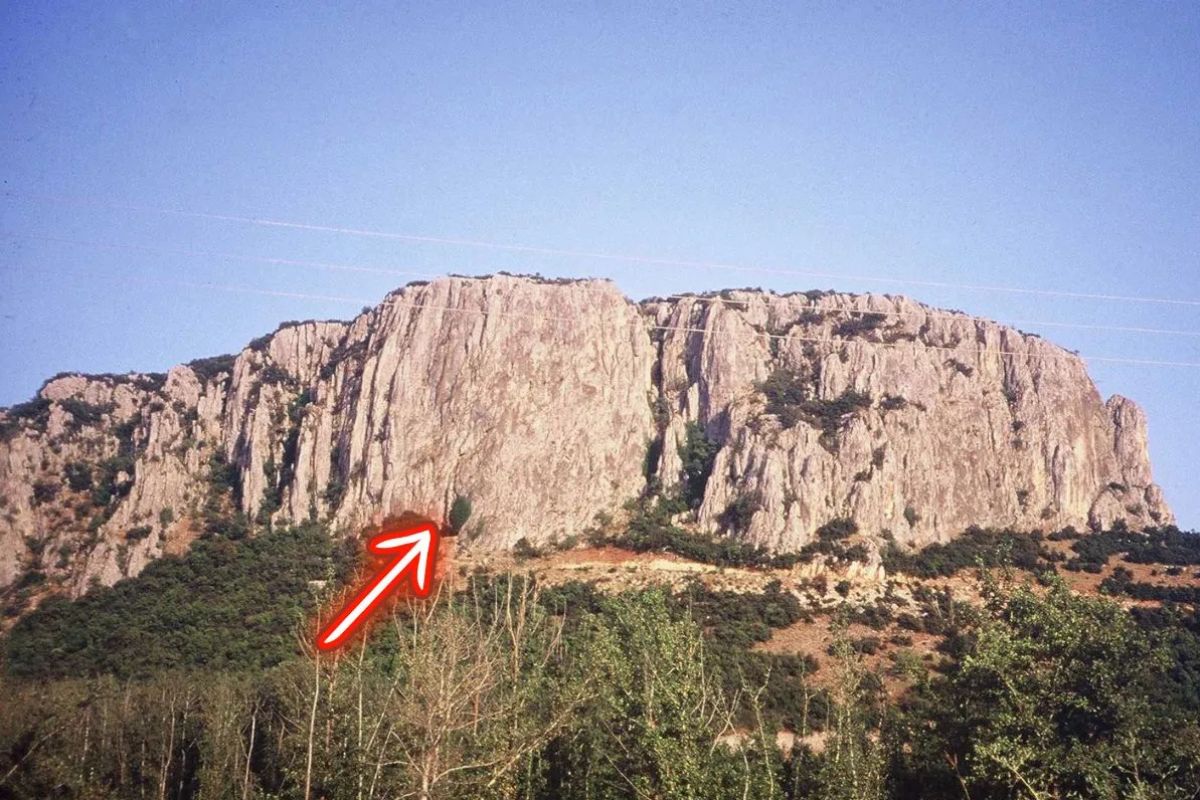
Deep beneath the limestone cliffs of Thessaly, Greece, archaeologists have uncovered evidence that rewrites our understanding of human construction history. The Theopetra cave, nestled just three kilometers from the famous Meteora monasteries, houses what researchers believe to be humanity’s oldest known artificial structure – a stone wall dating back approximately 23,000 years, making it nearly three times older than Egypt’s Great Pyramid of Kheops.
Archaeological marvel hidden in plain sight for millennia
The Theopetra cave system formed during the Cretaceous period, between 137 and 65 million years ago. However, human occupation began much later, around 130,000 years ago during the Middle Paleolithic era. Neanderthal populations likely first established themselves within these protective limestone chambers, beginning an extraordinary timeline of continuous habitation.
Dr. Catherine Kyparissi-Apostolika initiated systematic excavations in 1987, revealing layers of human activity spanning from the Paleolithic through the Neolithic periods until approximately 3,000 BCE. The archaeological team discovered an impressive array of artifacts including stone tools, shell jewelry, fire traces, burial sites, and remarkably preserved children’s footprints. These findings demonstrate the cave’s crucial role as a prehistoric sanctuary for successive human populations.
The site’s geological formations have provided exceptional preservation conditions, allowing researchers to study continuous human adaptation across multiple climatic periods. Modern scientists continue making groundbreaking discoveries in various locations, much like recent findings where more than 1,500 feet beneath the ice of Antarctica, scientists made an astounding discovery, proving that extreme environments often preserve remarkable evidence of life.
Engineering brilliance during the last ice age
The ancient wall represents a revolutionary architectural achievement constructed approximately 21,000 BCE during one of Earth’s most challenging climatic periods. Built using carefully selected stones bound with clay mortar, this structure blocked two-thirds of the cave’s entrance, reducing the opening to roughly one meter in width.
Archaeological analysis suggests this construction served as critical climate protection against the extreme cold that characterized the last glacial maximum. The wall’s strategic positioning demonstrates sophisticated understanding of thermal dynamics and airflow control, marking a pivotal moment in human architectural evolution.
| Ancient Structure | Location | Construction Date | Primary Function |
|---|---|---|---|
| Theopetra Wall | Greece | 21,000 BCE | Climate protection |
| Çatalhöyük | Turkey | 7,400 BCE | Urban settlement |
| Cairn de Barnenez | France | 4,800 BCE | Funerary monument |
| Stonehenge | England | 3,000 BCE | Ceremonial site |
The engineering techniques employed reveal remarkable problem-solving capabilities among prehistoric populations. These ancient builders understood material properties, structural stability, and environmental adaptation long before formal architectural principles emerged. Their innovative approach to survival architecture influenced subsequent construction methods throughout human history.
Treasure trove of prehistoric human evolution
Theopetra’s archaeological layers provide unprecedented insights into human transitional periods across prehistoric eras. Successive occupation levels contain tools from Paleolithic, Mesolithic, and Neolithic periods, alongside bone implements, shell artifacts, and early pottery fragments. The site serves as a comprehensive prehistoric timeline documenting human technological advancement.
Burial discoveries dating between 15,000 and 7,000 years ago reveal sophisticated funerary practices among small human groups. Archaeological evidence indicates these inhabitants maintained diverse diets including wheat, barley, olives, and various meat sources, suggesting advanced agricultural knowledge and hunting techniques.
Research indicates that cave occupation experienced periodic interruptions corresponding to major climatic shifts throughout prehistory. During intense cold periods, inhabitants adapted their living strategies, with the wall construction representing their most significant architectural response. Later periods saw the cave utilized as wartime shelter and livestock enclosure, demonstrating its enduring importance to local populations.
Just as ancient civilizations demonstrated remarkable foresight, modern scientific predictions continue shaping our understanding of human development. Interestingly, thirty years ago, Stephen Hawking made predictions for 2025 that showcase humanity’s continued capacity for long-term thinking and innovation.
Legacy of humanity’s earliest architects
Contemporary preservation efforts have closed Theopetra cave to public access, protecting this fragile archaeological treasure for future generations. Ongoing excavations continue revealing new information about early European populations, their burial customs, dietary practices, and technological innovations. The site remains actively researched by international archaeological teams.
The Theopetra wall predates famous monuments like Egypt’s pyramids and England’s Stonehenge by thousands of years, fundamentally challenging traditional narratives about human architectural capabilities. This discovery demonstrates that human ingenuity manifested long before the emergence of recognized ancient civilizations.
Modern archaeological discoveries continue expanding our understanding of ancient human achievements. Recent findings include significant resource discoveries, such as cases where geologists have discovered the largest gold, silver, and copper deposit, reminding us that Earth continues yielding secrets about human history and natural resources.
The Theopetra cave wall stands as testimony to human adaptability, creativity, and survival instinct during Earth’s most challenging prehistoric periods. This 23,000-year-old construction represents not merely humanity’s oldest known building, but evidence of our species’ enduring capacity to modify environments for survival and prosperity.

So there’s an actual photo but you choose to cover it up with a text box ?
No better than the local TV news covering up the golf shot of the decade with a banner saying it was the shot of the decade no one could see because of the banner.
Good Job
Yup. Idiots!!!
Show us
Grok had more details, including …
23,000 years ago, during the Upper Paleolithic period and near the peak of the Last Glacial Maximum, the region of modern-day Greece was inhabited by anatomically modern humans (Homo sapiens). These were early European modern humans, part of small, mobile hunter-gatherer groups associated with the Gravettian culture (roughly 33,000–22,000 years ago), which spread across much of Europe including southeastern areas like Greece. Neanderthals had gone extinct around 40,000 years ago, so no archaic humans were present by this time.
I celebrate the find and congratulate the team that did this work, it will add much to our knowledge.
But – can you call it the oldest human made structure ever found if you were to this up against that cut and notched log that was dug up in Africa some years back.
It was notched just as a person constructing a log cabin might do today – we mightn’t yet be able to say it was 100 % part of a building, but it sure looks like it could have.
I don’t remember the date at the moment but I’d recall it vastly older than 12,000 years.
“making it nearly three times older than Egypt’s Great Pyramid of Kheops.”
This pyramid was built circa 2,600 BCE. So…math…21,000BCE/2,600BCE=8.1
So, 8 times older than the Great Pyramid.
You have to factor in AD when you look at those times 21000 BCE is actually 23000 years ago, And 2600 BCE is actually 4600 years ago. So the difference here is actually 5 times older.