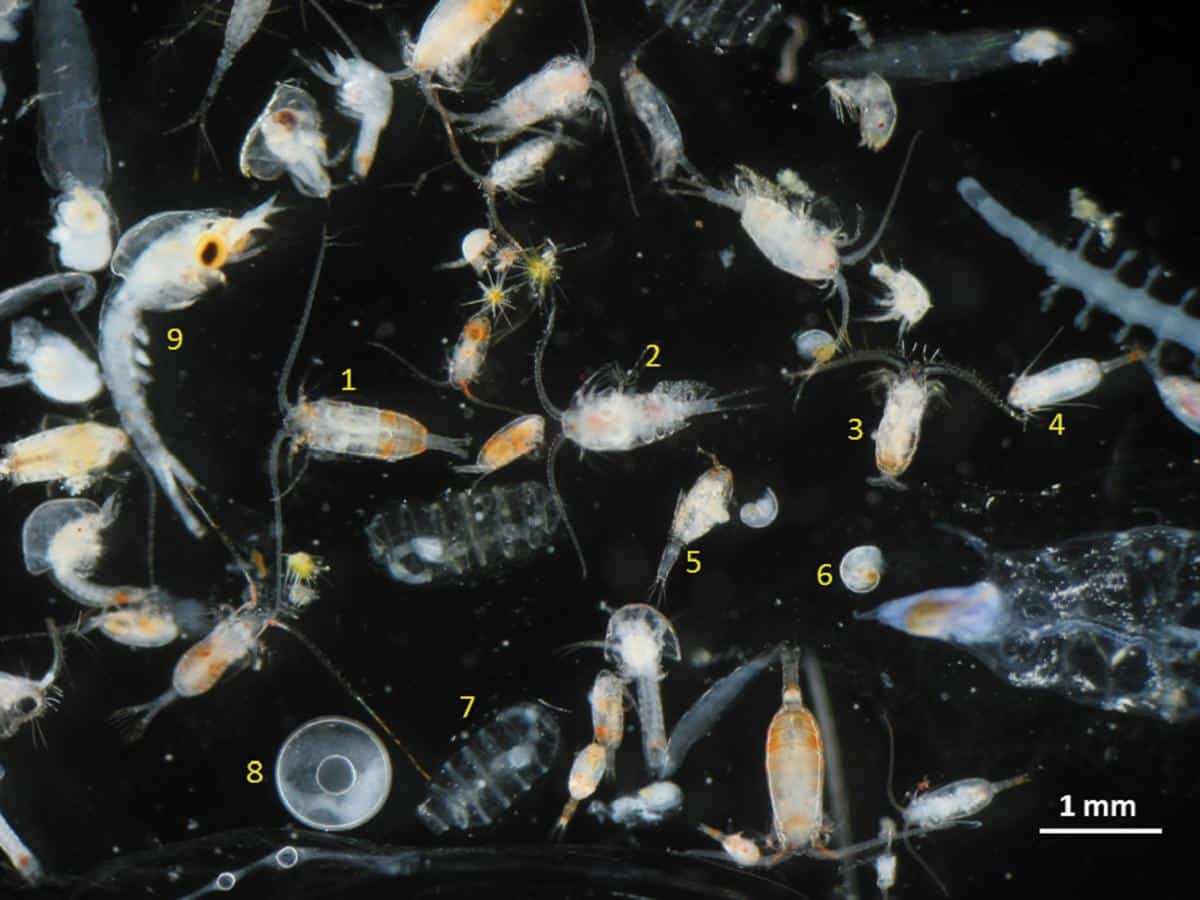
In biology it is said that the small is abundant, while the large is scarce. This statement is extracted from its constant reflection in nature and is applied to study in environments as different as the marine environment or a laboratory.
In aquatic ecosystems there is a group of really small organisms that, once again, abound to surprising levels and that are capable of maintaining the stability of the food chain almost anonymously. This group is called plankton, but within it there are two main types. One of them is zooplankton, which is made up of animals. If you want to learn about what zooplankton is and examples of it, as well as its great importance on the planet, we invite you to read this BIOencyclopedia article about this interesting animal group.
What is zooplankton and where does it live?
The fraction of plankton that has animal cellular organization is known as zooplankton, that is, whose cells are animal type. It can be stated then that zooplankton is the group of aquatic animals, generally of microscopic size (although they can also be simply small visible to the naked eye), that lives in suspension in the water column.
With this small set of characteristics this group of organisms would be clearly defined, but there are more characteristics of zooplankton that are worth highlighting:
- As they are animals, their trophic type is heterotrophic, that is, they obtain their organic matter from other living beings.
- Although the vast majority of species have locomotion systems that allow them to move, this does not help most of them to overcome the movement of water due to the action of the tides, so they tend to drift while floating.
- It can be found both in seas and oceans, constituting marine zooplankton, and in freshwater masses, constituting lentic and lotic zooplankton.
Compiling all this, it is extracted that zooplankton live in masses of water, both fresh and salty, throughout the entire planet.
We recommend you read this article about Plankton: what it is and types.
What do zooplankton feed on?
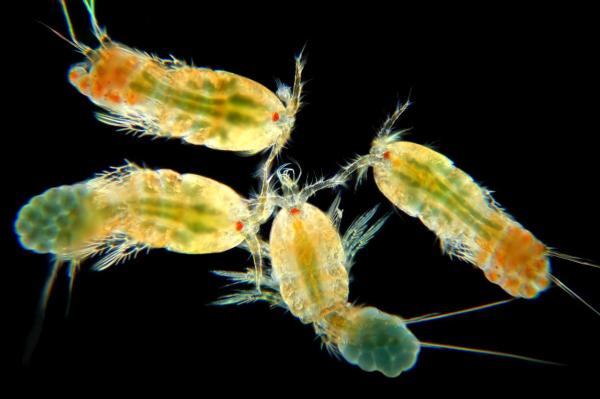
All animals that make up zooplankton, that is, all animal plankton, take the carbon they need from other living beings and then incorporate it into their own organic matter. This is essentially the same thing that people do when eating and, therefore, both zooplankton and humans are heterotrophs.
So what do zooplankton feed on? The answer is simple. Zooplankton feed on phytoplankton and zooplankton. That’s right, they consume the plant microorganisms present in the plankton, that is, the phytoplankton, and they also consume other animal organisms from the plankton.
The source from which living beings obtain their carbon makes them position themselves in one place or another in the food chain. Zooplankton eat phytoplankton, which takes the place of primary producers, and other species of zooplankton. This places it in the place of primary consumers, serving as a link in the complex trophic chain between primary producers (phytoplankton) and secondary consumers (in the areas where zooplankton lives, these are their predators, such as invertebrates, fish, mammals and birds).
Examples of zooplankton
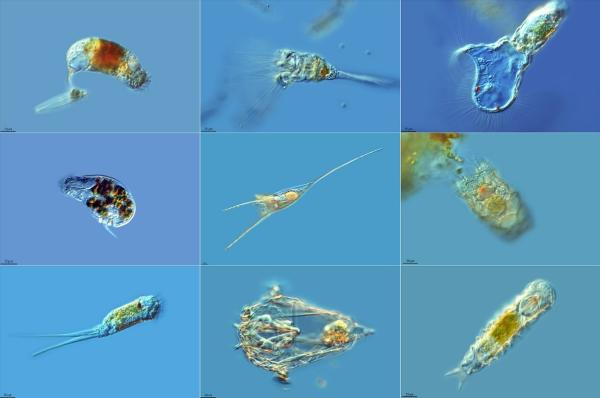
Within this group you can find very diverse species, from small crustaceans to larvae or transitional stages of fish, including even unicellular organisms. This tells us that zooplankton is not made up of species with a common ancestor, that is, it is not an evolutionarily defined group, but rather it is a group of organisms that has been created to practically refer to a wide variety of aquatic animals, very small and that fulfill the trophic function of primary consumers.
Examples of zooplankton according to time
A common classification of zooplankton takes into account the time during which each species is part of the plankton. In this way it has traditionally been differentiated between:
- Holoplankton: composed of what we generally imagine when we think of plankton, which are organisms that maintain their characteristics throughout their lives, being small in size, primary and aquatic consumers. Two examples are copepods and the small crustaceans that form krill schools.
- Meroplankton: this group is made up of transient forms or larvae of organisms that, when they are adults, are not included in what we know as plankton. Larvae of fish, mollusks and crustaceans abound.
Examples of zooplankton according to their size
Another fairly widespread and general classification is the one carried out based on the size of the species, giving rise to a separation into four groups:
- Nanoplankton: sizes less than 75 microns (one micron corresponds to one thousandth of a millimeter).
- Microplankton: ranges from 75 microns to 1 millimeter in length.
- Mesoplankton: between 1 and 5 millimeters, this group includes the majority of zooplankton.
- Macroplankton: organisms larger than 5 millimeters.
Examples of most representative zooplankton
On the other hand, due to the great diversity of the group, examples of zooplankton species are almost innumerable, but it is true that some may have greater representation in nature, either due to their role in ecosystems or simply due to their high population. Some of them can be found below:
- Copepods: it is one of the most diverse groups of crustaceans that exists. In general terms, they have a flattened, translucent body without a shell. They usually have swimming appendages on the front part of the body, which is separated from the back part by a complex joint. Despite its small size of 1-5 millimeters in length, its collective biomass exceeds one billion metric tons in all marine and fresh waters on the planet. Due to their abundance, they often dominate the level of primary consumers in aquatic communities. In marine ecosystems, the copepod Calanus is often the most abundant zooplankton organism.
- Euphausiaceae: this group comprises only 90 species, which contrasts with the copepods, but is instead the main representative of the group known as krill. They generally look like a shrimp, 3 to 6 millimeters long, with all of their thoracic segments fused into a shell that partially exposes the gills. Most species have an organ called a photophore that allows them to emit chemical light through the process of bioluminescence.
- Radiolarians: they are unicellular organisms whose main characteristic is the outward emission of filaments composed of silica that serve for protection and flotation.
- Cnidarians: they are a group of animals that have two well-differentiated forms in their life cycle. One of them is sessile (lives attached to the substrate), so it is not part of the plankton, and is known as the polyp phase. The second is free-living, swimming and is called the jellyfish phase. That’s right, this phase corresponds to the jellyfish that we all know and the small ones are part of the zooplanktonic community. The name of the group comes from its main characteristic, cnidocytes, cells that house stinging organelles called nematocysts, responsible for the well-known bites of these animals. They also have a reduced third phase in which they generate a planula larva with the ability to swim that is also included in the plankton group. Since they are only part of the zooplankton during their jellyfish and larval stages, cnidarians are an example of meroplankton. In this other article you can read more about the Medusa.
Importance of zooplankton
Although due to their small size it may be thought that these organisms are unimportant, their small size is precisely one of the main reasons why zooplankton is highly relevant, both in nature and in artificial environments.
Firstly, their function as primary consumers means that they carry the weight of almost the entire food chain on their small bodies, serving as a link between primary producers (the lowest level of the chain) and secondary consumers. They constitute the basis of the diet of animals as diverse as the blue whale, the mallard, the flamingo and the mussel.
Knowing the great relevance of its trophic function, it is not surprising that the plankton animal community is considered a good indicator of water quality in aquatic ecosystems throughout the planet, since if certain representatives of zooplankton do not exist in them, the food chain can become seriously destabilized.
On the other hand, although again related to its trophic role, zooplankton is commonly used by humans for raising fish in the food industry, being one of the highest quality types of food that can be offered to fry. A widely known example of feeding newborn fish in aquaculture is brine shrimp nauplii.
Differences between zooplankton and phytoplankton
Although phytoplankton and zooplankton together make up the planktonic community, there are some important differences between both groups:
- While zooplankton is made up of animals, phytoplankton is made up of plant species.
- Their metabolic type is different, zooplankton being heterotrophic, as we have already mentioned, while phytoplankton is autotrophic. This means that phytoplankton are capable of capturing carbon that they subsequently use to form their own organic matter from inorganic compounds, without having to obtain it from other organisms by feeding on them.
- These two previous characteristics define the space in which each of these groups usually live. Zooplankton do not require sunlight to carry out their vital activity, at least not directly. On the other hand, phytoplankton do need direct sunlight to carry out photosynthesis. This causes the phytoplankton to be distributed throughout the most superficial areas of the water column, that layer to which sunlight still penetrates and which is called the photic layer. For its part, zooplankton can be distributed beyond the photic layer, although it is concentrated in the photic layer and several tens of meters deeper because at these depths they find more oxygen and food.
If you want to read more articles similar to Zooplankton: what it is and examples, we recommend that you enter our Ecosystems category.
- Hickman et al (2009). Comprehensive principles of zoology. Fourteenth edition. McGraw-Hill.
- Conde-Porcuna et al (2004). Zooplankton as a member of the trophic structure of lentic ecosystems. Water Institute, University of Granada.
