
For the first time a satellite has captured a powerful tsunami in detail: the analysis of this data could improve prediction models.
A NASA and CNES satellite observed a tsunami with a level of detail never achieved before, paving the way for more accurate models and, in the future, more timely and effective warning systems.
The satellite born with another task. The protagonist of the story is SWOT (Surface Water and Ocean Topography), the satellite launched in 2022 with the aim of measuring the height of water surfaces across the planet – from oceans to large lakes, from rivers to coastal currents. Its key technology, a Ka-band interferometric radar (a type of radar that uses high-frequency, Ka-band radio waves and two antennas that work together to measure very precisely the differences in height of the water surface), allows it to acquire images of the sea surface over very wide swaths, with a resolution that far exceeds that of traditional altimetry satellites.
In the right place, at the right time. For years SWOT has worked studying minor currents and very subtle variations in sea level. Then, on July 29, 2025, a magnitude 8.8 earthquake in the Kuril Islands-Kamchatka subduction zone, off eastern Russia, generated a powerful tsunami in the North Pacific. Just then, SWOT was flying over the area.
X-ray of a tsunami. The intersection between satellite data and measurements from three buoys from the DART (Deep-ocean Assessment and Reporting of Tsunamis) system allowed researchers to obtain the first complete “x-ray” of the propagation of a tsunami wave in the open sea. What emerged surprised experts: the tsunami did not behave as a single large compact wave — as many models suggested — but showed an evident dispersive structure, fragmenting into a main front and a series of smaller waves that followed it at a distance.
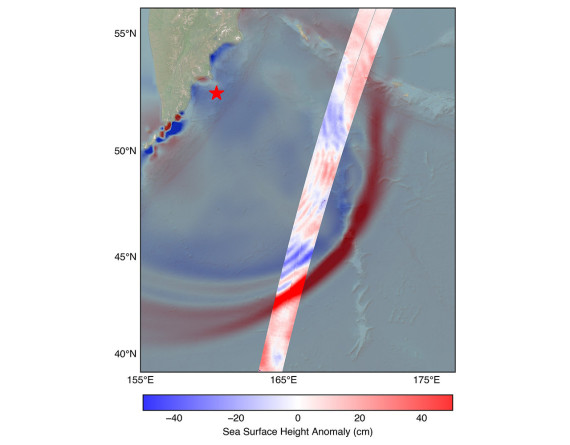

A revolution. Traditionally, in fact, tsunami models – especially those generated by strong subduction earthquakes – assume that these waves are not dispersive. This means that the energy is concentrated in a single large wave or in a very compact front, all the components of the wave (different wavelengths) also travel more or less at the same speed and during propagation in the open sea the tsunami maintains a stable shape, changing very little before arriving close to the coasts.
This idea derives from the fact that tsunamis have enormous wavelengths (hundreds of kilometers) and a very long period (from 10 to 60 minutes): in these conditions, classical theory predicts that dispersion is negligible.
The SWOT satellite measurements indicate, however, that the 2025 tsunami was not a single wave. It did not show a single clear front, but a more complex structure. Furthermore, the front has fragmented into several components. The data shows a very energetic main front, followed by a “tail” of smaller, but clearly organized and coherent waves. This fragmentation is typical of dispersive phenomena and in a dispersive wave, the different wavelengths travel at different speeds and the wave “fades”, widens or breaks up.
Why dispersion is important (and unexpected). The idea that an ocean tsunami could be more dispersive than expected It is surprising because it implies that energy does not propagate in a single “block” and suggests that the interaction with the bathymetry (the shape of the seabed) may be more complex than previously thought, making wave behavior less predictable with current models, which assume little or no dispersion.
Consequently, the timing of arrivals on the coasts can change, because individual subcomponents can slow down or accelerate, it can influence the distribution of energy: not only the first wave can be dangerous, but also the subsequent ones.
Because only SWOT was able to see it. Previous satellites observed the tsunami as a single line of data, passing perpendicular to the front: too little to understand the three-dimensional structure of the wave. SWOT, on the other hand, observes a band up to 120 km wide, measures the surface height with a resolution of a few centimeters and allows the entire shape of the wave to be reconstructed, not just a profile.
This new “top view” made it possible to detect features that were previously completely invisible. “SWOT is like a new pair of glasses,” explains Angel Ruiz-Angulo, physical oceanographer at the University of Iceland and first author of the study published in The Seismic Record. «With the data from the buoys we could only see the tsunami in isolated points of the ocean. Previous satellites showed, at best, a single streak across the disturbance. SWOT instead offers us an image up to 120 kilometers wide, with a resolution we have never had before.”
This ability allows us to capture not only the height of the wave, but also its overall shape, lateral variations, dispersion and interaction with ocean bathymetry. For scholars, this is invaluable information: knowing better the structure of a tsunami in the open sea means significantly improving the numerical models used to predict when and how it will hit the coasts.
Improve forecasts. SWOT and similar future satellites could contribute to near-real-time monitoring of tsunamis, complementing traditional buoy- and seismograph-based systems. It would not be a question of replacing existing networks, but of supporting them with a new observation capacity capable of “seeing” the wave as a whole.
