
Throughout life, the brain goes through five crucial moments in which it reconfigures and reorganizes its connections: here’s when they are.
Over the course of life we go through some moments that mark a profound transformation: for the brain there are four, and they delimit five different phases of our way of growing, maturing and thinking. Scientists at the University of Cambridge have identified four crucial turning points at which the brain reconfigures itself, redefining the organization of its brain connections. According to the study, published in Nature Communicationsthese moments of maturation would occur around the ages of 9, 32, 66 and 83.
Child brain: 0 to 9 years
The scientists compared brain scans of more than 3,800 people aged 0 to 90 by drawing on databases of brain MRIs, which map neural connections by observing how water molecules move through brain tissue. Starting from birth, brain connections develop following roughly the same pattern up to the age of 9. In this first phase, a consolidation of the network of connections prevails, in which the excess synapses (connections between neurons) are reduced through the process of pruning or pruningwhile the most useful and active ones survive.
The brain increases in volume, the gray matter (the set of the bodies of the neurons) and the white matter (the set of the axons, the extensions of the neurons) grow and with them the thickness of the cerebral cortex. The cortex, the layer that presides over the main cognitive functions, reaches a peak in thickness and its characteristic folds stabilize.
Adolescence? It ends at 32 years old
At 9 years old the brain switches to the next organizational mode, that typical of adolescence: it is a delicate moment in which cognitive abilities are transformed and the risk of mental disorders increases. In this second phase the white matter, the part of the brain tissue that contains the nerve fibres, continues to develop, the communication networks between neurons become increasingly efficient and refined even within specific regions, up to a peak at the beginning of the 30s: the “strongest turning point” of the entire life span, among those identified by scientists.
“Around age 32 we observe the greatest directional changes in wiring,” explains Alexa Mousley, the neuroscientist who led the research. “Based solely on neural architecture, we found that changes in brain structure typical of adolescence end around the age of thirty.”
The longest era
The adulthood phase is characterized by a stable brain architecture, which remains for a long time without major turning points, in which intelligence and personality reach their maximum expression and in which brain regions begin to become more compartmentalized. This gradual reorganization of brain networks reaches its peak around age 66, when a gradual decrease in brain connectivity begins due to white matter degradation.
This is also a rather delicate moment due to the risk of contracting pathologies that affect the brain.
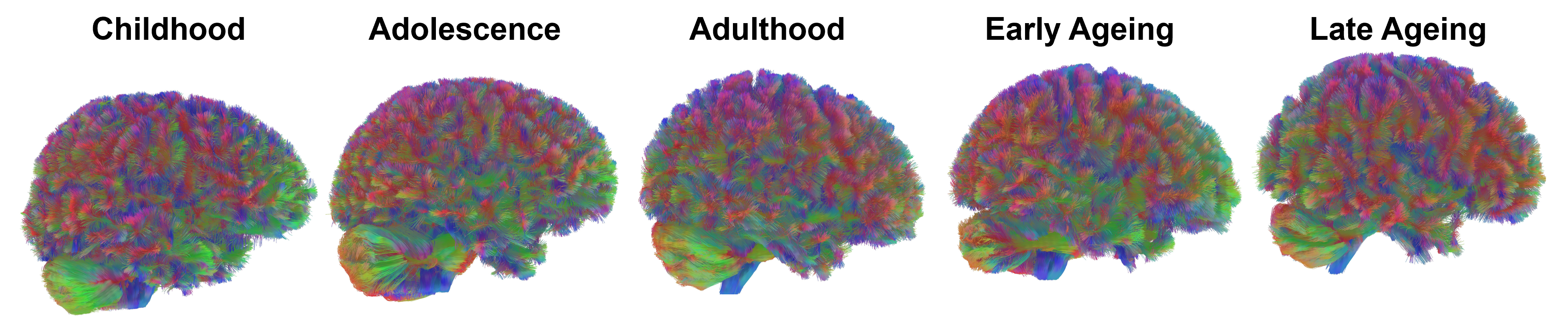
The more mature age
The most advanced phase of brain maturity begins, in which brain connectivity is further reduced and switches to a more local dimension, which relies more on certain regions.
According to the authors of the study, a better knowledge of the way the brain is “wired” at various stages of life will help to better understand which conditions we are most vulnerable to at different stages of life.
