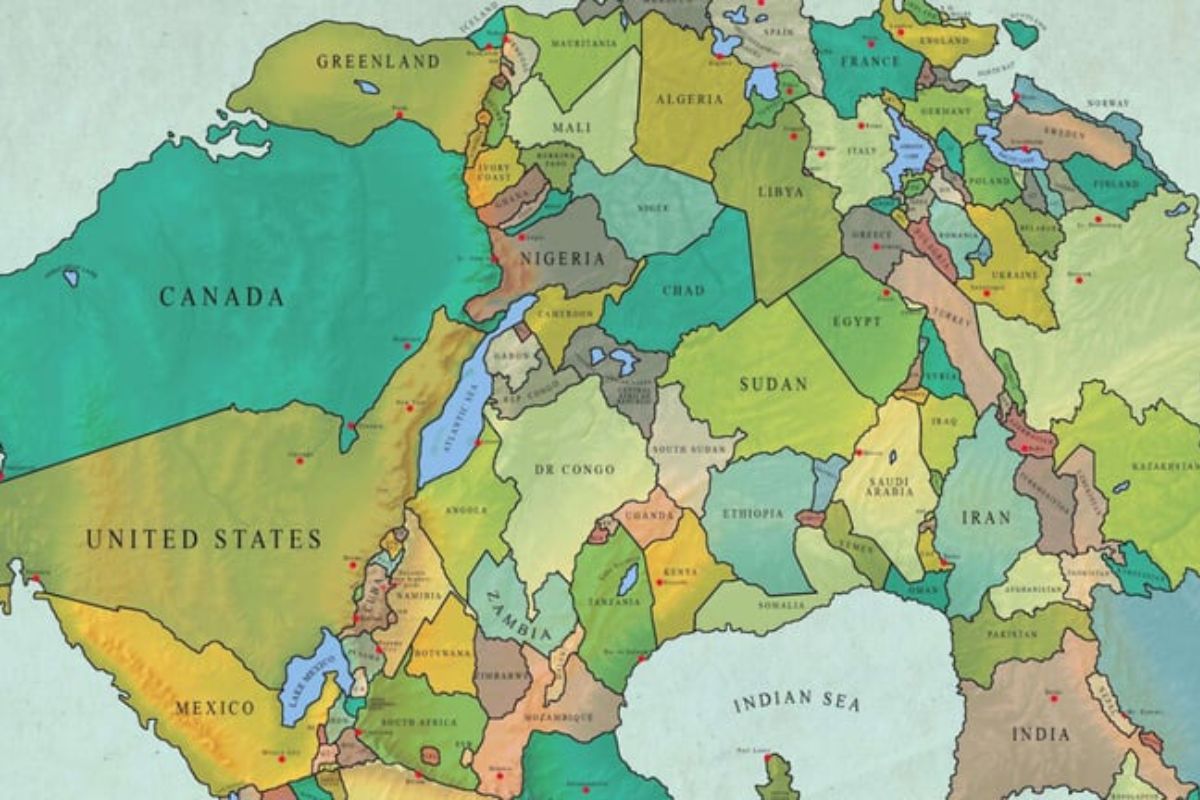
According to geologists, the Earth as we know it today is just an ephemeral stage in the history of our planet. In 250 million years’ time, all the currently separate continents could come together to form a gigantic supercontinent, known as Pangea Ultima.
Pangea Ultima: the Earth is closing in on itself
Around 200 million years ago, the original Pangea broke up to form the continents we know today. But this separation is not definitive. The tectonic plates continue to move slowly, colliding, moving apart or sliding under each other.
According to Christopher Scotese, the geographer behind the PALEOMAP project, this dynamic will inexorably lead to a new convergence of the Earth’s masses. Within 250 million years, the Atlantic will have disappeared, absorbed by the convergence of the Americas with Africa and Eurasia. The Indian Ocean will then become the new inland sea of this supercontinent, around which familiar but profoundly reshaped territories will be distributed.
An unprecedented neighbourhood for France
In this future configuration, France could find itself in a strategic position, close to the North Pole and bordered not only by Spain, Portugal and Italy, but also by North African countries such as Morocco, Algeria and Tunisia. This unprecedented geological proximity has been made possible by the disappearance of the Mediterranean and the northward movement of Africa.
The rest of the world will also see some astonishing upheavals: Cuba will merge with the United States, Korea will be caught between China and Japan, and Greenland will move closer to Canada.
A climate hostile to life
But this spectacular recomposition will not make everyone happy. A study published in Nature anticipates a mass extinction of mammals, caused by extreme climatic conditions. Climate simulations of Pangea Ultima indicate temperatures in excess of 40°C over the majority of the surface, as well as a concentration of CO₂ twice that of today, caused by intense volcanic activity generated by the collision of the plates.
Added to this is a slightly brighter Sun – by around 2.5% – which will accentuate the overall heat and make the planet more arid and inhospitable.
A possible refuge zone in the north
Despite this worrying picture, all may not be lost. Zones located at the northernmost latitudes, close to the current Arctic Circle, could offer climatic respite, with more bearable temperatures and access to more stable water resources.
France, with its regions rising towards this temperate zone, could then be one of the few habitable areas in this new world. The same applies to the UK, Portugal and parts of North Africa.
The formation of a supercontinent is not an isolated phenomenon. The Earth’s geological history is marked by a succession of cycles of continental melting and separation. Other models, such as Aurica, Novopangaea and Amasia, propose variations on this recomposition. But they all lead to the same conclusion: the Earth is in perpetual transformation, and the apparent stability of our borders is only a geological moment.
