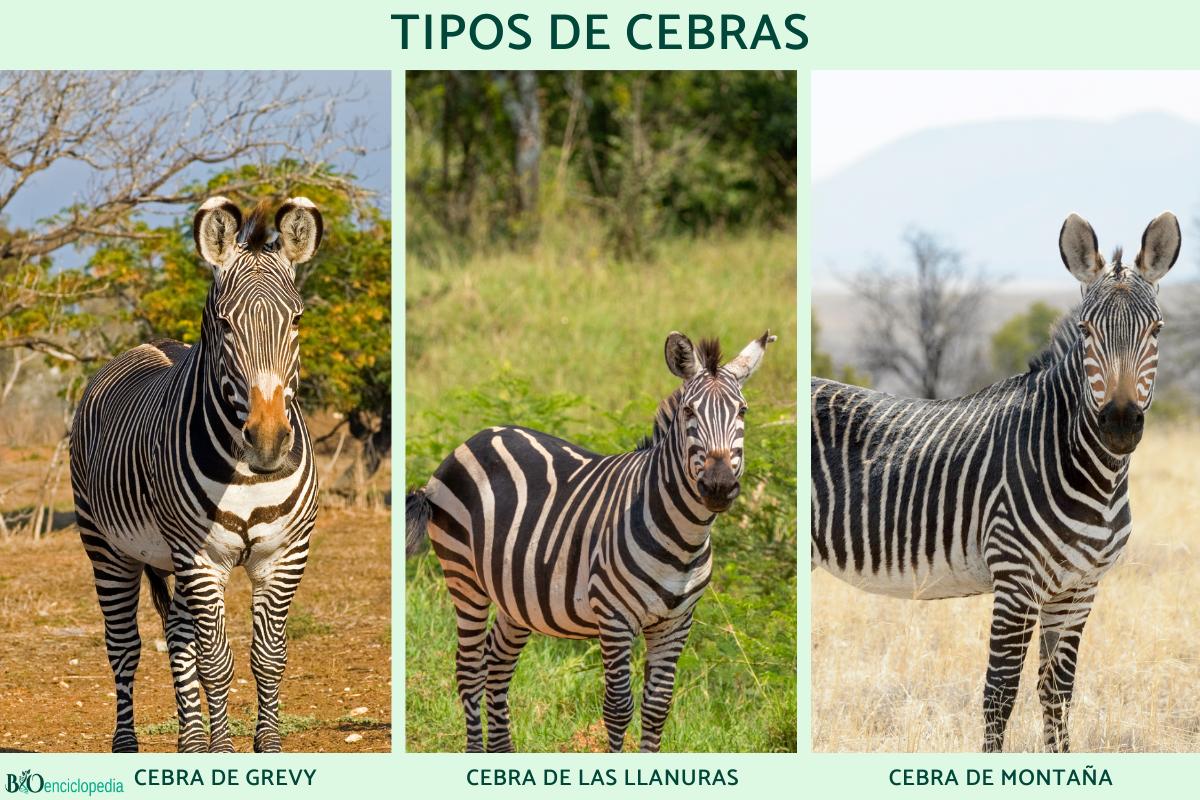
The zebra is a herbivorous African mammal known for its unique black and white stripes, which vary in each individual. Three types of zebras are recognized that belong to the genus Equus: Grevy’s zebra (Equus grevyi), plains zebra (Equus quagga) and mountain zebra (Equus zebra). If you want to know about the types of zebras, keep reading this BIOencyclopedia article.
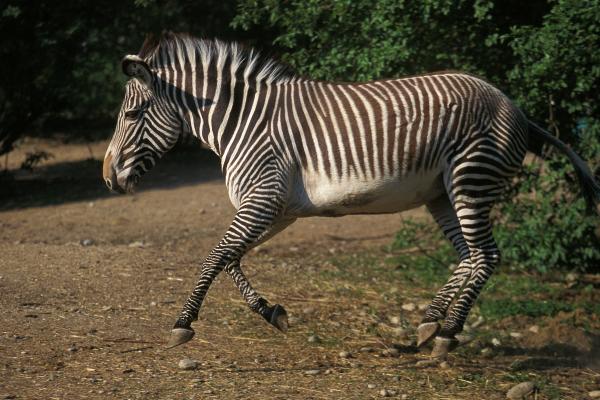
Grevy’s zebra (Equus grevyi)
Grevy’s zebra is distributed in northeastern Africa, mainly in northern Kenya and in small isolated populations in southern Ethiopia. Historically, it also inhabited parts of Somalia, Eritrea and Djibouti, but is now considered extinct in those places. The characteristics of zebras of this species are notably distinguished from others: it is the largest species of wild zebras, with a more robust body, elongated head, large ears and fur with very narrow black stripes that reach to the legs, while the belly is white, without stripes. The habitat it chooses is semi-arid savannas, stony plains and scrubland, where water sources are scarce and competition with livestock can be intense.
This zebra feeds mainly on grasses, legumes and shrubs, and can survive several days without drinking water thanks to its ability to process relatively low-quality vegetation. Regarding reproduction, gestation lasts approximately 13 months, the longest among equids, after which a single offspring is usually born that remains with the mother for the first few days before reintegrating into the occasional group. Regarding its conservation status, it is listed as “Endangered” by the IUCN, with estimates of only about 2,000 mature animals in the wild, mainly due to habitat loss, competition with domestic livestock and the fragmentation of its range.
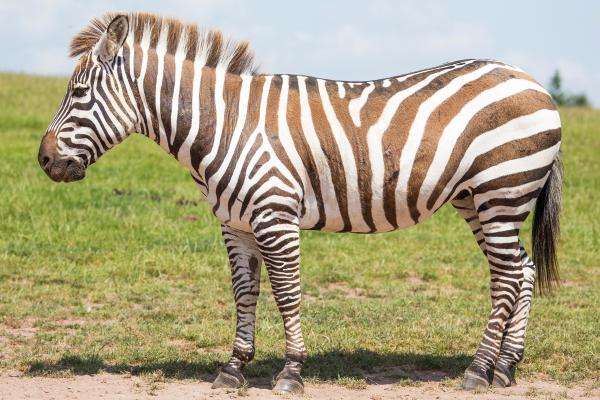
Plains zebra (Equus quagga)
The plains zebra is the most abundant and widely distributed zebra species in Africa. Its range extends from southern Sudan and southern Ethiopia southward through Kenya, Tanzania, to Namibia and northern South Africa. Despite this breadth, populations are fragmented and some subspecies have locally disappeared. Morphologically, they feature the classic pattern of relatively wide black and white stripes, a medium build compared to other zebras, and adapted for a life of constant grazing on open plains. Its habitat includes grasslands, savannas, shrublands and broken bushveld, from sea level to altitudes of up to 4,300 m on Mount Kenya.
As for food, it consumes mostly grasses, more than 90% of its diet, comprising around 50 different species of grasses, and during periods of scarcity it can resort to bark or rhizomes. Plains zebra reproduction occurs when the female reaches 3 to 4 years of age to give birth for the first time, and males form harems that they control for access to females. In terms of conservation, the species is classified as “Near Threatened” by the IUCN, with more than half a million estimated individuals, but with declines of up to 25% during the 1990s and 2000s in several states of its range.
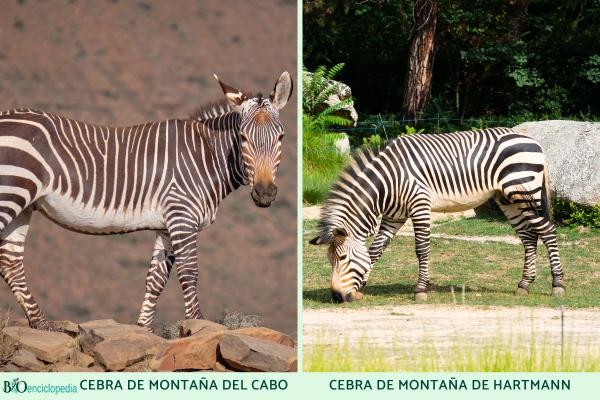
Mountain zebra (Equus zebra)
The mountain zebra is found exclusively in southwestern Africa, with two subspecies:
- Cape mountain zebra (Equus zebra zebra) in the Western and Eastern Cape provinces of South Africa.
- Hartmann’s mountain zebra (Equus zebra hartmannae) in Namibia and southwestern Angola.
Morphologically, this species is medium-small compared to other zebras, it has the typical stripes that reach the hooves, and a white belly in some cases. These characteristics of zebras of this species allow them to better adapt to steep terrain. Its shoulder reaches between approximately 1.16 and 1.50 m, and the weight is around 240-370 kg. Its habitat is made up of mountainous slopes, rocky slopes, plateaus and high-altitude grasslands, living even up to about 2,000 m above sea level, and adapting better than other zebras to rugged terrain and more dispersed vegetation.
As for food, mountain zebras are herbivores, whose diet consists mainly of grasses, although when vegetation is scarce they resort to shoots, bark or roots; They usually live in smaller groups than plains zebras. In breeding, breeding herds consist of an adult stallion and several mares with their offspring; Gestation is around 12 months and foals usually leave the maternal group between 13 and 37 months, depending on the subspecies. Regarding the conservation status, the species is classified as “Vulnerable” by the IUCN.
Now that you know the types of zebras, discover the Okapi.
If you want to read more articles similar to Types of zebras, we recommend that you enter our Biodiversity category.
- African Wildlife Foundation. (sf). Grevy’s Zebra. https://www.awf.org/wildlife-conservation/grevys-zebra African Wildlife Foundation
- AnimalFactGuide. (sf). Plains Zebra Facts | Common Zebras | Equus quagga. https://animalfactguide.com/animal-facts/plains-zebra/ Animal Fact Guide
- Animal Diversity Web. (sf). Equus zebra. https://animaldiversity.org/accounts/Equus_zebra/ Animal Diversity Web
- IELC LibGuides. (2015-2019). Plains Zebra (Equus quagga) Fact Sheet. San Diego (CA): San Diego Zoo Wildlife Alliance. http://ielc.libguides.com/sdzg/factsheets/plains_zebra
- IUCN. IUCN Red List of Threatened Species. https://www.iucnredlist.org/
