
For the first time it was possible to determine the mass and distance of a planet orphaned from its star, thanks to the gravitational lensing method.
A wandering planet, one of those worlds that float alone in space, practically invisible and without any reference star, has become a little less mysterious for the first time thanks to the effects of its gravity, and the teamwork of various telescopes. It was in fact possible to determine the mass and distance from the Earth of the celestial body: an unprecedented feat, described in an article on Science.
Where the rogue is located (and how much it measures)
KMT-2024-BLG-0792, or OGLE-2024-BLG-0516, the two scientific names attached to the same rogue planet (literal translation of the English term rogue planetgiven to starless planets), is located 9,950 light-years from Earth towards the center of the Milky Way, and has a mass roughly 70 times greater than our planet – not far from that of Saturn, which has a mass 95 times greater than Earth’s. According to Gavin AL Coleman, researcher at Queen Mary University of London and author of the study, this type of planets would be much more widespread in our galaxy than we think.
Wandering planets: what they are
Wandering planets, also called interstellars or orphans, are thought to have been knocked out of their systems by passing stars or other factors; without any type of gravitational bond, they wander through interstellar space, and are very difficult to observe: usually, in fact, the identification of “normal” exoplanets is based on the transit method, that is, it emerges from the periodic decrease in the brightness of their parent star or from its slight oscillation due to the gravity of the planet itself.
Magnifying glass
Without a reference star these methods are not practical, and furthermore, as they do not emit light on their own and without nearby light sources, the wandering planets are practically invisible. What came to the rescue was the phenomenon of gravitational microlensing (microlensing), the temporary distortion and amplification of the light of a distant star due – in this case – to the gravity of the wandering planet, passing between the star and the observer (a telescope).
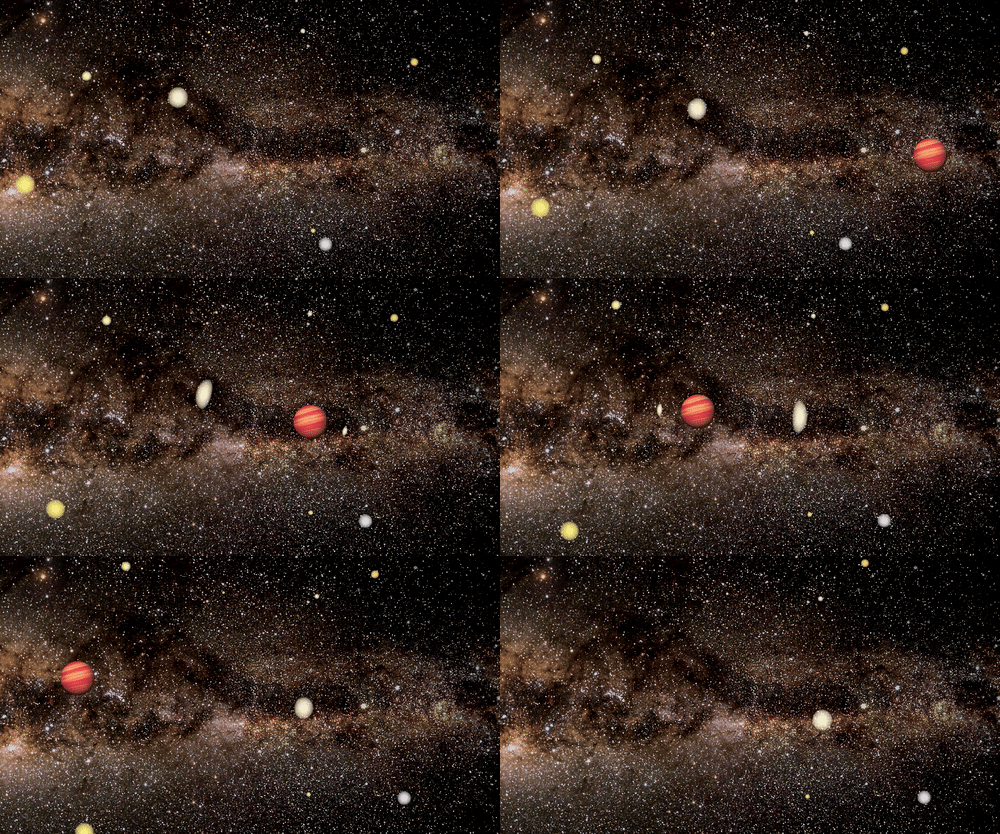
By observing the microlensing event from two different vantage points, from Earth with different telescopes and from Space thanks to the ESA Gaia satellite, astronomers managed to triangulate the distance of the wandering planet from Earth. And once they estimated the distance, they were able to calculate its mass by measuring how long its gravitational field had distorted the light of the distant star. Using the same method, the next generation of space telescopes could detect many more wandering planets in our galaxy.
