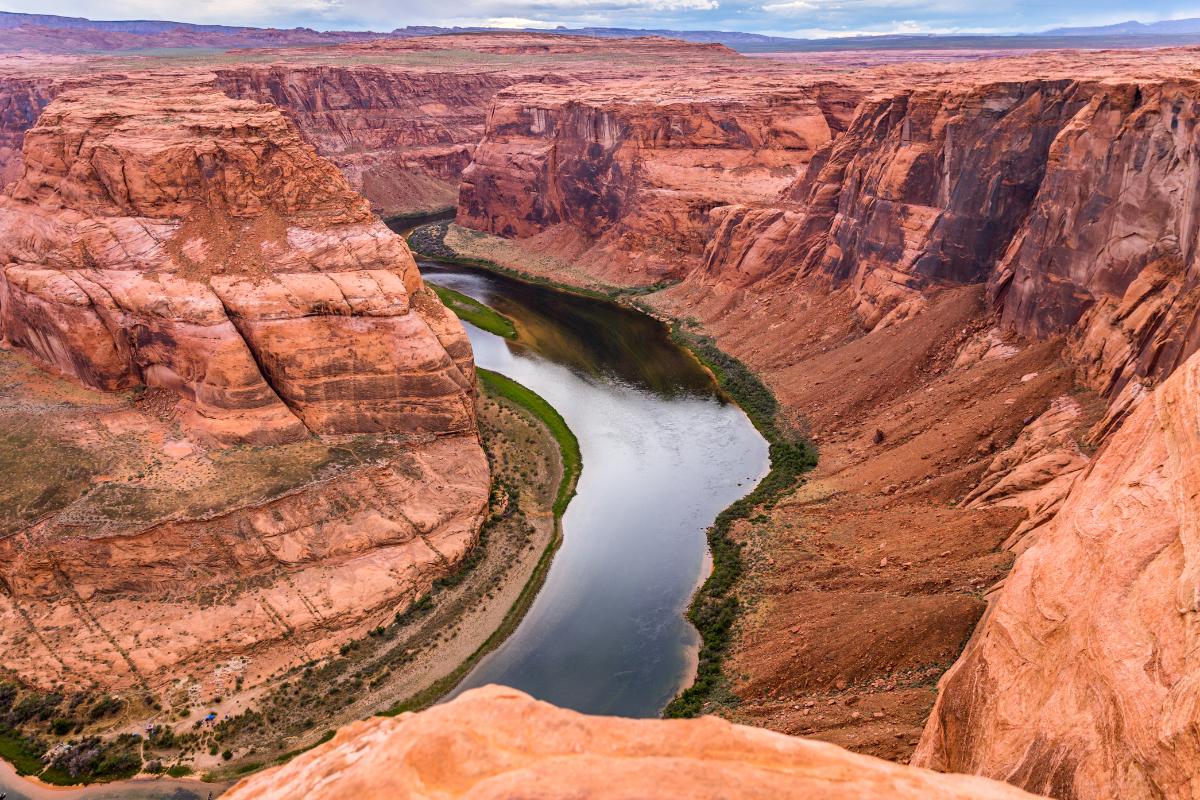
A canyon is a geographical formation characterized by a deep, narrow valley with steep walls, caused mainly by the erosive action of a river over millions of years. This type of relief can be found in different parts of the world and usually reveals geological layers that allow the history of the terrain to be studied.
In this Evidence Network article we explain what a canyon is and how it is formed, as well as some examples and their importance.
What is a natural canyon
A canyon in geography is a geographical formation that is characterized by being a deep and narrow valley, with steep or almost vertical walls, carved mainly by the action of a river over millions of years. It is formed when running water, usually from a river, slowly wears away the rock in the ground, carving out a gorge that becomes increasingly deeper with the passage of time. This process is known as fluvial erosion and occurs gradually, but constantly, affecting especially areas with softer or fractured rocks.
River canyons can vary greatly in size and appearance. Some are only a few meters deep and long, while others, such as the famous Grand Canyon of the Colorado in the United States, reach colossal dimensions: more than 400 kilometers long, up to 30 kilometers wide and a depth that exceeds 1,600 meters in some points. These gigantic formations are not only visually impressive, but they are also open windows into the geological history of the Earth, as they allow us to observe rock strata that have accumulated over millions of years.
How a canyon is formed
The formation of a canyon is a slow and complex process that mainly involves the action of water, time and the composition of the terrain.
- It all starts with a river flowing over a relatively uniform land surface. As water flows, it carries with it small particles of sediment such as sand, gravel, and rocks. These particles, in constant friction against the river bed, function as a kind of natural sandpaper that progressively wears down the soil.
- This constant wear is known as vertical erosion, and is the main mechanism responsible for the excavation of the canyon. The greater the flow and speed of the river, the more effective its cutting capacity will be. In areas where the terrain is steeper, water flows more strongly, accelerating the erosion process. Over time, this results in a deeper and deeper indentation in the Earth’s surface.
- However, erosion alone is not enough to create a large canyon. This is where other factors come into play, such as the geology of the terrain. If the land is made up of layers of different types of rock, some softer than others, the river will erode the less resistant layers faster.
- Tectonic movements also influence. If a region experiences land uplift, the river continues to erode downward to maintain its course, deepening the canyon even further.
- Another important aspect is lateral erosion. Over time, the edges of the canyon are also affected by wind, rain, snowmelt, and other weather agents. This slowly widens the walls and modifies its original shape, although the canyon continues to maintain its main structure in the shape of a “V” or “U”, depending on the geological characteristics.
In this other article you can learn about Water Erosion: definition, types, causes and consequences.

Examples of cannons
These are some of the best-known canyons in the world:
- Grand Canyon of the Colorado (United States): It is, without a doubt, the most famous canyon in the world and one of the most studied. It is located in the state of Arizona and was carved by the Colorado River for more than 6 million years. It measures approximately 446 kilometers long, up to 29 kilometers wide and almost 1,800 meters deep.
- Colca Canyon (Peru): This canyon is one of the deepest on the planet, with more than 3,200 meters deep in some sections, double that of the Grand Canyon. It is crossed by the Colca River and surrounded by majestic volcanoes and Andean towns.
- Sumidero Canyon (Mexico): Located in the state of Chiapas, this canyon is a natural symbol of the country. Its vertical walls reach heights of up to 1,000 meters, and the Grijalva River runs through it on a path that offers spectacular landscapes.
- Tara Canyon (Montenegro): This European canyon is located in the Durmitor National Park and is considered the deepest on the continent, with a depth that reaches 1,300 meters.
- Lobos River Canyon (Spain): Located between the provinces of Soria and Burgos, this canyon has been excavated by the Lobos River through limestone rock formations. It is a mix of geology, nature and history, since in its surroundings there are archaeological remains and medieval constructions. It is also a Natural Park, ideal for observing birds of prey.

Importance of cannons
These are some of the reasons why cannons are important and not just visually attractive:
- Geological and scientific value: Canyons offer a direct window into the Earth’s past. Thanks to its vertical walls, it is possible to observe strata or layers of rock that have been deposited for millions of years. Studying these formations allows geologists to understand the evolution of climate, tectonic movements, species extinctions and other significant geological events.
- Biodiversity and unique habitats: Although some canyons are located in arid or difficult-to-access regions, many are home to unique ecosystems. The depth of the canyon can create a microclimate different from that on the surface, allowing the existence of plant and animal species that are not found in other nearby places.
- Cultural and historical importance: Many canyons have been sacred or settlement sites for indigenous cultures or ancient civilizations. For example, native peoples such as the Hopi and Hualapai lived in the Grand Canyon of the Colorado, who still preserve traditions and spiritual ties with the area today.
- Economic and tourist resource: The canyons attract millions of tourists each year. Ecotourism and adventure tourism represent an important source of income for the regions where they are located.
If you want to read more articles similar to What is a canyon and how it is formed, we recommend that you enter our Other environment category.
- Renewables.blog. (sf). What are river canyons?. Recovered from https://renovables.blog/agua/que-son-los-canones-fluviales/
- Robledo, L. (1980). The enigmatic canons of Juan del Vado (Madrid?, ca. 1625–Madrid, 1691): News about his life (Review published by Verónica Rioja on Scribd). Journal of Musicology, 3(1/2), 129–196. Recovered from https://es.scribd.com/document/646809452/Canones-Juan-Vado-LIMIDO
- IngeoExpert. (2020, April 16). The Grand Canyon of the Colorado: how it was formed. Retrieved from https://ingeoexpert.com/2020/04/16/el-gran-canon-del-colorado-como-se-formo/?srsltid=AfmBOoqtChlVPqt-KHPNi-e8J7x9FawluPX-1yw_54k2Cly97r6UkNhb
