When we observe the sky with a telescope, the Universe appears as a riot of spectacular objects: billions of galaxies, each populated by hundreds of billions of stars, often with a huge black hole at the center and entire planetary systems in orbit. At first glance, it would seem natural to think that all – or almost all – the matter of the universe is concentrated right there, in these cosmic giants.
But no. According to the Big Bang theory, only about 5% of the total content of the Universe is made up of ordinary matter, that which is made up of atoms composed of protons, neutrons and electrons, that is, that which we see or can see. But here arises an enigma that has occupied astronomers for decades: visible stars and galaxies contain only a small fraction of them.
Where is the rest hiding? The most plausible answer, the result of years of studies, leads away from bright objects, into the dark space that separates galaxies. A space that, although often called “empty”, is not empty at all. Atoms and electrons are scattered in a giant filamentary structure that spans the cosmos: the so-called “cosmic network”.
«During my career as an astronomer I have studied this very network, and I know well how difficult it is to identify and measure such rarefied matter. Yet, a new study published in recent months has finally managed to complete the census of ordinary matter in the Universe, thanks to an innovative observation method”, explains Chris Impey, professor of astronomy at the University of Arizona.
A difficult census. The most obvious starting point for looking for ordinary matter is stars. Gravity collects them into galaxies, and galaxies can be counted in the observable Universe: they are estimated to number several hundred billion. Each galaxy in turn contains hundreds of billions of stars, although many wander isolated, outside of galactic structures.
Overall, astronomers estimate that there are about 10²³ stars — hundreds of times more than grains of sand on all the Earth’s beaches — and about 10⁸² atoms in the Universe. Impressive numbers, but still insufficient. Careful calculations show that stars contain just 0.5% of the universe’s matter. The rest of the ordinary matter — not dark matter or dark energy — must therefore be found elsewhere. Furthermore, only 0.03% of matter is made up of elements heavier than hydrogen and helium, such as carbon and other elements fundamental to life.
The invisible gas between galaxies. “The main missing deposit is the intergalactic medium, the space that separates one galaxy from another,” Impey continues. Here the density is extremely low: on average one atom per cubic meter, less than a billionth of a billionth of the density of Earth’s air. But given that the observable universe spans 92 billion light-years, even such a small density corresponds to an enormous amount of matter.
However, this gas is very hot – it reaches temperatures of millions of degrees – and for this reason it mainly emits X-rays. Observing it is difficult: X-ray telescopes are less sensitive and smaller than optical ones, making the census incomplete.
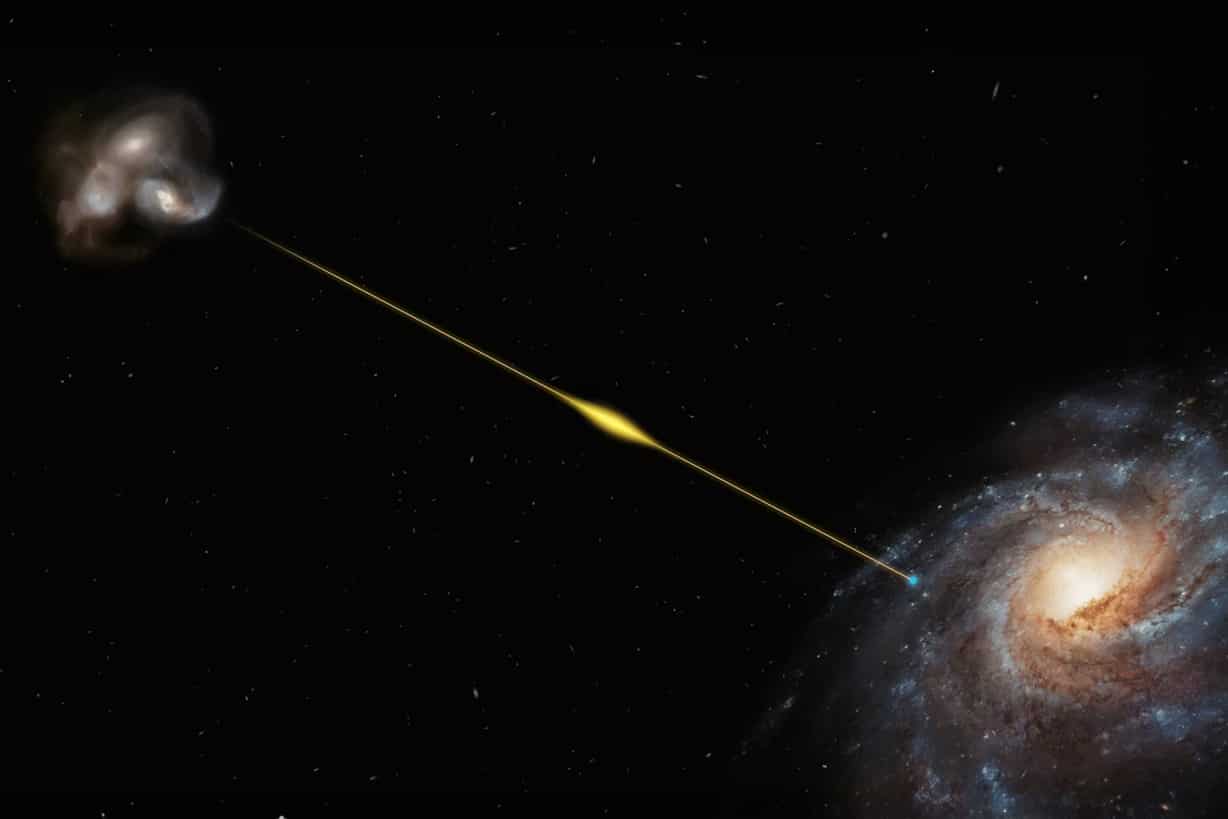
Radio bursts as new “cosmic probes”. The turning point came thanks to Fast Radio Bursts (FRBs): short but very powerful explosions of radio waves which, in just a millisecond, can emit the energy that the Sun produces in three days. Discovered in 2007, we now know that they come from distant galaxies and are probably generated by magnetars, ultracompact neutron stars with incredibly intense magnetic fields.
When a radio burst passes through intergalactic space, it interacts with electrons in the hot gas. Longer-length radio waves are slowed down more than shorter ones, producing signal dispersion similar to that of a prism breaking up light into a rainbow. By measuring this dispersion, astronomers can calculate how much matter the signal encountered along its path.
The puzzle reassembled. In one study, a team from Caltech and the Harvard Center for Astrophysics analyzed 69 fast radio bursts using a network of 110 radio telescopes in California.
The result was decisive: 76% of the ordinary matter in the universe is found in the space between galaxies, 15% resides in galactic halos, the regions surrounding galaxies, and only 9% is concentrated in stars and cold gas inside galaxies. This census represents a confirmation of the Big Bang theory, which precisely predicts the quantity of ordinary matter produced in the first minutes of the universe’s life.
A look beyond. Today, thousands of fast radio bursts are observed, and future networks of radio telescopes could discover 10,000 of them per year. With such large samples, these events will become very powerful tools for cosmology, allowing not only to count atoms, but also to map the cosmic web in three dimensions.
A great mystery, therefore, has been solved: we now know where almost all the ordinary matter in the Universe is found.
The cosmic picture remains incomplete. Most of the content of the Universe is composed of dark matter and dark energy, entities that are still largely unknown. Dark matter, in particular, exceeds ordinary matter by more than five times and manifests itself only through its gravitational effects, such as gravitational lenses that deform and amplify the light of distant galaxies. One enigma has been clarified, but the bigger one remains open. At least, however, today we know much better the fate of “normal” atoms: those that make up the stars, the Earth and ourselves.
