
Animals can live in terrestrial environments or in aquatic environments. Terrestrial animals are understood to be those that live all or part of their life on land, unlike aquatic animals that live predominantly or entirely in water. Let’s look at the characteristics of each group.
Characteristics of land animals
Those that live primarily on the ground are considered terrestrial, but the wide diversity of animals prevents all of them from being classified under this same parameter. That is, they share a terrestrial nature, but not all of them actually live on the ground, which is why the following classifications are distinguished:
- Arboreal: they are those that live on trees, such as the tree kangaroo (Dendrolagus) or the orangutan (Pongo).
- Saxicolous: they live between or on rocks, like hyraxes (Procaviidae).
- Sandflies: they live in the sand, like beach fleas (Talitrus saltator).
- Troglobes: are those that live inside caves, such as ghost snails (Zospeum tholussum).
- Aerial: flight is a fundamental part of their life cycle, and birds are a clear example.
Few animals are exclusive to the same subenvironment. For example, the tree snail (genus Achatinella) is 100% arboreal as it is only found in trees, and the common swift (Apus apus) is a bird that develops its entire life cycle in flight and only touches land for reproductive purposes.
However, there are also animals that combine sub-environments according to the stage in which they are found. For example, mosquitoes, dragonflies, among other insects, begin their larval stage in water and in the adult stage they have wings. Another example occurs with sea turtles, which despite spending a large percentage of their lives in the water, emerge regularly to inhale oxygen and the females go from the aquatic to the terrestrial environment to lay their eggs.
All land animals were part of the aquatic world millions of years ago. That is, our first ancestors and all the rest of the animals lived in the planet’s ocean, according to scientific research.
What we see today are the results of an evolution that began to develop from primitive land plants that emerged on dry land. The nutrients of the new soils, in addition to the energy provided by sunlight, favored the beginning of life and, in turn, its diversification. By this we mean that behind each land animal, there is a slow evolutionary process where each biological element had a radical adaptation for survival.
Research indicates that the first land animals appeared on Earth around 400 million years ago (Silurian Period) and moved by crawling on the ground. It is believed that among the first terrestrial organisms in the Earth’s evolutionary history are arthropods and insects.
First of all, the gravity of terrestrial life is very different from aquatic life. For this reason, land creatures have supportive tissues. Likewise, a type of skin or coat is required to prevent body fluids from leaking. Respiration is very important, because unlike aquatic organisms that exchange oxygen and CO2 dissolved in water, those that breathe through air need a different mechanism to carry out the inhalation and exhalation process.
In the reproductive aspect, water animals generally release eggs and sperm into the liquid that surrounds them; something very different from what happens outside there. On the other hand, the locomotion of terrestrial animals is very different from the locomotion of those that live in water, since the latter use certain movements and mechanisms for impulse, swimming, submersion, pursuit, etc., etc.
Finally, light, sound and smells travel and are perceived completely differently in both habitats. Pressure sense and electroreception, among other systems, are not effective in air. For all these reasons, the change from one ecosystem to another in an animal can take thousands of years.
aquatic animals
Life on the planet began in water. It evolved from the seas approximately 3.5 billion years ago and for more than 3 billion years, everything was limited exclusively to that form of existence. The soils were too arid and only harbored lichens and some bacteria, but little by little, the conditions became favorable for the development of the first primitive plants.
Aquatic animals live much or all of their lives in water as part of an evolution adapted to this environment. As in terrestrial environments, aquatic environments, whether marine or freshwater, fulfill three functions for animals: they offer protection, food, and adequate conditions for reproduction and breeding.
Certain animals are merely aquatic, while others are identified as semi-aquatic or hygrophilous. Fish, for example, breathe underwater and carry out their entire life cycle there; That is, they cannot survive without water, so they are fully adapted to this condition, unlike semi-aquatic animals that are generally classified as terrestrial, but which in reality dedicate a large part of their day to the aquatic environment as part of a specific behavior mainly related to feeding or reproduction.
For their part, hygrophilous animals are those that prefer humid environments, which are generally found in floodplains or acidic wetlands known as peatlands.
Just as the past of all terrestrial creatures arose in water, in some cases, species that managed to adapt to terrestrial environments are once again undergoing biological modifications to rejoin life in water.
Clear examples are pinnipeds and penguins. If we look at seals or sea lions, we will notice that their hind limbs were once separated; And in the case of penguins, what were once soft, flexible wings now show rigidity like flippers. Both mentions are the product of evolutionary processes as part of a frequent need to find food in the ocean. For this reason, their walking on solid ground is increasingly “clumsier” and at some point in life (it could be thousands of years), penguins and seals will be part of the list of aquatic animals.
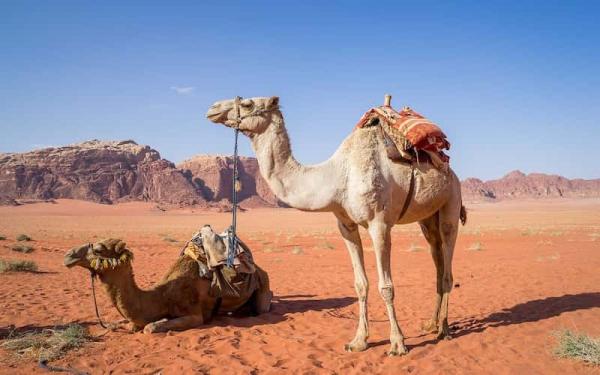
Examples of land animals
- Camels and Dromedaries.
- Felines (lion, tiger, cheetah, lynx, etc.).
- Canids (dog, wolf, dingo, etc.).
- Primates (gorilla, chimpanzee, lemur, etc.)
- Land snakes.
- Most spiders.
- Ant.
- Muskox.
- Onychophorus.
- Cane toad.
- Roman snail.
- Land turtle.
- Squirrel.
- Koala.
- Tlacuache.
- Porcupine.
- Chameleon.
- Elephant.
- Giraffe.
- Armadillo.
- Hyena.
- Horse.
- Pig.
- Raccoon.
- Impala.
- Hen.
- Mole.
- Deer.
- Scorpion.
- Toucan.
- Lazy.
- Eagle.
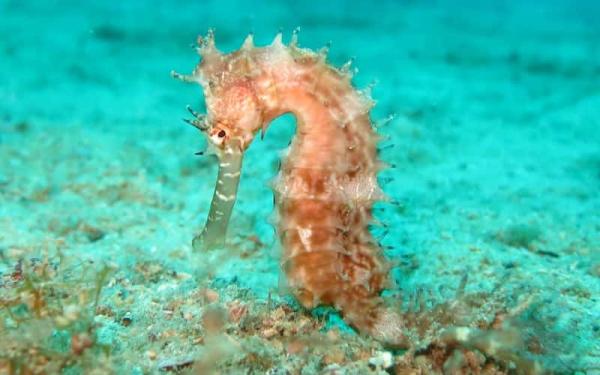
Some examples of aquatic animals
- Seahorse, example of an aquatic animal.
- Fish (shark, piranha, electric eel, etc.).
- Cetaceans (orca, sperm whale, narwhal, blue whale, etc.).
- Cephalopods (octopus, squid, cuttlefish and nautilus).
- Bivalve mollusks (oyster, clam, mussel, etc.).
- Sea turtle.
- Sea otter.
- Jellyfish.
- Portuguese caravel.
- Manatee.
- Sea snakes.
- Starfish.
- Sea cucumber.
- Shrimp.
- Coral.
- Lobster.
- Penguin.
- Duck.
- Axolotl.
- Sea horse.
- Sea urchin.
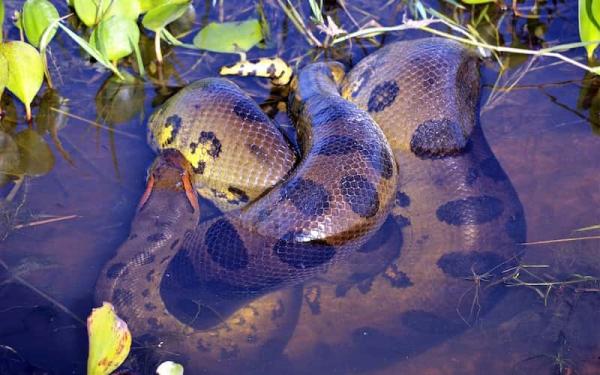
Some examples of semi-aquatic animals
- Anaconda, example of a semi-aquatic animal.
- Marine pinnipeds.
- Polar bears.
- Spider Dolomedes minor.
- Platypus.
- Crocodile.
- Capybara.
- Anaconda snake.
- Mud snake.
- Hippo.
- Polar bear.
- Otter (except marine).
- Marine iguana.
- Salamander.
- Beaver.
- Box water mouse.
If you want to read more articles similar to Terrestrial and Aquatic Animals, we recommend that you enter our Ecosystems category.
H.Blume, Rivers, Lakes, Lagoons and Marshes: Ecoguide to Discover Nature. AKAL Editions, 2003.
https://www.geol.umd.edu/~tholtz/G104/lectures/104land.html https://en.wikipedia.org/wiki/Terrestrial_animal
