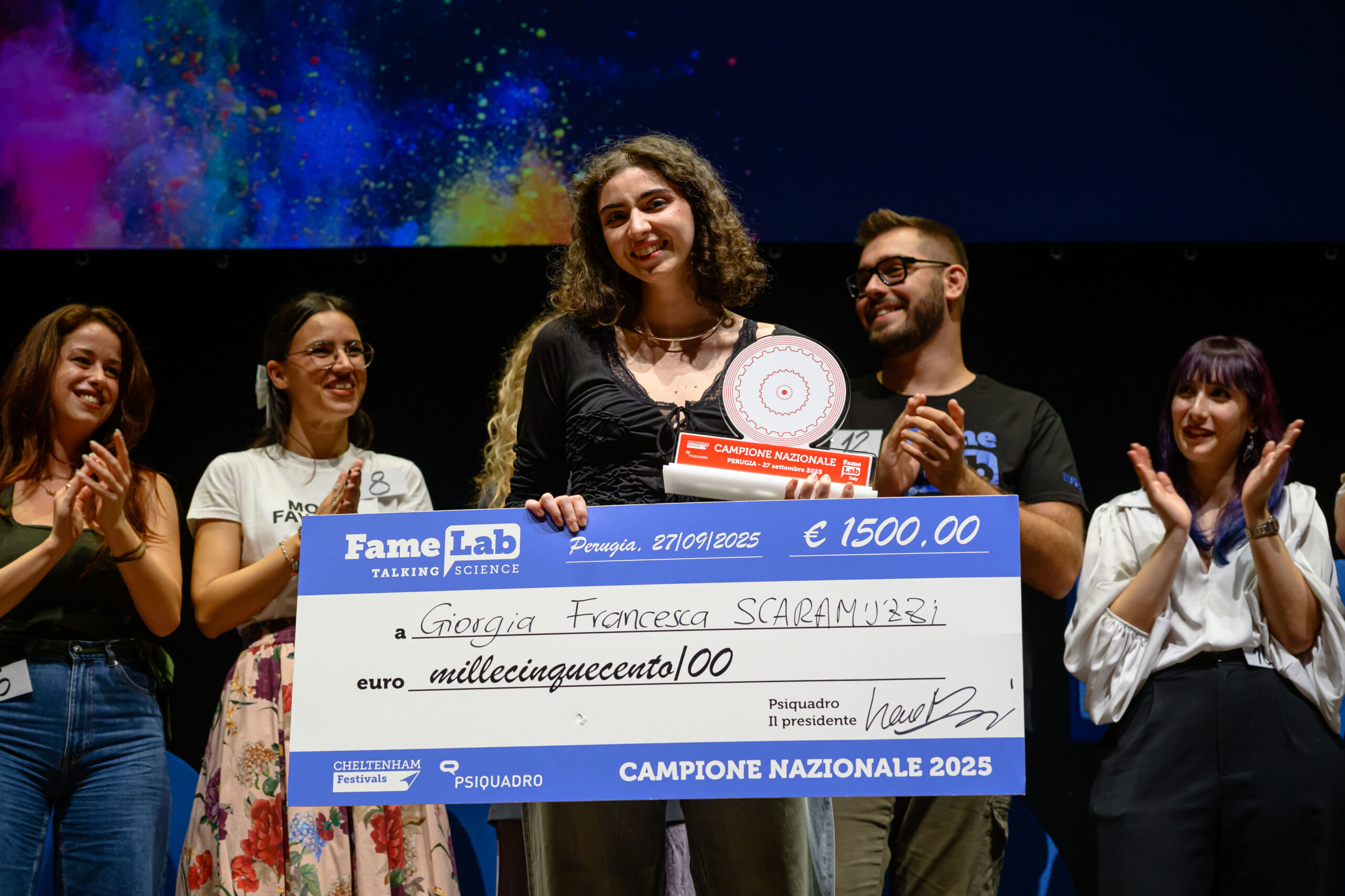
On September 27, we participated as a jury in the Italian Famelab 2025 final, the first talent in the world for scientific disseminates: the winner will fly to the international edition at CERN in Geneva.
“40Hz is the perfect brain BPM”, guarantees Giorgia Francesca Scaramuzzi, a doctoranda in neuroscience applied to the University of Bari and a hunger winner 2025, the first talent for scientific popularizers, organized by Psquadro in collaboration with the Cheltenham Science Festival. 15 competitors, including researchers and assignists in various Italian universities, challenge each other in a sort of communication tender that has a precise rule: the intervention cannot exceed three minutes. Penalty, the singing of the rooster! Yes, a rooster, but we’ll see him later.
They specialize in areas ranging from ontrophysics, passing through environmental engineering. And they aim for the international final to be held in November at CERN in Geneva. This year also contributed Evidence Networksitting in the ranks of the jury together with Costanza Miliani, director of the Institute of Cultural Heritage Sciences (ISPC) of the National Research Council (CNR), and Nicola Cicoli, who directs the communication laboratory of the mathematics of the University of Perugia.
What is FameLab. We could say that FameLab is a communication of communication of science that is held in 30 countries around the world. But walking behind the scenes of the Teatro del Pavone di Perugia, where the Italian final has been held, we realize that it is also much more, like all the places where people united by the same passion meet.
It is an opportunity to team up and exchange ideas, despite being constantly living immersed in a highly competitive world, as one of the participants on Instagram writes. Where you can walk through the corridors by repeating words and gestures of your intervention, without seeming crazy. Where other skills are refined, those of communication and dissemination precisely, in addition to their own study.
The Famelab Italia 2025 finalists. Giorgia Francesca Scaramuzzi therefore won by bringing a research on the use of multisensory brain stimulation to combat neurodegenerative diseases, such as Alzheimer’s. He compared this technique to a DJ who enters a somewhat disordered disco and reports all people on the track to move at the same rhythm. Or, to be more precise, the brain waves to oscillate at the same frequency: the famous 40Hz we were talking about at the beginning.
In second place, Arshia Ruina, assignist in physics of the particles, who starting from an interactive survey on our holidays, the attention of the public was guaranteed in the explanation of the activity of gigantic telescopes that capture the images of the gamma rays coming from space.
Finally, third classified by Michele Foglieri, PhD student in Astrophysics.
Imagining it as a network made up of many monkeys (88 million, to be exact), he told how an artificial intelligence is trained to recognize a gravitational lens and to understand whether or not the signal of the presence of a galaxy is or not. “It’s like looking for an ant in a stadium,” he summarized.
The public prize. The public prize instead went to Filippo Fazzino, researcher in healthcare-environmental engineering at the University of Catania. Its research scope is the treatment of domestic waste water or, as he says, “the transformation of water into water”. He therefore deals with testing filtering and cleaning techniques to eliminate the so -called emerging contaminants such as drug residues, microplastics and Pfas.
And the chicken? Yes, as a fourth juror was him, a rubber chicken, the starvation mascot of Italia. It sounded, that is, he was played by the jury, at the end of the three minutes and was inflexible: anyone on stage had to conclude his intervention. In truth, everyone (or almost) have returned perfectly on time. And now the first three classified will come to visit us on the days of the Evidence Network Live 2025, from 7 to 9 November.
