
The continental crust is the solid layer that forms the continents, thicker, older and lighter than the oceanic crust. It is characterized by its diversity of rocks, low density and complex structure. Its composition is mainly granitic. It is formed by partial melting of the mantle, magmatic differentiation, subduction and orogenic processes.
Read more about what the continental crust is, characteristics, composition and formation in this Evidence Network article.
What is continental crust?
The continental crust is the solid, outer layer of the Earth that forms the continents and some shallow areas under the oceans. It is older, thicker and more complex than the oceanic crust and constitutes the setting where the geological processes that shape mountains, plateaus, plains and sedimentary basins develop. Its origin is linked to the early history of the planet, when the first land masses began to consolidate and evolve due to the combined action of volcanism, tectonics and erosion.
Over billions of years, this crust has undergone continuous transformations that explain the diversity of current landscapes and geological structures. Therefore, studying it allows us to understand the dynamics of the planet, the rock cycle, the distribution of natural resources and the evolution of life on the Earth’s surface.
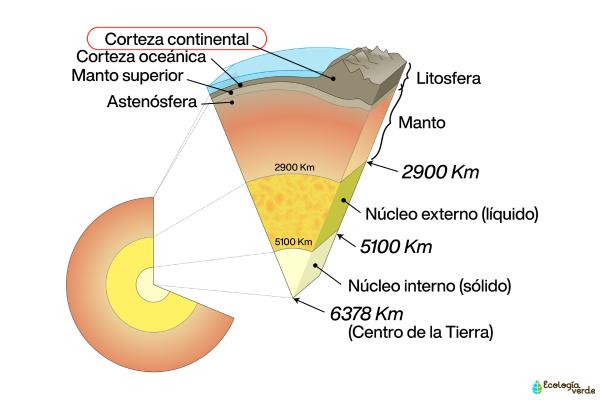
What are the characteristics of the continental crust?
The continental crust is distinguished by its great geological complexity and its variability in both composition and thickness. Below, we will summarize the main features:
- Thickness: It is usually between 30 and 70 km thick, although in mountain ranges such as the Andes or the Himalayas it can exceed 70 km due to tectonic thickening.
- Predominantly granitic composition: it is largely formed by silica-rich rocks, such as granites and gneisses, which makes it less dense than oceanic crust.
- Density: its average density is 2.7 g/cm³, which favors its “floating” on the mantle in a balance known as isostasy.
- Antiquity: contains the oldest rocks on the planet, some more than 4 billion years old.
- High lithological diversity: it combines igneous, metamorphic and sedimentary rocks of different ages and origins.
- Heterogeneous internal structure: it presents numerous discontinuities, folds, faults and metamorphic zones.
- Direct relationship with plate tectonics: it is constantly modified by collisions, continental separations, subductions and cortical deformation processes.
What is the structure and composition of the continental crust?
The continental crust is made up of two large levels: the upper crust and the lower crust, each with a particular composition, texture and physical behavior. As a whole, the continental crust has an average composition called “andesitic,” a term that reflects its enrichment in silica and light elements compared to oceanic crust. This difference explains a good part of the contrasts between both types of crust and is also key to understanding how continents are formed and why they persist for such long time scales.
Upper crust
It is the most accessible part and the one that is studied in greatest detail thanks to outcrops, drilling and mineral analysis. It has a variable thickness, generally between 15 and 30 km, and is composed of plutonic igneous rocks (granites), volcanic rocks (rhyolites), low to medium grade metamorphic rocks and large volumes of sediments accumulated in basins. This area records most of the observable geological history, including orogenies, magmatic intrusions, erosion events, ancient marine deposits and other processes that allow us to reconstruct the evolution of the continents.
lower cortex
It is located at greater depths and is less accessible, so its study depends mainly on geophysical methods such as seismology. It has a more mafic composition, with rocks rich in minerals such as pyroxenes and amphiboles, and its density is higher. Many of these rocks are believed to come from the cooling of basaltic magmas that were trapped beneath the upper crust and, over time, underwent metamorphosis under high pressures and temperatures.
How is the formation of the continental crust?
The formation of continental crust is a long and dynamic process that began on the early Earth and continues to this day, although at different rates. It is a succession of tectonic, magmatic and metamorphic processes that have created, destroyed and reconstituted the crust over time. The process of formation of the continental crust can be summarized as follows:
- Partial melting of the mantle. The initial process involves the partial melting of rocks from the upper mantle, generating basaltic magmas. These magmas rise and form oceanic crust or stagnate at depth.
- Magmatic differentiation. Some basaltic magmas undergo differentiation processes, that is, their composition changes as certain minerals crystallize and separate from the rest of the magma. This produces liquids richer in silica, which are the basis of continental rocks.
- Fusion of the preexisting cortex. In subduction zones, water released by the descending plate reduces the melting point of the overlying rocks, generating andesitic and granitic magmas. These magmas accumulate, rise and consolidate new volumes of continental crust.
- Accretion and amalgamation of land. Over millions of years, crustal fragments (microplates, volcanic arcs, continental shelves) are added to continents during collision processes. This increases the size and complexity of continental masses.
- orogenic deformation. When two continental plates collide, the crust folds, thickens and rises, forming large mountain ranges. This thickening adds volume to the continental crust and modifies its internal structure.
- Surface erosion and recycling. Once mountains are formed, erosion removes materials that are deposited in sedimentary basins. These sediments, when buried, can metamorphose and rejoin the cortical system, continually renewing the upper crust.
- Craton stabilization. Over time, some regions achieve a thermal and tectonic balance that turns them into cratons: very ancient and stable nuclei on which modern continents rest. These areas represent the most resistant and durable part of the continental crust.
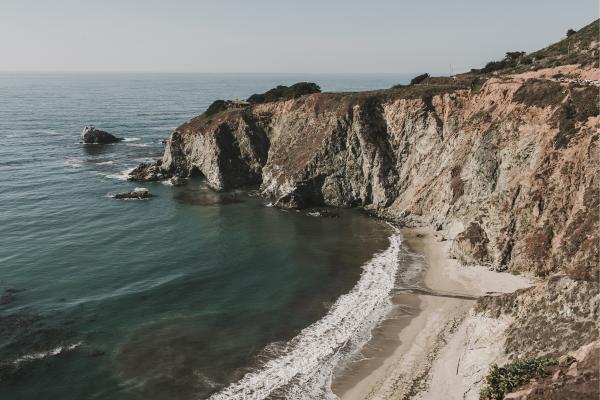
What are the differences between continental crust and oceanic crust?
Although both form the solid surface of the planet, they present clear differences in thickness, composition, age and tectonic behavior. The differences are:
- Thickness: The continental crust is much thicker (30–70 km) than the oceanic crust (5–10 km).
- Composition: the continental one is rich in silica and light minerals, while the oceanic one is mainly basaltic and mafic.
- Density: Due to its composition, continental crust is less dense, while oceanic crust is heavier and tends to subduct.
- Age: The continental crust contains very old rocks, some more than 4 billion years old. The ocean is young and does not exceed 200 million years due to its constant recycling in subduction zones.
- Durability: the continental crust remains over time and accumulates, the oceanic crust is continually renewed.
- Origin: the continental crust is formed in subduction zones through magmatic differentiation and accretion, the oceanic crust is born in oceanic ridges by expansion of the seabed.
- Associated relief: the continental relief supports mountains, plateaus and plains, while the oceanic relief forms deep basins and ridges.
You can learn more about the Oceanic Crust: what it is and characteristics here.
If you want to read more articles similar to Continental crust: what it is, characteristics, composition and formation, we recommend that you enter our Other environment category.
- American Museum of Natural History. The Earth’s Crust. Available at: https://www.amnh.org/exhibitions/permanent/planet-earth/how-has-the-earth-evolved/the-earths-crust
- Albarède F. 1998. The growth of continental crust. ScienceDirect. Available at: https://www.sciencedirect.com/science/article/abs/pii/S0040195198001334
