
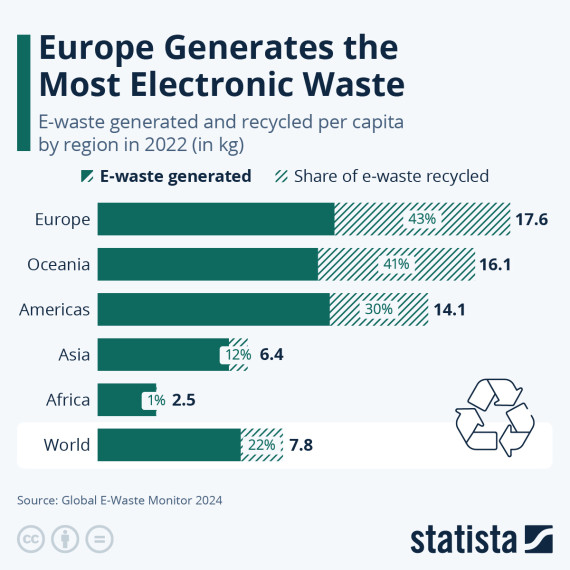
The recycling of electronic waste (or e-waste) is a problem that we have been trying to solve for years: what remains of smartphones, tablets and PCs often ends up in open-air landfills in Africa or Asia, with devastating consequences for the health of the inhabitants and the environment. At the root of the e-waste problem, in addition to the fact that we do not properly recycle the electronic devices we dispose of, there is the difficulty in finding clean, economical and efficient methods to extract metals (precious and otherwise) from waste.
A Chinese research team has now exposed it in a study published in Angewandte Chemie International Edition a method that promises to quickly, economically and ecologically recover gold from e-waste.
How it happens. Unlike many of the methods used so far, which use toxic chemicals such as cyanide, the new technique involves the use of a simple aqueous solution of potassium peroxymonosulfate and potassium chloride. When the solution comes into contact with the gold it transforms it into a catalyst: the metal therefore activates the chloride ions and peroxymonosulphate, which produce very reactive oxidants; these break the bonds between the gold atoms: at that point the chloride ions bind to the metal atoms and release them into the aqueous solution, facilitating their recovery.
How much you save. The entire process takes place in less than 20 minutes at room temperature, and costs around a third of the current market price of the most popular gold recovery techniques. With an efficiency of 98.2%, it manages to recycle 1.4 grams of gold per 10 kg of waste at a cost of approximately $72 – a figure equal to approximately $51,400/kg, significantly lower than the current market price of gold which is around $145,000/kg.

In addition to costing less, the new method also consumes approximately 62.5% less energy than traditional techniques and produces less secondary waste; the dissolved metals can in fact be recovered through simple reduction and purification steps, thus obtaining high purity gold.
