
Forest fires represent a constant threat to ecosystems, infrastructure and people. To reduce its impact, one of the most used strategies in territory management is the creation of firewalls. A firebreak is a strip of land cleared of flammable vegetation, designed to stop or limit the advance of fire in forest areas. In this Evidence Network article we are going to explain everything you need to know about what forest firebreaks are, their types and how they help prevent forest fires.
What are firebreaks in the forest?
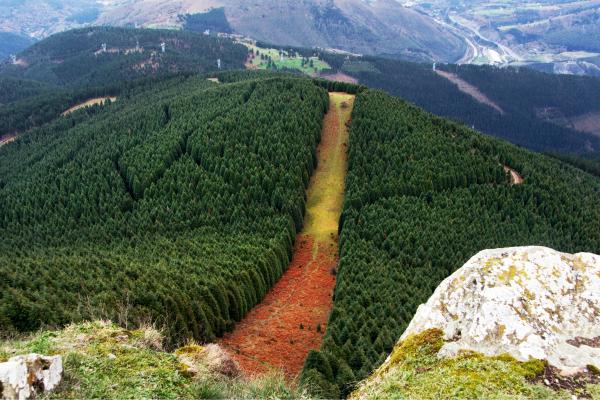
Firebreaks are strips of land cleared of vegetation that are created within forests with the aim of slowing or stopping the advance of a forest fire. They function as a physical barrier that interrupts the passage of fire by eliminating combustible material, such as branches, dry leaves and bushes.
These spaces can vary in width, depending on the type of vegetation, the slope of the terrain and the risk of fires in the area. Some firebreaks are made manually or with machinery, while others are maintained with controlled grazing or even prescribed burning.
We encourage you to watch this video about forest fire prevention, an essential part of fighting fires in forests.

What types of firebreaks are there in forests?
There are several types of firebreaks, and their design depends on the intended use, the characteristics of the terrain and the level of fire risk in the area:
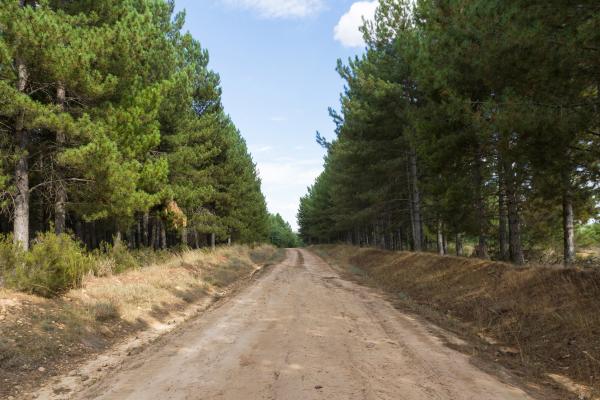
- Natural firebreaks: These are areas where vegetation is already sparse by nature, such as rivers, lakes, rocky areas or dirt roads.
- Fireworks: These are strips opened on purpose, usually with heavy machinery or hand tools. They are cleared of vegetation, leaving only the soil bare or with a minimal layer of vegetation cover to prevent the fire from advancing.
- Agricultural or livestock firebreaks: These are areas used for crops or grazing, which are strategically located to serve as a fire containment strip.
- Permanent and temporary firebreaks: Permanent ones are fixed structures, maintained throughout the year, while temporary ones are created only at certain times, such as during the dry season or when there is a fire risk alert.
How do forest firebreaks help prevent fires?
The main function of firebreaks is to interrupt the progress of a fire by removing material that could continue to fuel it. But they also offer other important advantages:
- They limit the spread of fire: By creating a strip without vegetation, the fire loses the “fuel” it needs to continue advancing.
- They create safe areas for the work of firefighters and brigades: Firebreaks allow teams to work more safely, as they provide them with a space free of vegetation from where they can fight the flames without the immediate risk of being surrounded.
- Facilitate access to remote areas: Many firebreaks are built as roads or used as access trails.
- They serve as lines of defense in controlled fires: Firebreaks are used as a safe limit so that these burns do not get out of control and do not affect other areas of the forest.
- They reduce the risk in nearby inhabited areas: When there are homes, farms or other buildings near the forest, firebreaks can act as a protective barrier, preventing the fire from reaching them.
What vegetation is used in firebreaks?
The plants used in firebreaks must meet certain characteristics:
- Low flammable content: Species are chosen that do not burn easily, that is, they have a high moisture content in their leaves or that do not release volatile oils that favor combustion.
- Low height: Low-growing vegetation (grasses or low bushes) is preferred that does not allow the fire to rise and spread to taller trees.
- Rapid growth and easy maintenance: Some plant species are used because they help cover the soil quickly, preventing erosion and facilitating the regeneration of the area, but without becoming a risk.
Examples of vegetation used in firebreaks
- Grasses and low grasses, such as fescue arundinacea either Agrostis capillaris.
- Low-growing legumes, such as white clover (Trifolium repens) or alfalfa (Medicago sativa), which also help to enrich the soil.
- Resistant, low-risk shrubs, such as black broom (Cytisus scoparius) in controlled areas.
- Low-growing native plants, adapted to the local climate and that do not favor the spread of fire.
What are the advantages and limitations of firewalls?
Advantages of firewalls
- They help stop the spread of fires. By removing flammable vegetation, they create a physical barrier that can stop or slow the spread of fire.
- Firebreaks often serve as roads or passageways, allowing firefighters and brigades to reach affected areas faster.
- They allow teams to work in a more controlled environment and with less risk of being surrounded by flames.
- They protect infrastructure and inhabited areas.
Firewall Limitations
- They do not guarantee that the fire will stop completely.
- They require constant maintenance.
- They can cause environmental impact.
- They do not replace other prevention measures.
- Designing, building and maintaining firewalls requires resources, specialized personnel and coordination between institutions.
- They can create a false sense of security.
Does a forest firebreak completely stop a fire?
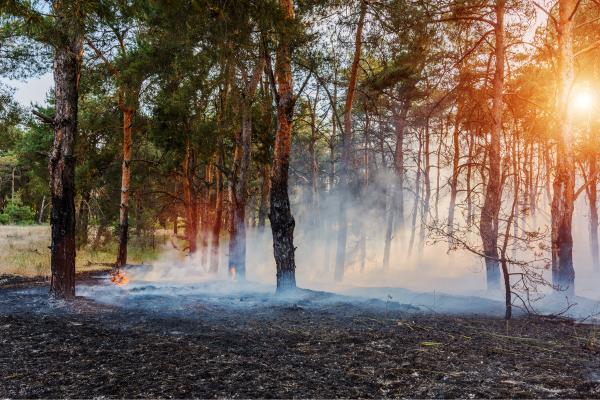
Although firebreaks are a very useful tool in the fight against forest fires, they alone do not guarantee that the fire will stop completely. Its main function is to slow down or interrupt the progress of the fire, eliminating plant material that could continue fueling the flames. However, there are several factors that can cause a fire to jump or pass through a firewall:
- Strong wind: Gusts can carry burning embers several meters away, even beyond the clear strip of the firebreak.
- Height and intensity of the flames: In very aggressive fires, the flames can be so high that they manage to pass over the firewall.
- Steep slopes: Fire moves quickly up steep slopes, and in these cases the firebreak may be insufficient if it is not well designed.
- Poorly maintained firebreak: If vegetation has grown back into the firebreak strip or flammable materials are present, it loses effectiveness.
Who is responsible for building and maintaining firewalls?
The responsibility for building and maintaining firebreaks falls on various institutions and actors, depending on the country, region and type of terrain:
- Public administrations: In most countries, regional, provincial or national governments are the main ones in charge of planning and executing firebreaks in public forests or protected areas.
- Forestry brigades and fire prevention services: Teams specialized in forest management and firefighting are the ones who carry out much of the physical work.
- Contracted companies: Authorities sometimes delegate these tasks to private companies specialized in forestry work, which have heavy machinery and trained personnel to operate in difficult terrain.
- Volunteers and local communities: There are environmental volunteer programs where citizens collaborate in cleaning forests and maintaining firebreak areas.
Frequently asked questions about forest firewalls
How long is a firebreak in the forest?
The width of a firebreak varies depending on the slope, type of vegetation and local regulations, but usually ranges between 10 and 30 meters. In high-risk areas it may be higher.
What is the difference between a firewall and an auxiliary strip?
A firebreak is a strip without flammable vegetation that stops or slows fires. An auxiliary strip is an area with controlled vegetation that reduces the fuel load but is not completely cleared.
What maintenance does a forest firebreak need throughout the year?
It requires periodic tasks such as clearing, removing shoots, pruning and cleaning plant residues, especially before the fire season.
What machinery is used to create firebreaks in forest areas?
Bulldozers, backhoes, tractors with brush cutters and sometimes specialized forestry machinery such as motor graders or vegetation shredders are used.
Do firebreaks affect the forest ecosystem?
Yes, they can affect the habitat of some species and ecological connectivity, but if designed correctly they can minimize the impact and serve as ecological or biodiversity corridors.
Is it possible to reforest or revegetate areas used as firebreaks?
Yes, you can revegetate with low flammable risk species or controlled vegetation covers that make fire prevention and ecological restoration compatible.
Can drones be used to monitor forest firebreaks?
Yes, drones allow for quick and accurate inspections of the state of firebreaks, detecting dense vegetation or outbreaks, and planning maintenance tasks more efficiently.
If you want to read more articles similar to Firebreaks in the forest: what they are, types and how they help prevent forest fires, we recommend that you enter our Other environment category.
- Bordino, J. (July 28, 2025). Firebreaks in the forest: what they are and how they prevent forest fires. GEOencyclopedia. Available at: https://www.geoenciclopedia.com/cortafuegos-en-el-bosque-que-son-y-como-previenen-los-incendios-forestales-1109.html
- Editorial Team of Repuestos Fuster. (January 22, 2025). Firebreak crops to fight fires. Fuster spare parts. Available at: https://www.repuestosfuster.com/blog/cultivos-cortafuegos-soluciones-sostenibles-frente-a-incendios/
- FuegoLab Editorial Team. (June 6, 2014). If a firewall doesn’t stop fire, what is it for? FuegoLab. Available at: https://fuegolab.blogspot.com/2014/06/si-un-cortafuegos-no-para-el-fuego-para.html
- CIEFAP Editorial Team. (December 2003). Firebreaks and fuelbreaks in coniferous plantations (PDF technical sheet). Andean Patagonian Forestry Research and Extension Center. Available at: https://ciefap.org.ar/documentos/fichas/FTA9N4Cortafuegosycortacombustibles.pdf
- InduAmbiente Editorial Team. (December 2022). To prevent forest fires. InduAmbiente. Available at: https://www.induambiente.com/secciones/destacamos/para-evitar-incendios-forestales
