
We entered the workshops where the members of the world electrical networks are tested with millions of volts to prevent faults and black-outs and guarantee the system holding in the face of the challenges of climate change.
Traveled traffic lights, closed shops, loose ice creams, veil people, stall cities. Summer black-outs are increasingly frequent, and in recent weeks Turin, Bergamo, Florence (but have also happened in France and the USA): when the demand for energy increases, it happens that the network that transports electricity from the production plants to our home counter-through high, medium and low voltage cables, and then transformers, distribution cabins, interrupting, sections.
But how do you prevent a failure that affects a point of the net makes the whole system collapse? To understand it we went to the Milan workshops of Cesi, an Italian company with offices scattered all over the world, which carries out the tests to verify the hold of the various members of the electrical network, guaranteeing their resilience.
Even at the bottom of the sea the first element to be tested are the high voltage cables, which run thousands of kilometers at the bottom of the sea or underground and must last even 40 years before being replaced. Here is the insulating sheath that must withstand the continuous heating due to the passage of electricity. Because of climate change, the sheath is put even more to the test because with extreme temperatures it becomes more difficult to disperse heat. “To ensure the continuous isolation capacity, we perform tests on these cables to simulate their entire life in one year, also because once they are buried or placed on the seabed, the cables and the related joints cannot be recovered and repaired easily”, explains Alessandro Bertani, Operations Italy Director.
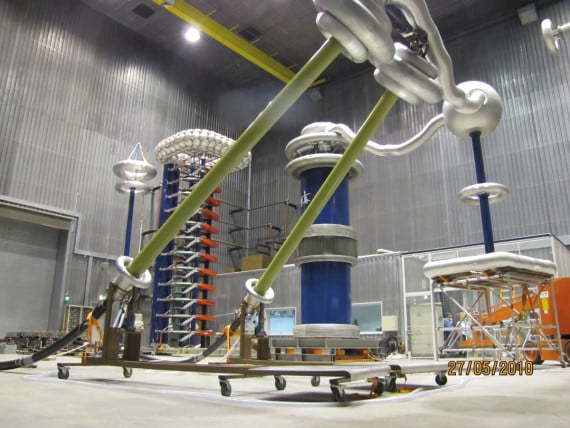
“The manufacturers give us the cables and the joints to be tested,” explains Bertani while I enter a large laboratory where a huge electrical cable of tens of meters is crossed by the current. «In the duration test we submit the cable on much more extreme conditions than those it will face during normal use. We pass a large amount of current (thousands of amps) and push it with great force, that is, we apply a very high tension, up to 900 kilovolt. To make a comparison, in our homes the tension is only 220 volts ».
“This allows us to verify that the cable also resists solicitations higher than the real ones, guaranteeing safety and reliability over time” continues Bertani.
«By applying current and voltage with separate equipment, we manage, at contained energy costs, to perform repeated cycles in which the cable is stimulated as if it were subjected to the maximum eligible power: consequently the cable increases and decreases in temperature, and this is always controlled with various sensors and thermalferences. We must verify that the insulating sheath, which decades ago was made on paper impregnated with oil but today sees the increasing use of plastic polymers, reggles to repeated thermal stress and does not cause dispersions, which would give rise to faults. The cables have long been used in alternating current networks, although in reality it has been discovered that to transport electricity to large distances it is better to use the current current (the one that goes in a single direction, from the positive pole to the negative, editor’s note) in recent years increasingly used to create new connections; The reason is that it causes less dispersion long traces, which can also be 2,500 km or superior ». At the beginning and at the end of the duration test, another is also made to see if the isolation resists exceptional events: “We apply for a few millisecond impulses even of 2 million volts, to see if the cables hold without dispersion”.


However, a bunker for tests the electric current in addition to traveling in the cables must also be transformed, interrupted in cases of faults, managed by the distribution cabins and other components such as the dissemination to reconfigure the network: all these components, as for the cables, must be able to resist very high currents that are generated on the net during short circuit. If these tests, switches, disseminors, transformers and other devices installed on the field could not be done, they could break, merge, glue or even burst.
“Therefore we pass very high currents of tens of thousands of amps for a time less than the second, to see if, for example, the switches work and interrupt the flow of current, or if the transformers or cabins resist without burning”, explains Fabio Faccheni, head of the high power workshops in Milan, while showing me a cabin literally incinerated by an electricity discharge.
«This is the reason why these tests take place outdoors or in a huge reinforced concrete bunker useful to contain possible explosions. Safety is important not only for the holding of the electricity grid, which must always be balanced and without changes, and able to isolate the area of the failure from everything else, but also for people: the technicians who went for example to repair a medium voltage framework in a cabin, must be protected by any flames or discharges, which must be contained in the framework “.
Home tests at the end of his journey, electricity arrives at home and is managed by the counter, and also in this case it is intervened to test its resilience, also because, as Bertani explains, “the probability of failure of all the components that we test stands around 25%, but if we talk about those who have electronics on board, such as the counters, or as well as other elements of the network that must be controlled remotely, can be controlled at 60%. That’s why we place meters, but also transformers and switches with their control and control systems, in a semi -eco -eco -in -senior chamber (a room with reflective floor and with walls that absorb electromagnetic and sound waves, editor’s note), and we radiate them with those electromagnetic waves from which they can be invested when they are at home or in the external environment, in order to verify if they are immune or have malfunctions. At the same time we measure the electromagnetic waves issued by the same objects to understand if they can negatively influence the surrounding equipment ».

Resilient network are then other tests, such as those on the life cycle of the batteries used in large containers for the accumulation of electricity. “Not only do we load them and unload them continuously but, as we do with many other components such as the transformers, we also put them in climatic cells where we verify their operation while modifying humidity rate from 0 to 100%, and temperatures from below zero up to 60 ° C”, explains Bertani.
But the most interesting challenge is to guarantee the resilience of electrical networks, since their design. Cesi – which is participated by Enel and Terna – for example collaborates in large projects such as the Tyrrhenian Link, a strategic infrastructure that connects Sicily to Sardinia and the Italian peninsula with a double submarine cable of 970 kilometers.
A work that enhances the network to welcome and make the most of the energy from renewable sources. Similar projects are constantly developing: “They range from north-south corridors to Germany, to Italy-Montenegro connections, to those between the United States and Canada, between Egypt and Saudi Arabia, up to the project for thousands of kilometers in Asia and others,” says Bertani. Designing today means exploiting all this knowledge, including the investigations that Cesi is sometimes called to carry out sample on pieces of the network in use and useful to verify any critical issues, to anticipate the problems of a future that promises to be increasingly complex.
“Climate change,” explains the CEO Nicola Melchiotti, “presents unprecedented unknown, given that cables and components must be designed and testing that will have to resist in some decades at temperatures that no one can predict with precision. The question will have an increasing impact in our sector also on issues that were once non -existent. An example is the need to build high and medium voltage converters to about ten centimeters from the ground. The reason? Resisting floods that were once very rare and today are on the agenda ».
