
Gravitational wave detectors and space telescopes have discovered black holes that are difficult to explain with current theories. What if they were formed with the big bang?
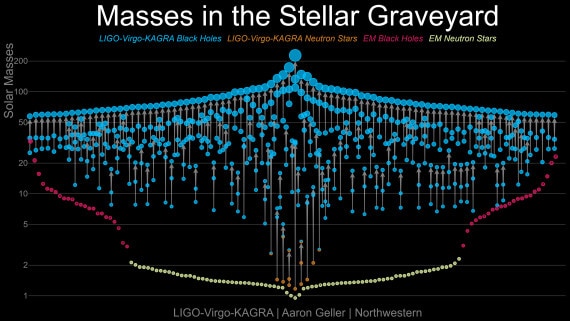
On July 13, the discovery of the most impressive clash between black holes ever recorded by the international network of gravitational wave detectors LVK (Ligo Virgo Kagra) was announced. The event was observed on November 23, 2023 and was baptized GW231123. They were two giants of 103 and 137 solar masses, who merged together to produce one with mass over 225 times higher than that of the sun. A record, but not only …
Clash between Titans. The most surprising thing is that in the first approximation, according to the current “standard” knowledge, neither of the two initial black holes should have existed. It is no isolated case. Even in the GW190521 clash, one of the starting black holes had a mass of 85 solar masses, too large to explain according to the star evolving models.
And even the Webb and Chandra spatial telescopes found an “impossible” black hole like UHZ1, of a very different but always too large type (tens of millions of solar masses) for having formed with the known mechanisms when the universe was only 470 million years old (now it has 13.8 billion). So where do these giants come from? What exactly happened in the confrontation recently made known? And what binds the black holes detected with gravitational waves to those observed by spatial telescopes at the dawn of the times?

As ultra -fast tops
Let’s start to frame the details of the GW231123 event well. “This clash is interesting for two reasons,” comments Gabriele Franciolini, a theoretical physicist at CERN in Geneva who deals with black holes. “The first are the masses at stake, the second their rotation.” Before the impact, in fact, the two objects revolved each one around their axis at 80-90% of the maximum speed, that is, at about 400 thousand times the terrestrial rotation. The main figure to understand are the masses. “I am within what is called Mass Gap, a range in which it is difficult to explain with astrophysical models how they can form,” says Franciolini.
Normally, black holes are formed at the end of the life of much larger stars in the sun. Once the light elements that supported the merger reactions, the star “turns off” and collapses under their weight, are exhausted. This generates a compact nucleus on which the fall gas bounces violently, generating an explosion called Supernova. If the initial star is quite large, in the center it remains a black hole. This is the established mechanism with which black holes are formed with mass ranging from some solar masses to some dozens of solar masses.
Repetition clashes. Therefore it is unlikely that the observed black holes have formed by stellar evolution, unless they are very particular and very rare situations. What are the most plausible hypotheses, then? “The first is that they are the result of previous clashes,” explains Franciolini. «In this scenario, called” hierarchical “, initially lighter holes were formed, which however were in environments very denied of stars and other black holes. From one or more subsequent clashes, it would have come to the current ones ».
Even the high rotation speed observed is consistent with this scenario, because when two black holes collide, they make it falling spiral on each other, and the final black hole inherits the overall rotation for the law of “conservation of the angular moment”. “The problem is to understand if these processes can take place quite frequently to explain an event like GW231123,” concludes Franciolini.
More data. To get to an answer, it is useful to have more and more observations and study the statistics of the clashes as all possible starting masses vary. For this reason, the data of the observation runs of the LVK network are very precious, as the last issued on August 26, relating to the period 24 May 2023 – 16 January 2024 (first half of the fourth run, O4A). “The previous catalog contained about seventy events, now they are around 220,” says Franciolini.
Early giant. Waiting for responses from studies that, however, will take years, the mystery slips if you go to look at astronomical data, and in particular to the observations of the James Webb Space Telescope, which – with its infrared gaze – is scrutinizing the universe at distances never seen before, in the period in which the first stars and the first galaxies were formed. «The more massive galaxies are being seen, and in greater number, than what was thought based on the standard theory of the formation of the structures. And more massive black holes are also being observed. ” The most emblematic example is UHZ1, which has a mass between 10 and 100 million solar masses and dates back to when the universe was just 470 million years old. In this case, these are “beast” different from those we have spoken so far, because the mass is much greater.
But the mystery is the same: how was Uhz1 born? If it had formed in the methods known, that is, through the formation of star black holes that then collide with each other and incorporate other subjects, we would have wanted to be longer than the age of the universe at the time, unless the growth had occurred at a truly frantic rhythms.
It was hypothesized then that this giant has formed by direct collapse of a large amount of matter, without going through the formation of supernova. “The direct collapse of a mass of this type, however, can only take place in very particular conditions,” observes Franciolini. “The mass should be very symmetrical and homogeneous, otherwise it would be fragmented and would find yourself with many smaller black holes.” Coincidentally, these black holes would have a mass of about 100 solar masses.


Violent fluctuations. Faced with these uncertainties, it is not surprising that the theorists are on the hunt for new mechanisms that can explain the origin of black holes. Gabriele Francioli al Cern deals with this, of how in the early stages of life of the universe – even before the stars were formed – “primordial” black holes can be created. To better understand what it is about, the concept of horizon must be introduced. We consider the universe visible today: it is located within a border, called horizon, within which there are the objects we can see. Objects beyond the horizon, on the contrary, are too far away and we cannot view them, because from the big bang to today the light they have emitted has not yet made time to reach us. What is within our horizon can have a relationship of the cause and effect with us, what is outside the outside.
The horizon expands over time, because the more time passes and the more the light of the distant objects has time to reach us. On the contrary, going back in time, the horizon becomes smaller and smaller. And we have reached the point. It is thought that in its very first phases the universe has undergone a hyperaccelerate expansion called “inflation”. At that time, the cosmos was shaken by quantum fluctuations, from which the current structures would be born much later: stars, galaxies and galaxies clusters. “If there were small -scale marked fluctuations, they could be collapsed under the force of gravity forming primordial black holes,” explains Franciolini. And the moment when this happened – fractions of a second after the Big Bang – was determined by the horizon: a region collapsed when the horizon expanded to the point of incorporating it in full, otherwise its individual parts would be “disconnected” with each other. In practice, as soon as these fluctuations have found time to do it, they have become black holes.
Dark matter. «This scenario can produce masses in a huge range, from some gram to hundreds of solar masses. It depends on what the initial conditions were, that is, on the staircase to which these perturbations of great density developed, “comments Franciolini.
At one end of the scale there are black holes with a mass of about 10-12 solar masses, typically the mass of an asteroid (10-12 it is equal to one millionth of a millionth). They would have the size of an atom and, if they really existed in large quantities, they could constitute the missing mass of the universe, that is, what is commonly called “dark matter”, solving one of the great puzzles of the universe. It is a hypothesis among many, but it could be subjected to verification through astronomical observations in the future (in particular, through the observation of the cosmic fund of gravitational waves).
A new observatory. At the other end of the staircase there are the black holes equal to 100 solar masses. They were the masses at stake in GW231123, the ones we started from. “The primordial scenario allows you to create black holes even of this type,” explains Franciolini. And if there had been enough, clashing together from the beginning they would have had all the time to produce even black holes like UHz1, solving two mysteries in one fell swoop.
“The primordial scenario unifies the two situations”, he emphasizes Franciolini. “And we know it will be tested. With the new generation of gravitational wave observers such as Einstein Telescope, in fact, we will explore even greater distances than the current ones and we will know if these black holes were there before the galaxies were formed – 10 or 100 million years after the Big Bang – or not ».
