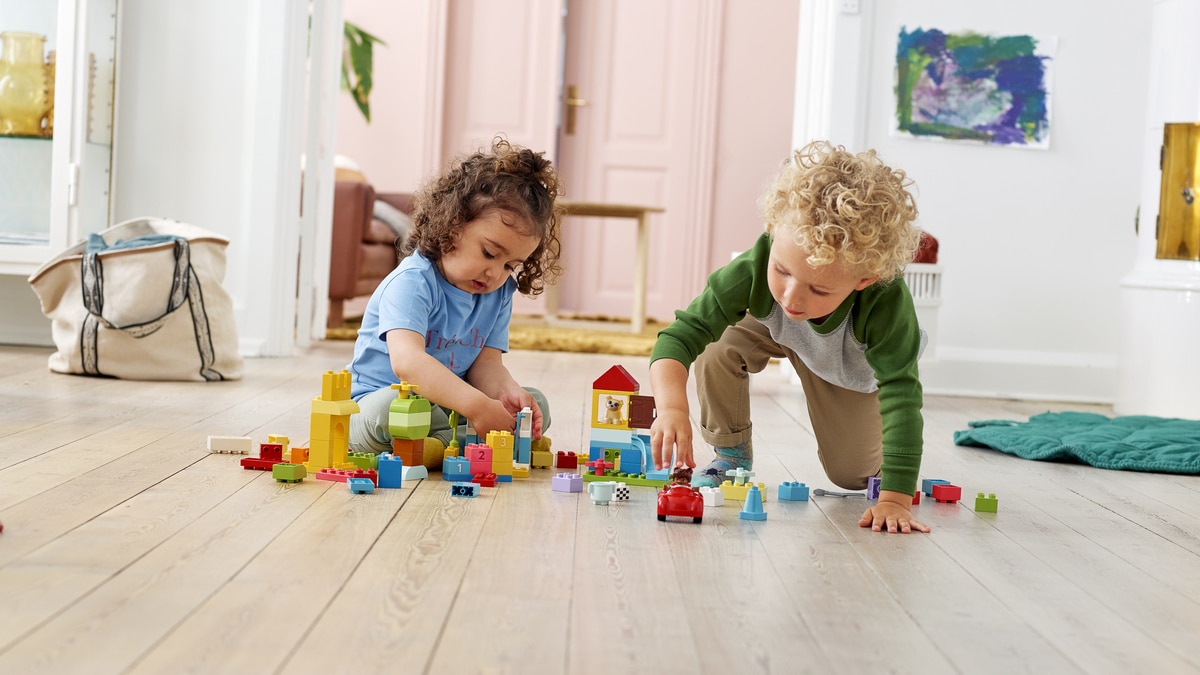
How do you choose a construction game for a young child? What characteristics to consider and how do the gaming possibilities change as you grow? Here are some indications to help you make your choice
This article is sponsored by
Choosing the toys to make available to our children is an important responsibility, because even through this choice we can take care of their needs and accompany them as they grow. Therefore, the cheapest product, the first one we find or the one that strikes us most is not always the most suitable.
But what should we pay attention to? And how can we understand if a game is appropriate for the child’s age and abilities? Let’s try to identify some important characteristics, taking LEGO DUPLO constructions as an example.
The fundamental characteristics
The materials that children come into contact with during play should have some fundamental characteristics:
- be safe;
- present a certain aesthetic and informational order;
- promote concentration;
- be intuitive.
Let’s see in detail what it means and why these aspects are important in the different stages of growth.
Safety
When we talk about safety, we are referring first and foremost to the materials and characteristics of the toy. It is important to choose products that comply with safety standards, also recognizable by the CE marking, and always check the age indicated by the manufacturer, as happens for the various LEGO DUPLO sets.
In fact, in the first years of life, children also explore their surroundings through their mouths. It is therefore essential that toys are made with safe, resistant materials and free of small parts that can be ingested, especially when they are intended for little ones.
Choosing age-appropriate materials allows children to experiment with greater freedom, using their senses to explore and manipulate objects. At the same time, it allows adults to accompany the game without having to continually intervene to prevent potentially dangerous behavior, while maintaining the necessary supervision.
Aesthetic order and informative order
There are toys on the market that offer many activities at the same time: recognizing colors and shapes, associating images and words, following a story or solving small problems. This wealth of stimuli can be interesting, but it is not always necessary, especially when the child is very young and is still familiarizing himself with a certain activity.
In the first years of life it can also be useful to propose simple materials, which allow you to concentrate on one experience at a time, without having to manage too much information at the same time.
Let’s think, for example, of LEGO DUPLO bricks. A small child may initially be limited to grabbing them, putting them together, stacking them or trying to fit them together. They are apparently simple gestures, but through which he can experiment with shapes, sizes and relationships between objects. At this stage, bricks of similar shape and size can facilitate exploration, allowing the child to concentrate on fitting together and on color differences.
As he grows up, however, he will be able to appreciate a greater variety of shapes, sizes and colours, using them to create increasingly complex constructions. The skills acquired through their first experiences will allow them to face new gaming possibilities, following their interests and imagination.
Naturally, these are not the same stages for everyone: each child develops skills and preferences at his own pace, and it is important that the materials proposed respect these differences.
Promote concentration
A game like that of LEGO DUPLO bricks can also encourage concentration thanks to its simplicity: no sounds, lights or other stimuli are necessary to involve the child in the activity.
Attention can thus turn to the material itself and its possibilities: choose a brick, try to fit it, observe the result, change your mind and start again.
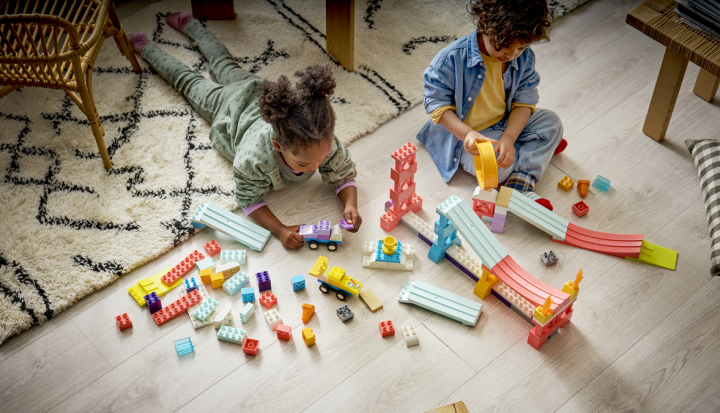
Repeating these gestures allows the child to progressively become familiar with the material, discover its characteristics and experiment with new solutions. It may also happen that a construction does not succeed as imagined: in these cases the game offers the opportunity to deal with a small difficulty, try again or look for an alternative.
Furthermore, by manipulating the bricks, the child exercises fine motor skills, i.e. the ability to make small and precise movements with the hands and fingers. Over time, his grip and coordination become more secure, allowing him to create constructions that are increasingly closer to his intentions.
The growing mastery of gestures can thus also expand creative possibilities. A child who initially especially enjoys stacking bricks will be able, with experience, to use them to build a house, a bridge or anything else his imagination suggests.
In this sense, free construction sets such as LEGO DUPLO Brick Container offer multiple possibilities: they do not propose a single story to follow, but leave the child the freedom to choose what to build, experiment and modify their creations.
Intuitiveness
Another important characteristic of play materials is intuitiveness, i.e. the possibility for the child to understand how to use them through exploration, without necessarily needing explanations from an adult.
LEGO DUPLO bricks, for example, can be manipulated and combined in many different ways. Even a very young child can begin to experiment freely, perhaps by placing the pieces together rather than fitting them together, or using them in ways that the adult had not imagined.
In fact, there is no single correct way to play with constructions. A child may decide to follow a model, invent something completely different, or simply explore the characteristics of individual pieces.
This freedom is found, for example, in sets such as LEGO DUPLO Creative Pets 3 in 1, which allows you to combine bricks to create different animals, or LEGO DUPLO Colorful Creative Box, which offers materials to use for free constructions.
As they grow, sets that offer recognizable environments and characters can also become interesting, such as LEGO DUPLO 3-in-1 modern family house with characters. In this case, in addition to construction, the child can dedicate himself to symbolic play, inventing situations and stories that take inspiration from everyday life.
Subsequently, when the child’s dexterity and interest allow it, constructions with smaller pieces and more complex projects can also be introduced, such as those proposed by the LEGO 4+ and 5+ sets. However, the transition from DUPLO bricks to traditional ones must not be seen as an obligatory stage to be reached at a certain age: it can happen gradually, respecting individual abilities and preferences and the safety indications of the products.
The adult’s task, therefore, is not to always show the child how to use a toy correctly, but to make suitable materials available to him, observe how he uses them and accompany him when he needs it, leaving him the time and freedom to make his own discoveries.
