
There is a part of the world for which immortality is no longer an impossible dream, but a goal to be achieved. It is the thin thread that binds Silicon Valley, to Russia, to Xi Jinping. And beyond. But we will soon all be able to benefit from concrete progress in biotechnology.
I ask you a question: would you like to live forever? I guess you said no. Or, perhaps, a not too convinced yes. I’ll ask you another question: do you wish you were still alive tomorrow? Bryan Johnson, the American entrepreneur who is the protagonist of the Netflix documentary, also asks us this Don’t Diedon’t die. The change in perspective is easy to understand: yes, we would like to live many more years as long as we are in good health, independent and autonomous. Chinese President Xi Jinping and his Russian counterpart Vladimir Putin are of the same opinion, having exchanged confidences during the Victory Parade in Beijing on how advances in biotechnology could extend life expectancy by up to 150 years.
This week we talk about two of the greatest fears of human beings: illness and death. But also the possibility of defeating them.
We are already living more, but how much?
We don’t need much reasoning to realize how technological and medical development have allowed us to live longer. If in 1913 the life expectancy of a European did not reach 47 years, in the space of just over a century it has exceeded 79 (81, according to the latest Eurostat data). In the graph drawn by Our World in Data, the curve shows exponential growth that begins with the second industrial revolution (1870) and never stops.
Just as Xi claims, advances in biotechnology – especially in vaccines, gene therapy and regenerative medicine – will lead to an extension of everyone’s average lifespan. Pandemics and wars permitting.
Would you live better if you hacked your genome?
To date, however, the famous secret to living a long time is still a good genetic makeup. In short, luck. Possibly combined with a healthy diet, sport and good quality sleep. One of the largest studies ever carried out on the subject then underlines how mental health is not at all optional.
But if the genome doesn’t cooperate, there are those who try to hack it. Literally.
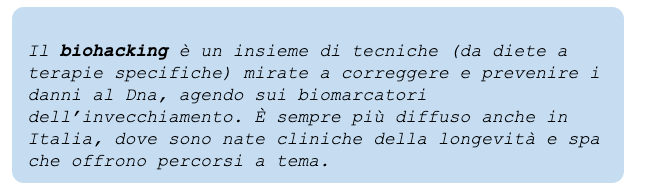
The main problem with biohacking is that it is not regulated and a bit of everything ends up in it. In fact, if some centers collaborate with universities, others are autonomous and often the suggested therapies have little scientific basis.
Brian Johnson, who we were talking about at the beginning, made this practice the main activity of his days. It has become a case study, or rather, a sort of guinea pig on which to test new biohacking approaches, including drugs.
But it has also reached 2 and a half million followers, between Instagram and Tiktok, to whom it advertises supplements and superfoods. Spoiler: superfoods don’t exist.
Maybe the answer is small.
We leave aside borderline practices such as cryonic conservation, which today potentially concerns 4 thousand people (including those who already use it and those who have reserved their own metal cylinder), and minduploading, i.e. the transfer of the mind to a computer. We’ve talked about it several times above Evidence Network and for the moment they have no scientific concreteness.
If, however, we want to focus on the next step in the field of biotechnology, which will truly allow us to live better and longer, we will have to sharpen our eyes. Yes, because the future of medicine is six times smaller than your hair.
To be precise, today it measures no more than 100 microns (thousandths of a millimetre), but the attempt is to reduce it to 10. And in this very small space there will have to be a nanorobot capable of being injected into your body, moving autonomously, reaching the target on which to intervene and then degrading itself in complete safety.
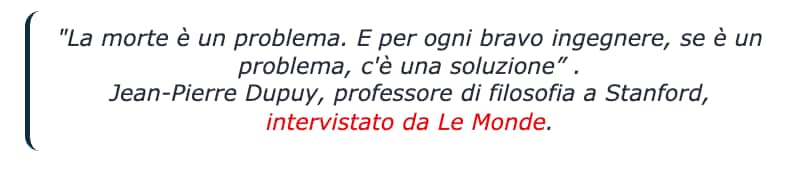
A lethal weapon, they say.
To better understand the scope of this technological revolution, let’s start from the TNF (Tumor Necrosis Factor) receptors. They are proteins present on the surface of tumor cells capable of triggering what is called apoptosis, the programmed death of the cell. For years they have been seen as a potential target of oncological treatments, but reaching them is not at all simple. In addition to the fact that they are also found in healthy cells.
At the Karolinska Institutet in Stockholm (yes, the one where the Nobel Prizes are awarded) they tried to solve both problems by developing a nanorobot made of DNA filaments. DNA is an ideal “material” for nanotechnology because it can be programmed to self-assemble in a specific and predictable way. With this micro engineering discovery they transported a series of molecules, the ligands, which could bind to the TNF receptors, to the tumor. How did they only affect cancer cells? Because some tumors, including breast cancer, create a slightly acidic microenvironment, which the nanorobot recognizes as a signal to activate. In animals, there was a reduction of almost 70% in tumor cells. “A lethal weapon” according to Björn Högberg, who coordinated the study.
We will cure diseases, but from the inside.
Oncology treatments are today the field of choice for nanorobots. Here, they allow us to resolve one of the main problems of chemotherapy and radiotherapy: the side effects caused by the inevitable destruction of healthy cells together with the mutated ones.
But he’s not the only one.
Imagine having a small machine inside you capable of doing virtually anything: removing clots and clots in blood vessels, suturing those same vessels to stop bleeding, taking photos of portions of organs or tissues at close range to facilitate a diagnosis, analyzing tissues directly on the spot, putting biopsies into retirement. In Boston they are trying to use them to repair neurons damaged by neurodegenerative diseases, while at the Polytechnic University of Lausanne (EPFL) they are working on a bioprinter that reconstitutes tissues in the gastrointestinal tract.
The nanorobots move on average at 5 millimeters per minute, like the fastest cells in the human body, sperm. And they do it in different ways. They can let themselves be carried by the blood current, or be guided from the outside by means of magnets. A prototype developed by the Bioengineering Institute of Catalonia for the treatment of bladder cancer uses urine. In fact, it contains urease, an enzyme that splits urea into ammonium and carbon dioxide: in this way, urea acts as a biofuel while the energy released by the reaction becomes the propellant. Tested on mice, the nanorobot reached all the walls of the bladder and reduced the tumor by 90%.
When will we be treated by a nanorobot?
According to several experts, it will take 7 to 10 years before nanorobots enter clinical practice. In fact, most of the studies are still in the basic research phase or are starting to be tested on animal models. But there is some progress.
In 2022, the Indian Institute of Science developed nanorobots in the shape of microscopic propellers capable of performing deep oral cleaning in the event, for example, of a tooth’s root canal. Giovanna Camardo had also talked about it above Evidence Network and, in the meantime, they were tested on human teeth extracted from patients. Furthermore, in the United States, several research centers are working on human trials.
And these trials will also have to answer new questions. Will the same dose of medication be needed or will we need to reduce it? Do different adverse effects emerge when an active ingredient is administered directly to the affected area? How will patients react to the idea of a nanorobot “walking” around their body?
Close your eyes and listen
This male leopard seal, three meters long and one of the largest predators in the Arctic, would like to dedicate a nursery rhyme to you:
Leopard seals have a repertoire of five different sounds, which they draw on to compose various songs.
And they are not simply used to woo females.
To be recovered
- Thomas Villa interviewed Jane Goodall a few weeks before her death and shared with her several anecdotes about her research that changed the way we see animals forever. You can find it in the issue of Evidence Network on newsstands.
- When and why was Hamas born? Probably sooner than you thought. The journalist and historian Paola Caridi, who lived for 10 years in Jerusalem, tells it.
- The Monumentale in Milan and the Père-Lachaise in Paris are among the most beautiful cemeteries in Europe, collected by Federica Ceccherini in a virtual tour on Evidence Network History.
We greet you with a quiz
What is the oldest university in the Western world? Okay, this one was easy. But could you also say what the first state road was? (The summary here).
How to subscribe to Spoiler
Did you like Spoiler? It arrives every week and it’s free. To sign up, just click here!
